How We Build Business Intelligence for Englewood
Every BI build for an Englewood organization begins with a clear question: what decisions are you making right now on incomplete or stale information? For a nonprofit, that might be: which programs are we over-resourced on and which are we under-resourcing relative to community demand? For a small food business, it might be: which days and which products are profitable and which are not? For a home healthcare provider, it might be: which services are we delivering efficiently and which are running over cost? The answer to that question is the scope of the BI engagement.
We work with whatever data infrastructure already exists. For many Englewood organizations, that means extracting from a case management system, a simple accounting tool like QuickBooks, a POS system at a food business, or even well-structured spreadsheets maintained by a program coordinator. The data quality in these sources varies, and addressing that variability is part of the pipeline design work. We do not tell Englewood organizations to upgrade their systems before we can help them. We build the extraction and transformation logic that makes existing data useful.
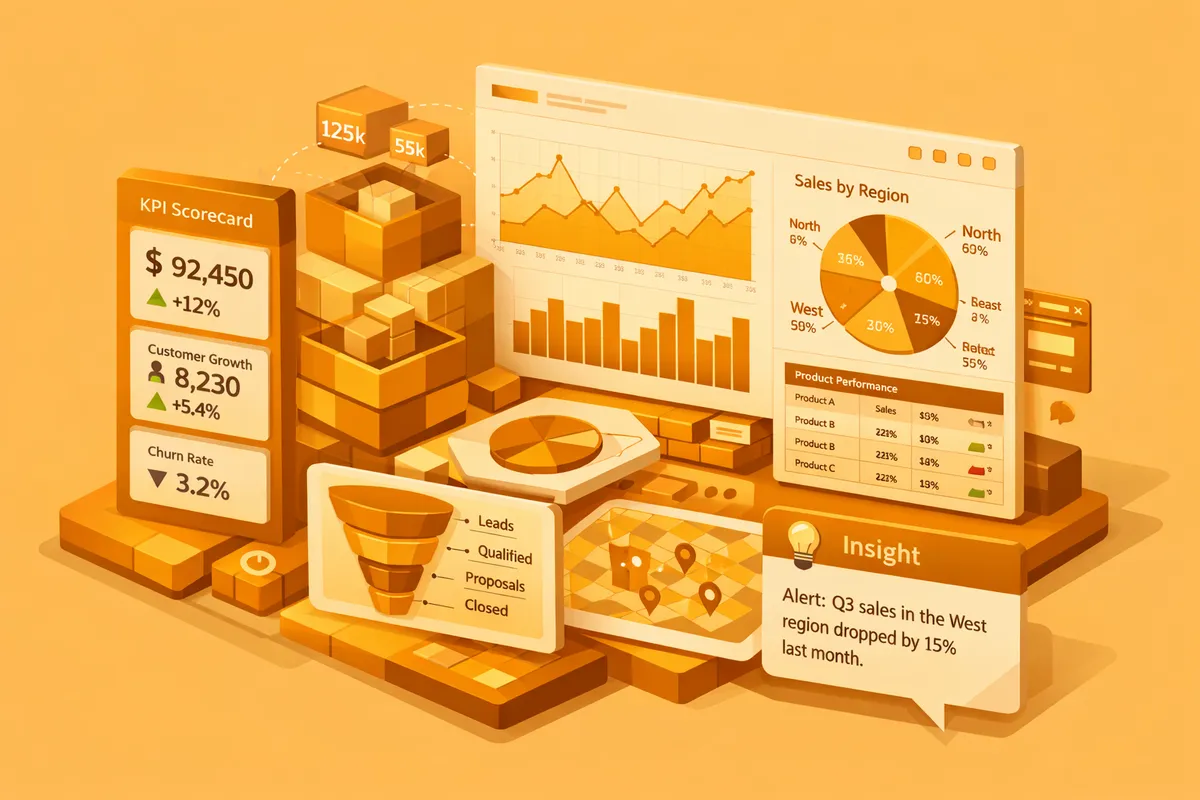
Dashboard design for Englewood community organizations centers on operational metrics tied directly to the organization's stated goals. For a nonprofit, the dashboard shows program reach by geography and demographic, cost per participant by program, grant utilization by funding source, and service delivery trends week over week. For a small business on 63rd Street, it shows revenue by product or service line, margin by day, and cost variance against targets. Every element on a dashboard we build is there because it informs a specific decision.
Industries We Serve in Englewood
Community nonprofits and social service organizations near Ogden Park and Kennedy-King College use BI to track program enrollment, service delivery intensity, grant utilization, and demographic reach. When a program director can see a live view of which services are at capacity and which have space, staffing and outreach decisions improve immediately. Funders reviewing outcome data from a live dashboard rather than a compiled year-end report see a more credible picture of organizational effectiveness.
Urban agriculture and food businesses anchored at Growing Home and the broader Halsted Street corridor use BI to manage harvest yield by crop and plot, wholesale customer revenue, direct market sales, and staffing costs against output. Agricultural businesses operate on tight margins where production efficiency directly determines sustainability. A seasonal view of yield trends and cost ratios lets farm managers make planting and staffing decisions based on real operational history.
Home healthcare and community health providers serving Englewood residents need BI that connects patient census, service delivery hours by care type, billing and collections, and staff utilization. Along Ashland Avenue and Racine Avenue, community health organizations operate in a market where cost control and outcome tracking are both mission-critical and funder-required. BI dashboards give leadership a real-time view of operational health across all three dimensions.
Barbershops, salons, and personal service businesses on 63rd Street use BI to track revenue by service type and staff member, client return rates, scheduling efficiency, and retail product performance. Even for a small operation, the difference between knowing which services drive profit and guessing shapes every hiring and pricing decision.
Churches and faith-based community organizations use BI to track congregation engagement, ministry program participation, facility utilization, and donation trends by giving segment. Englewood's churches are significant community institutions that coordinate social services, youth programming, and community organizing. BI helps them allocate capacity and demonstrate impact to partner organizations and regional funders.
Small food businesses and caterers operating in the neighborhood use BI to manage menu profitability, order volume trends, food cost ratios, and event catering versus direct sales performance. For a small food business with a catering component and a walk-in counter, understanding which revenue stream is actually carrying the operation changes the growth strategy.
What to Expect Working With Us
1. Organizational decision audit. We start by learning the decisions your leadership makes regularly and the data gaps that make those decisions harder. For an Englewood nonprofit, this conversation typically surfaces five to seven places where better data would change a program or budget decision. Those gaps define the project scope.
2. Data source inventory and pipeline design. We map every system that holds data relevant to your operations: case management software, accounting tools, spreadsheets, POS systems, attendance logs. We assess data quality honestly and build transformation logic that makes existing data useful rather than requiring a technology change first.
3. Iterative builds with organizational review. We build in short sprints and review working dashboards with the program staff or managers who will use them at each stage. This keeps the output grounded in how the organization actually operates rather than how a dashboard designer imagines it does.
4. Training for self-sufficiency. We train program coordinators, executive directors, and operations staff to use and extend the dashboards we build. The goal is an Englewood organization that can update its own reports, add a metric when a new funder requires it, and use data as a normal part of running the operation.