How We Build PWAs for Edgewater
The starting point is always the use case definition: what does the app do that the website cannot, or cannot do as well? For a yoga studio on Granville Avenue, the answer is usually class scheduling with offline cache for the current week's schedule, push notifications for class changes or instructor substitutions, and a home screen installation that makes the studio as accessible as a native app. For a coffee shop on Clark Street, the answer might be an advance order queue with real-time pickup status, loyalty point tracking, and a menu that loads without a network request.
We build on the modern PWA stack: service workers that handle caching and offline behavior, a web app manifest that enables home screen installation, and a performance architecture that scores 90-plus on Core Web Vitals. The technical foundation ensures that Google treats your PWA as a first-class web experience, which benefits search ranking alongside the in-app experience.
For Edgewater businesses with multilingual customers, PWAs support full internationalization at the application level. A Devon Avenue restaurant PWA that serves Spanish, Tagalog, and English speakers handles language switching at the user preference level, caches translated content offline, and sends push notifications in the user's selected language.
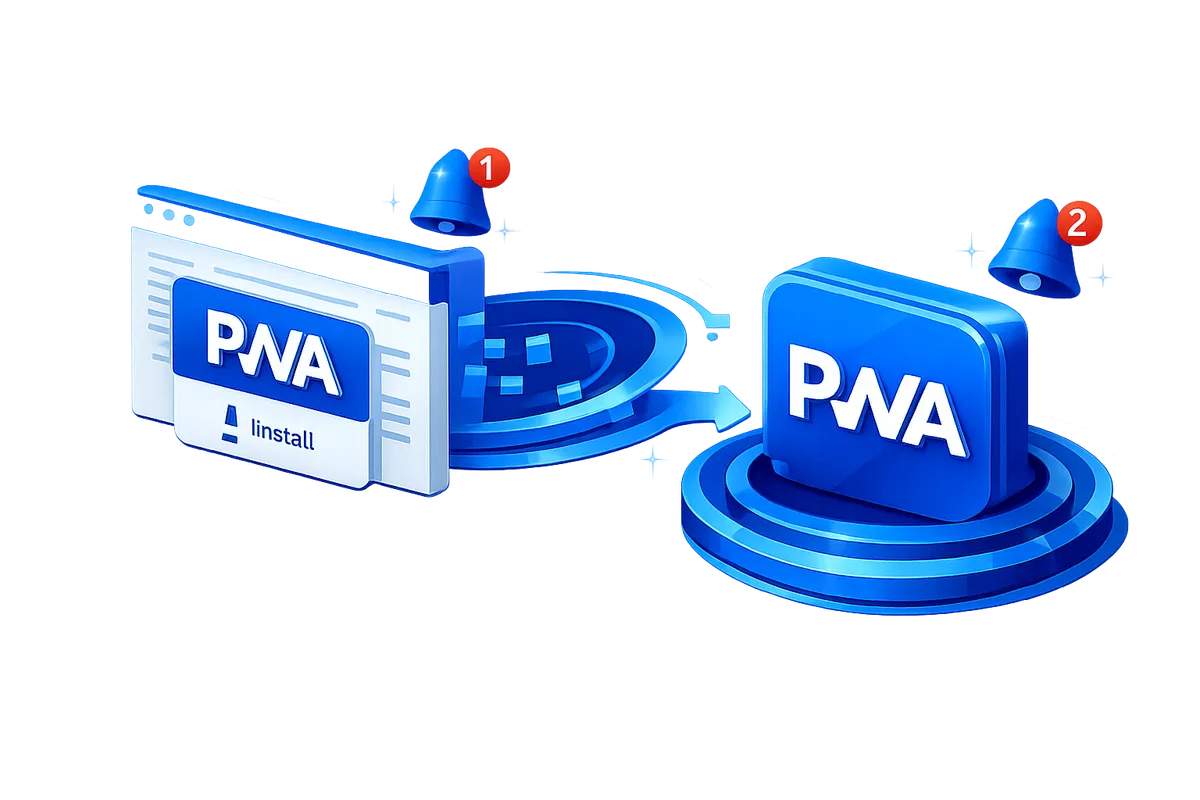
Push notification capability is a specific PWA advantage over standard mobile websites. A yoga studio can notify students that a spot opened in a full class. A restaurant near Berger Park can push a notification about same-day lunch specials to customers who installed the PWA. A bookstore on Clark Street can alert customers when an author event is confirmed. These are the kinds of real-time communications that build the habit loop native apps depend on, delivered without an App Store gatekeeping the relationship.
Industries We Serve in Edgewater
Yoga and fitness studios on Granville Avenue and Broadway have the clearest PWA use case in the neighborhood. Class schedules change, instructors substitute, spots open in popular sessions. A PWA with push notifications, cached schedule display, and one-tap registration from the home screen turns the studio's digital experience into a daily habit for active students rather than a website they visit when they need to find a schedule. Students who install the PWA visit more frequently than those who bookmark a mobile website.
Ethnic restaurants on Devon Avenue and Broadway serve customers who order ahead, check menus for dietary accommodation, and return on weekly routines. A restaurant PWA with an advance order flow, a menu that works offline, and push notifications for daily specials or estimated pickup times creates a direct channel between the restaurant and its regular customers that no third-party delivery platform can replicate. Order fees stay with the restaurant instead of funding a platform.
The dental and medical practices along Bryn Mawr Avenue and Granville Avenue that build patient-facing PWAs see meaningful improvements in appointment adherence. Push notifications for appointment reminders, one-tap check-in on arrival, and offline access to intake forms that were completed on a previous visit are all PWA capabilities that reduce no-show rates and front desk friction simultaneously.
Independent bookstores on Clark Street can use PWAs to build the reading community connection that turns occasional shoppers into regular visitors. A bookstore PWA that surfaces staff picks, tracks purchase and wishlist history, sends push notifications for author events, and caches an offline browsing experience creates the habit loop that sustains a local bookstore against the convenience of online retail.
Coffee shops near the Edgewater Historical Society and along Sheridan Road use PWAs for advance ordering and loyalty programs. The advance order flow that lets a commuter submit their order from the Granville Avenue Red Line platform before walking to the shop reduces wait time, increases throughput, and creates a proprietary ordering channel that earns the shop higher margins than third-party pickup apps.
Real estate offices serving the Edgewater and Rogers Park corridor use PWAs for client-facing search and alert experiences. Buyers who install the real estate office's PWA receive push notifications when new listings matching their criteria appear near Bryn Mawr Avenue or within specific Edgewater blocks, creating a direct advisory channel that outperforms email for urgency.
What to Expect Working With Us
1. Use case prioritization and technical feasibility. We define the three to five app behaviors that will drive the most value for your specific Edgewater business and confirm which are achievable through PWA architecture versus which would genuinely require a native app. For 90% of Edgewater service and retail businesses, the PWA covers the full use case. We document the exceptions before committing to a scope.
2. Design and architecture. PWA design follows mobile-first principles with particular attention to the interactions that occur outdoors on Sheridan Road or inside high-rise lobbies with variable signal quality. Touch targets, gesture navigation, and offline fallback states all get designed explicitly rather than assumed. The result is an app that feels native on both iOS and Android rather than a responsive website in a thin shell.
3. Service worker and caching strategy. The service worker is where PWA performance is won or lost. We configure caching policies specific to your content types: static UI assets get aggressive caching, dynamic data like class schedules or menu availability gets a stale-while-revalidate strategy that shows cached content instantly while fetching updates in the background. The offline experience is always intentional, never a blank screen.
4. Launch, installation prompts, and push enrollment. PWA adoption depends on getting customers to install it. We design the installation prompt experience for your specific context, whether that is a QR code at the yoga studio front desk, an install prompt triggered after a second visit, or a post-checkout prompt on Devon Avenue. Push notification enrollment follows the same principle: the ask happens at a moment of demonstrated interest rather than on first visit when the customer has no reason to say yes.