How We Build Document Management Systems for Edgewater
Edgewater engagements begin with a document audit that maps your current document environment: every document type your business creates and receives, where each type currently lives, who accesses each type, how many documents of each type exist, and what compliance or retention requirements govern each. For an Edgewater medical practice, the audit surfaces clinical records in the EHR, billing documents in a separate billing system, insurance correspondence in email, and administrative records in a shared drive, with no consistent access controls across these systems. For a property management company near Berger Park, the audit surfaces lease agreements in Dropbox, maintenance records in text messages and email, and financial records in accounting software, with the relationships between these systems existing only in the property manager's memory.
From the audit, we design the document taxonomy: the classification structure that makes documents findable by document type, date, client, tenant, patient, property, or any other attribute relevant to your operations. For an Edgewater dental practice, the taxonomy is patient-centric: each patient record contains the structured documents relevant to that patient's care, with metadata enabling search across the full patient population by record type, date, or insurance carrier. For a property manager, the taxonomy is property-centric: each property record contains lease agreements, inspection reports, maintenance records, and correspondence associated with that property and its units. The taxonomy is built around how your business actually thinks about its records.
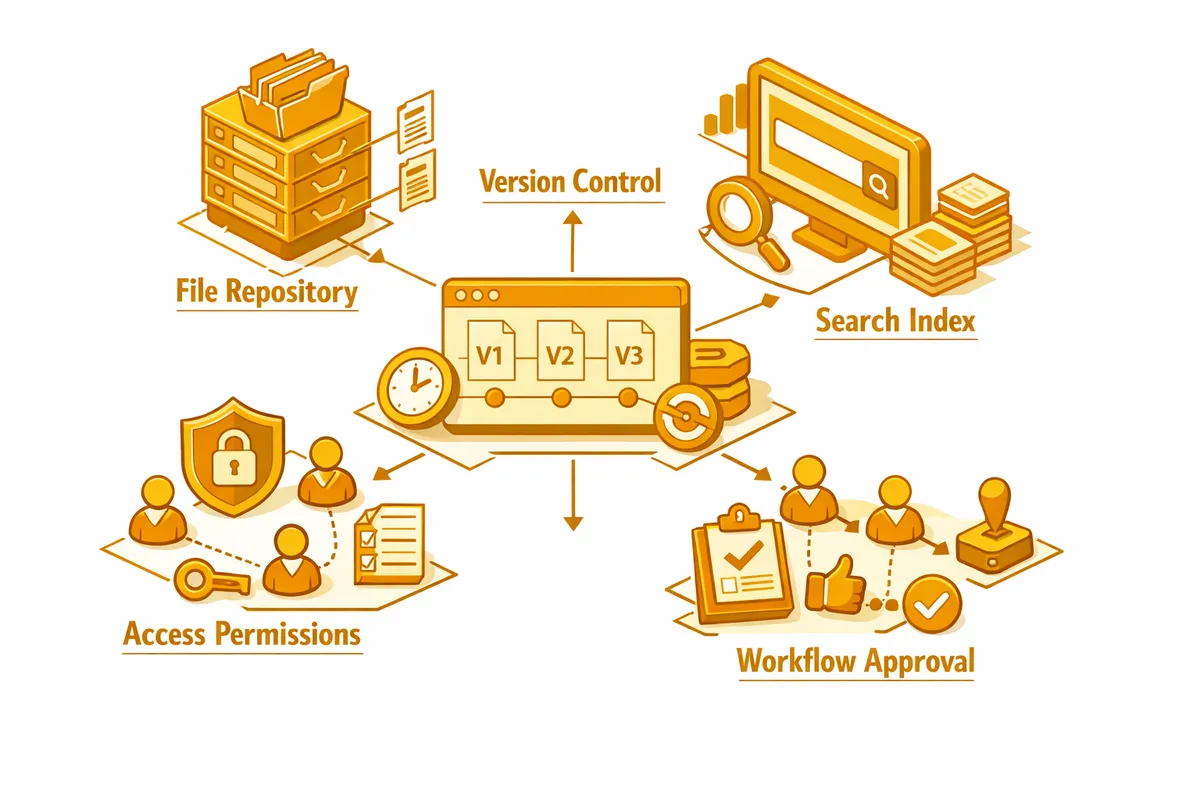
Implementation follows the taxonomy with access controls that match your organizational roles. In an Edgewater medical practice, front-desk staff access scheduling and billing documents without clinical record access. In a property management company, maintenance staff access work orders and unit inspection records without access to lease agreements or security deposit accounting. We migrate existing documents into the new structure, applying consistent naming and metadata during migration so the new system starts organized rather than inheriting existing disorder. Training for your Edgewater team covers the system's daily use before go-live.
Industries We Serve in Edgewater
Medical and dental practices along Clark Street, Granville Avenue, and throughout Edgewater need HIPAA-compliant document management with patient-centric organization, role-based access controls limiting record visibility to authorized clinical staff, complete audit logs for every access, and retention policies enforcing HIPAA's specific requirements for different record types. For Edgewater practices serving diverse patient populations including immigrants and international residents, multilingual intake form management and translation record storage are additional considerations the taxonomy should address.
Real estate offices and property managers handling the dense Edgewater rental market near Sheridan Road and Bryn Mawr Avenue need property-centric document management for lease agreements, move-in and move-out inspection records, maintenance requests and completion records, security deposit accounting, and tenant correspondence. When a tenant dispute requires producing three years of maintenance records for a specific unit, the system produces them in seconds rather than requiring a search through email and physical files.
Ethnic restaurants and independent dining businesses on Broadway and surrounding streets manage vendor contracts, health inspection records, liquor licenses, food handler certifications, and employee records across document types with different retention requirements and different regulatory significance. Centralized storage with type-based organization and automated retention flagging reduces the administrative burden of document compliance for businesses built around service, not paperwork.
Yoga studios and wellness practices near Berger Park and throughout Edgewater manage liability waivers, instructor agreements, membership contracts, and certification records. For any wellness business collecting client health information, proper access controls and retention policies are compliance requirements, not optional improvements. A document management system with role-based access prevents liability waiver files from being accessible to staff who have no reason to see them.
Coffee shops and independent retail businesses on Clark Street and Devon Avenue accumulate vendor agreements, lease documents, employee records, and insurance certificates without the volume or complexity that usually motivates investment in document management, until a lease renewal requires finding the original agreement, a vendor dispute requires producing correspondence from two years ago, or an insurance claim requires producing maintenance records. Centralized document storage with a logical taxonomy serves these businesses with minimal implementation complexity.
Dentists and specialized medical offices in Edgewater face the same HIPAA framework as general medical practices, with the additional document complexity of specialist referrals, insurance prior authorization records, and equipment maintenance and certification records for clinical devices. A taxonomy that spans patient records, insurance documentation, referral correspondence, and equipment records addresses the full document environment of a specialty practice.
What to Expect Working With Us
1. Discovery and audit. We catalog your document types, current storage locations, access requirements, compliance obligations, and retention needs. For Edgewater medical, dental, and wellness practices, this includes a review of HIPAA document requirements and an assessment of how current practices compare to applicable standards.
2. Taxonomy and architecture design. We design the document classification structure, metadata schema, access control model, and retention policy framework specific to your Edgewater business. You review and approve the architecture before implementation begins.
3. Implementation and migration. We build the system and migrate your existing documents into the new structure, reorganizing and applying consistent naming and metadata during migration. Core implementations serving your highest-priority document types are live within eight to fourteen weeks.
4. Training and ongoing support. Post-launch training for your Edgewater team, adoption monitoring, and a warranty period for early issues. Optional maintenance retainers for policy updates, taxonomy changes, and integration support as your document environment grows.