How We Build AI Strategy for Edgewater
We begin with business immersion rather than a questionnaire. We spend time understanding how your Edgewater operation actually functions: where staff time goes, where bottlenecks form, where quality inconsistency originates, and what decisions get made on incomplete information. For a dental practice on Broadway, this means understanding patient scheduling workflows, insurance verification processes, and the administrative tasks that pull clinical staff away from patient care. For a restaurant on Clark Street, it means understanding the prep, ordering, and customer communication workflows where inefficiency accumulates.
From that operational picture, we build an AI opportunity map: where AI could create measurable value, what that value would be, and what a realistic implementation path looks like. We also identify explicitly where AI creates more complexity than it resolves, and where a process improvement is a more appropriate answer than a technology investment.
The build-versus-buy analysis follows from the opportunity map. Some Edgewater business problems are best solved by configuring an existing AI tool in a day. Others require custom development. Others are most efficiently solved by changing a process. We give you an honest assessment of which category each opportunity falls into, along with the cost and timeline implications.
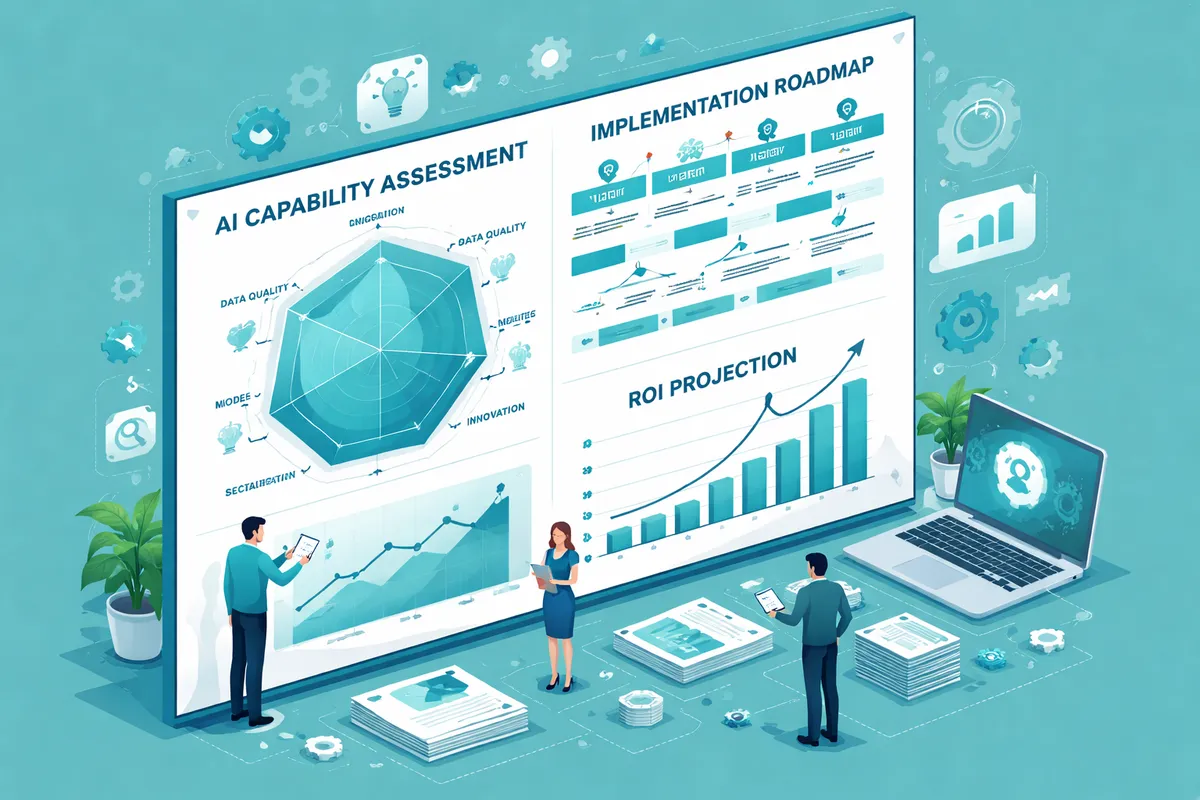
The output is a prioritized roadmap with year-one initiatives, year-two investments, and the skill and infrastructure development the plan requires. For most Edgewater businesses, year-one focuses on one or two high-impact, low-complexity implementations that generate measurable returns while building the data infrastructure and staff confidence that supports later, more sophisticated investments.
Industries We Serve in Edgewater
Dental and medical practices along Broadway and Bryn Mawr Avenue face AI strategy questions around patient communication, scheduling optimization, insurance verification, and clinical documentation assistance. We navigate the HIPAA compliance constraints that narrow the field of permissible AI applications and identify the specific tools that fit independent practice operations rather than hospital systems. The strategy for a three-dentist practice on Bryn Mawr differs substantially from what vendors pitch to larger organizations.
Ethnic restaurants and cafes along Clark Street and Broadway operate at the intersection of community identity and business efficiency. AI strategy for these businesses focuses on where technology supports authentic customer relationships rather than replacing them. Inventory management, demand forecasting, and marketing automation create genuine efficiency without changing the character of an Edgewater neighborhood restaurant serving its specific community.
Yoga studios and wellness centers near Berger Park and along Sheridan Road use strategy engagements to evaluate AI for member communication, class scheduling optimization, retention prediction, and content creation. The wellness market along the Edgewater lakefront is competitive, with clients who move between studios based on class variety and instructor access. Strategy helps these businesses identify where AI creates genuine retention advantage.
Real estate offices along the Sheridan Road lakefront corridor, serving buyers and renters who target the Edgewater Beach Apartments and lakefront access buildings, use AI strategy to evaluate market analysis tools, lead nurturing automation, and client communication efficiency. The Edgewater real estate market has specific dynamics that generic real estate AI tools may not address without customization.
Independent bookstores and specialty retailers along Granville Avenue and Clark Street use strategy to evaluate AI for customer communication, inventory management, event promotion, and content creation. Independent retail in Edgewater survives on community loyalty and distinctive service, and strategy consulting helps these businesses identify AI applications that strengthen those advantages rather than genericizing them.
Professional service businesses including law firms, accounting practices, and consulting offices serving the Edgewater professional community use AI strategy to evaluate document automation, client communication efficiency, and the research and analysis applications where AI creates the most measurable productivity gain for small professional practices.
What to Expect Working With Us
1. Business immersion and operational assessment. We spend the first phase understanding your Edgewater operation from the inside: workflows, decision points, staff structure, current tools, and where the real friction is. We do not assume the problem you describe initially is the highest-value problem to solve.
2. AI opportunity mapping and prioritization. We develop a ranked map of AI opportunities specific to your business, with honest assessments of value, feasibility, cost, and timeline. We identify which opportunities are appropriate for immediate action, which require infrastructure development first, and which are not worth pursuing given your constraints.
3. Build-versus-buy analysis. For each priority opportunity, we assess whether an off-the-shelf tool fits, whether custom development is required, or whether a process change is the right answer. We provide the decision framework and cost-benefit analysis.
4. Multi-year roadmap development. We sequence the priority opportunities into a realistic adoption roadmap that accounts for the operational capacity your Edgewater business has to absorb change. Year one focuses on high-impact, lower-complexity implementations that build data infrastructure and staff confidence.