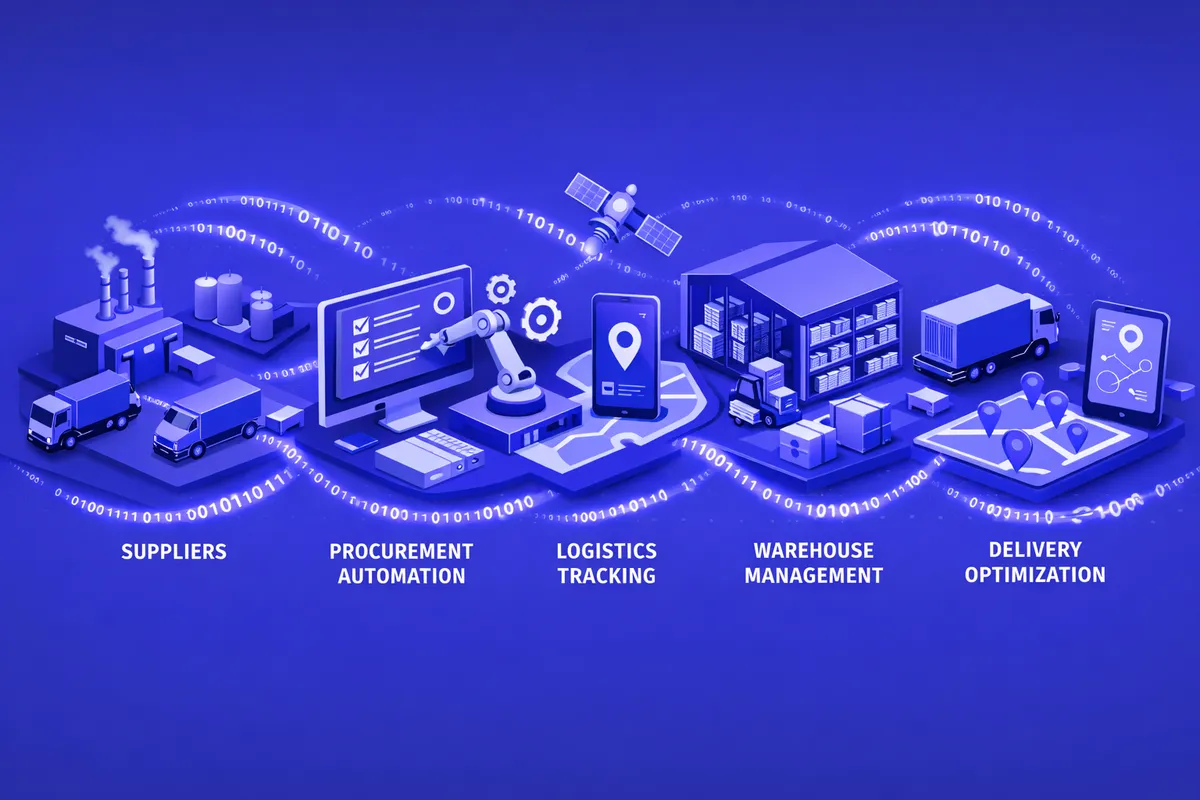
How We Build Supply Chain Automation for East Garfield Park
Supply chain automation for East Garfield Park operators begins with the specific constraints of community development business: limited staff, multiple funding streams, and procurement operations that evolved informally under resource pressure. We start with a process inventory rather than a technology pitch. For a Hatchery Chicago food business, that inventory documents every supplier relationship, every ordering pattern, and every manual step between a low-inventory moment and a restocked shelf. For a nonprofit on Washington Boulevard, it maps every procurement approval required by each funder and the current documentation method for each.
From the process inventory, we identify the highest-priority automation targets. For food businesses in East Garfield Park, the priority is usually ingredient procurement automation: connecting inventory levels to reorder triggers, automating purchase order generation for approved suppliers, and building supplier performance tracking so sourcing decisions are based on documented reliability rather than memory. For community health organizations, the priority is typically expense categorization and approval routing, because the compliance cost of manual categorization exceeds the cost of automating it.
Integration is central to how we build for East Garfield Park operators. Food businesses at Hatchery Chicago often use accounting software like QuickBooks; we integrate procurement automation with the accounting system so every purchase order generates the corresponding expense record without manual entry. Nonprofits on Washington Boulevard often have grant management software; we connect procurement automation to grant reporting so expense documentation is produced as a byproduct of normal purchasing rather than assembled separately at reporting time.
We build in phases matched to East Garfield Park's pace. The first phase addresses the highest-cost manual process. The second phase extends automation to secondary procurement workflows. The third phase adds the vendor performance visibility and reporting that turns procurement data into business intelligence. Throughout, we train the people who will use the system, because automation that confuses staff reverts to manual processes within months.
Industries We Serve in East Garfield Park
Food businesses and early-stage CPG entrepreneurs at Hatchery Chicago on the East Garfield Park food incubator campus manage ingredient sourcing, packaging procurement, co-packer relationships, and distribution logistics simultaneously. Supply chain automation for Hatchery tenants addresses the transition from informal purchasing to structured procurement: approved supplier lists, purchase order workflows, receiving confirmation, and invoice matching. When a food business scales from local farmers markets to regional retail, the procurement infrastructure is already in place rather than built under pressure.
Community health organizations and social service nonprofits along Lake Street and Washington Boulevard operate procurement subject to funder requirements that make manual tracking genuinely risky. Automated procurement with expense categorization by funding source, vendor approval list enforcement, and approval routing by dollar threshold turns compliance from a manual month-end task into an automatic byproduct of normal purchasing. Community organizations near Garfield Park Fieldhouse that run multiple programs funded by separate grants benefit most directly from this structure.
Barbershops, salons, and personal care businesses along Madison Street and Central Park Avenue manage supplier relationships for styling products, equipment maintenance, and facility supplies. For these businesses, supply chain automation is less about complexity and more about reliability: automated reorder triggers for frequently used products, vendor performance tracking across multiple distributors, and purchase history documentation that supports negotiating better contract pricing. The goal is a system that prevents stockouts and finds the savings already available in existing supplier relationships.
After-school programs and youth-serving organizations in East Garfield Park manage procurement for educational materials, program supplies, food service for participants, and facility maintenance across program calendars that shift seasonally. Automated procurement for youth organizations on the West Side addresses both the operational need and the compliance requirement: materials purchased for specific programs are categorized correctly from the moment the purchase order is generated, not sorted out during grant reporting.
Churches and faith-based community organizations near Garfield Park that operate food pantries, social services, and community events manage procurement at volumes that exceed what informal purchasing can handle reliably. Automated vendor management, purchase approval workflows, and expense tracking help faith-based operators in East Garfield Park run their community programs with the same financial discipline their funders and donors expect.
Community development contractors and construction-adjacent businesses operating in the West Side revitalization corridor coordinate materials procurement, subcontractor management, and project supply logistics across multiple job sites. Supply chain automation for contractors in East Garfield Park addresses materials ordering, subcontractor documentation, and receiving reconciliation: the operational backbone that keeps projects on schedule when Madison Street construction activity accelerates during warmer months.
What to Expect Working With Us
1. Procurement process and vendor inventory. In the first two weeks, we document your complete vendor landscape and every step in your current procurement process. For East Garfield Park food businesses, this includes every supplier, every ordering method, and every informal purchasing channel. For community organizations, it includes every funder requirement that affects purchasing. This inventory is the foundation for everything that follows.
2. Compliance and integration mapping. Before building anything, we identify the compliance requirements that automation must satisfy and the systems that automation must integrate with. For nonprofits on Washington Boulevard, that means grant management and accounting system integration. For Hatchery Chicago food businesses, that means accounting software and co-packer communication workflows. The integration map determines the automation architecture.
3. Priority-first build with full documentation. We build the highest-impact automation first and document every workflow so your team understands what the system does and why. East Garfield Park operators cannot afford systems that become black boxes when the person who set them up leaves. Documentation is not optional.
4. Training, monitoring, and iteration. After deployment, we run hands-on training with every staff member who will use the system and monitor adoption for the first sixty days. When staff encounter friction, we address it rather than accepting workaround behavior. The measure of success is not whether the system launched; it is whether your team uses it consistently six months later.