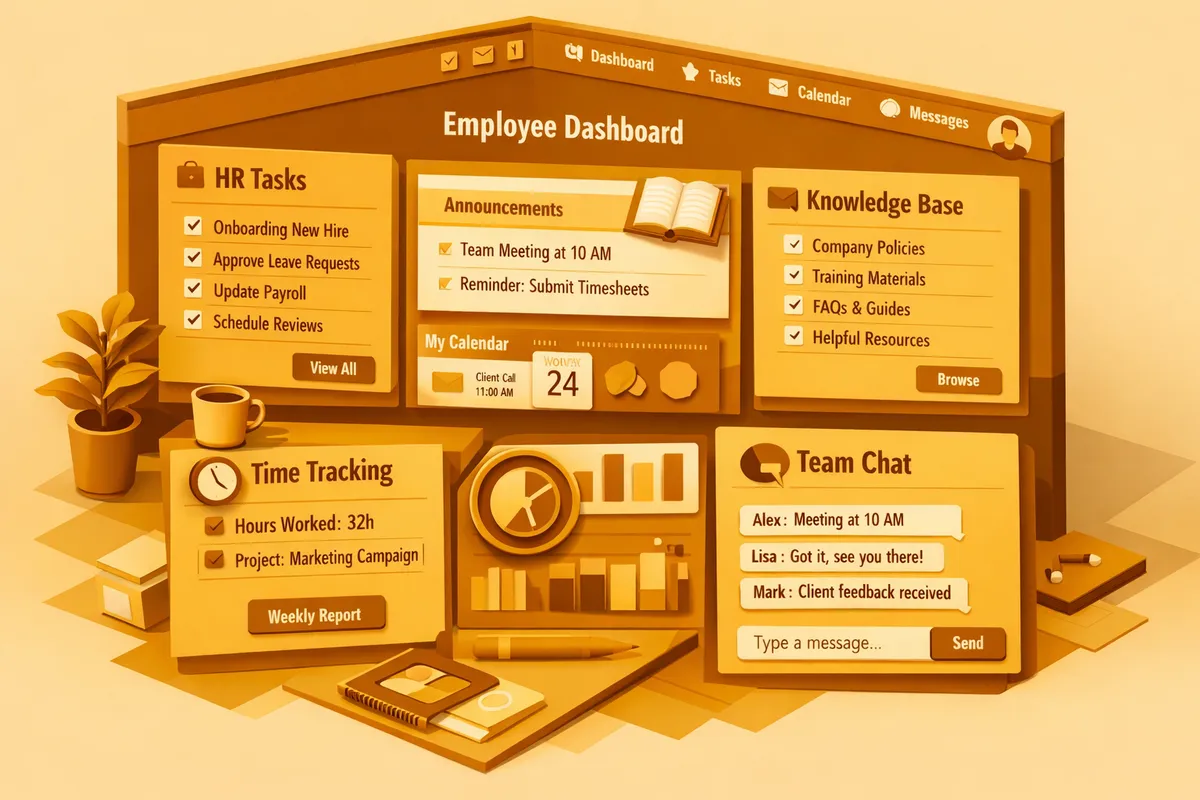
How We Build Employee Portals for East Garfield Park
We start with the HR function, not the technology. Before designing anything, we interview the HR administrator, the executive director, and a cross-section of frontline staff to understand what requests consume the most HR time, where employees currently go to find information, and what problems arise repeatedly in the current process. For East Garfield Park organizations on Madison Street, that interview almost always surfaces a short list of high-frequency transactions: time-off requests, schedule checking, pay stub access, and policy document questions. Those become the core of the portal.
The portal architecture we build is role-stratified. Employees see their own information and the actions available to them. Supervisors see their direct reports and can approve requests, review schedules, and access relevant HR documentation for their team. HR administrators see everything and can manage configurations without developer involvement. This role structure means the portal is useful to everyone without exposing information inappropriately.
For positions with grant-funded cost allocations, we build the time sheet and hour reporting functions to capture cost center information at the point of entry rather than requiring a reconciliation step afterward. An after-school program coordinator who works 20 hours on Program A and 5 hours on Program B allocates their hours during the time sheet submission, and the system routes those allocations to the correct grant budget automatically.
We integrate with the payroll platform the organization already uses. Portal-submitted time sheets flow directly to payroll without re-entry. Pay stubs are accessible in the portal once they are generated in payroll. That integration eliminates the most common time-consuming HR transaction: distributing pay stubs and answering questions about pay.
Industries We Serve in East Garfield Park
Community nonprofits and development organizations on Kedzie Avenue with mixed full-time, part-time, and AmeriCorps staff benefit from employee portals that handle the complexity of multiple employment types in a single system. AmeriCorps members have different time reporting requirements than employees. Contracted outreach workers may need different document access than staff. A well-configured portal handles all of those distinctions without requiring the HR administrator to maintain separate processes for each group.
Food businesses scaled beyond the Hatchery Chicago phase on Lake Street are often hiring production, operations, and distribution staff simultaneously. An employee portal standardizes onboarding for all new hires, ensures food safety training completion is documented before anyone accesses the production floor, and gives the operations manager schedule visibility across shifts without requiring HR involvement in routine scheduling questions.
After-school programs and youth development organizations near Garfield Park Fieldhouse with seasonal hiring cycles use employee portals to run standardized onboarding for program staff hired in August and September. Required documentation including background check authorizations, mandated reporter training confirmations, and emergency contact forms is collected digitally before the program year begins, reducing the first-week paperwork burden that currently falls on site coordinators.
Barbershops and personal care businesses along Central Park Avenue benefit from simpler employee portal functions. A shop with four employed stylists and a front desk coordinator does not need a complex HR system, but a portal that handles time-off requests, provides access to pay stubs, and stores the policy documentation every new hire receives makes the operation more professional and reduces the owner's administrative interruptions.
Community health organizations managing clinical staff, outreach workers, and administrative employees have licensing and certification tracking requirements on top of standard HR functions. An employee portal that flags license expiration dates 90 days out, requires staff to upload renewal documentation, and notifies the clinical director of any lapses prevents the compliance gaps that could affect billing credentialing.
Churches and faith organizations on Washington Boulevard that operate registered childcare programs, senior services, or youth programs face Illinois licensing requirements for certain staff credentials. An employee portal that tracks DCFS background checks, mandated reporter certifications, and CPR training expiration keeps the organization in compliance without requiring a full-time compliance administrator.
What to Expect Working With Us
1. HR workflow audit and priority mapping. We document every HR transaction your staff and employees currently manage and identify which ones are highest volume and highest administrative burden. For East Garfield Park nonprofits with grant-funded positions, we also map the cost allocation requirements so the portal design can address them from the start.
2. Portal design and role configuration. We design the portal's information architecture, permission structure, and workflow logic before development begins. You review and approve the role structure and feature set so there are no surprises during build. For organizations with AmeriCorps members or multiple employment types, this review is critical to making sure all groups are properly served.
3. Payroll and HR system integration. We connect the portal to your existing payroll and HR platforms so time sheets, leave balances, and pay stubs flow automatically between systems. Integration testing with real pay periods ensures the connection is reliable before you depend on it.
4. Staff launch with role-specific training. We run separate orientation sessions for employees, supervisors, and HR administrators because each group has a different set of portal functions. The employee session takes 30 minutes. The supervisor session takes an hour. The HR administrator training is more thorough and includes configuration management so the portal can be updated without developer involvement.