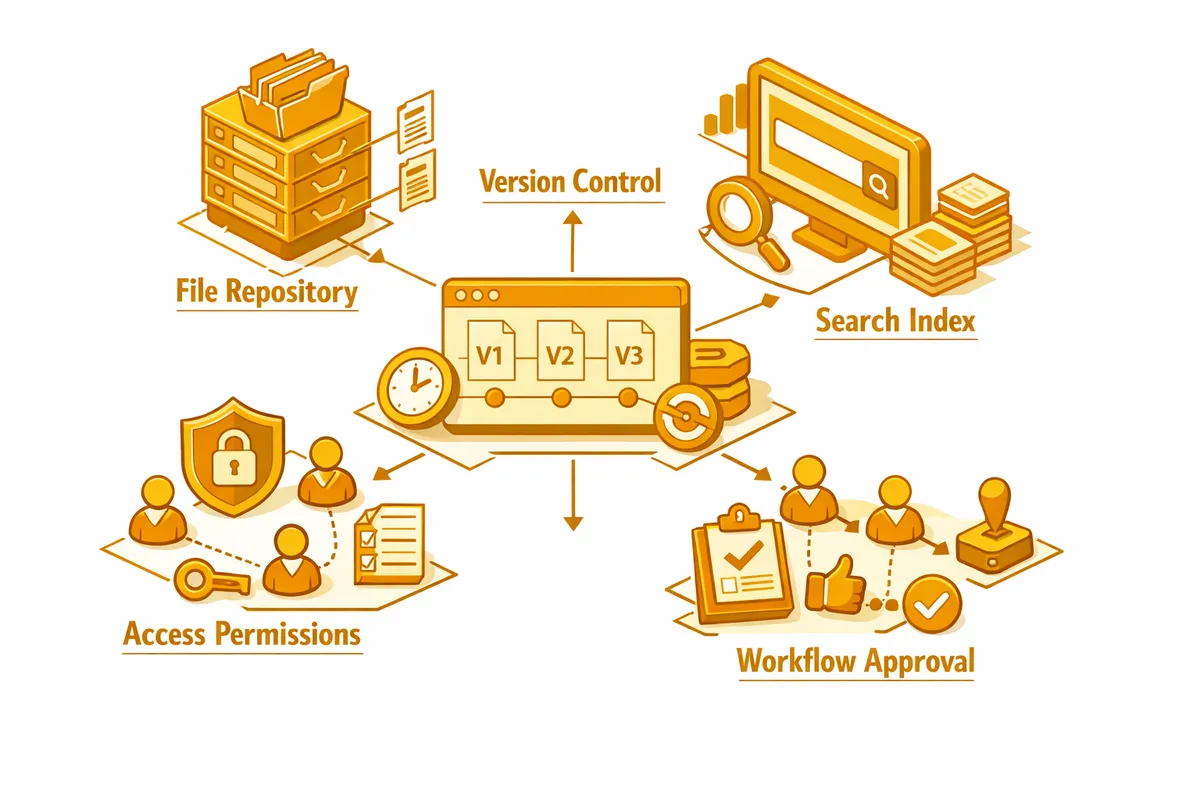
How We Build Document Management for East Garfield Park
The design process starts with a document inventory. We work with your team to list every document type your organization creates, receives, or is required to retain, then map how each type is currently stored, who needs access, how long it needs to be kept, and whether it has been audited against before. For a community nonprofit near Garfield Park Fieldhouse in East Garfield Park, that inventory might cover 40 to 60 distinct document types spanning grant agreements, client intake forms, board minutes, payroll records, and property inspection reports.
From the inventory, we design a folder taxonomy and metadata schema that reflects how your staff actually searches for documents, not how a librarian might classify them. Search behavior matters more than folder logic. A program coordinator looking for a client consent form will search by client name or program year, not by document category. We build the metadata around those search patterns.
Implementation covers migration, permissions, and workflow. Migration means moving existing documents from shared drives and physical files into the new system with consistent naming and tagging. Permissions means setting access rules that protect client confidentiality and grant-specific information appropriately. Workflow means building the routing for new documents: an executed grant agreement that arrives by email should automatically be filed in the right grant folder, tagged with the funder name and grant period, and notified to the finance director.
For food businesses, we build the compliance document architecture specifically around food safety and retail documentation requirements, with automated expiration reminders for supplier certificates and allergen statements so nothing lapses without a renewal prompt.
Industries We Serve in East Garfield Park
Community nonprofits and development organizations on Kedzie Avenue and Madison Street manage document portfolios that span client records, grant files, board governance documents, HR records, and property files. Document management for these organizations requires role-based access that lets a program coordinator access client files without touching payroll data, and lets the finance director access all grant documents without seeing clinical records that require HIPAA protection.
Food businesses scaling beyond the Hatchery Chicago incubator on Lake Street build document systems around food safety compliance, supplier certifications, product specifications, and retail buyer requirements. Every document has an expiration date and a renewal workflow. When a retailer requests a current certificate of insurance or an updated ingredient specification, the document is available in seconds, not after a 30-minute search through email.
After-school programs and youth development organizations near Garfield Park Fieldhouse maintain student records, attendance documentation, permission slips, emergency contact forms, and program outcome data that spans multiple academic years and multiple funder audits. Document management systems for youth programs include retention rules aligned with DCFS and DFSS requirements and access controls that protect student information appropriately.
Churches and faith organizations on Washington Boulevard store a distinct mix of documents: governance records like bylaws and meeting minutes, property records for owned buildings, financial records going back decades, and program documentation for any social services they operate. A well-organized document management system for a church is particularly valuable during pastoral transitions, when institutional knowledge walks out the door and new leadership needs to find 10-year-old legal documents.
Community health organizations operating in the East Garfield Park corridor manage clinical records, billing documentation, grant program files, and public health compliance records. Document management for health organizations must balance HIPAA access controls with operational efficiency. A care coordinator needs fast access to relevant patient documents without having unrestricted access to the full record system.
Barbershops and personal service businesses along Central Park Avenue have simpler document needs, but the value of organization is the same. Business licenses, lease agreements, supplier invoices, employee records, and insurance certificates stored in a searchable system are accessible in minutes when a landlord requests proof of insurance or a license renewal requires documentation from two years ago.
What to Expect Working With Us
1. Document inventory and taxonomy design. We catalog every document type your organization manages and design a folder and metadata structure that matches how your staff searches and how your auditors ask for things. For East Garfield Park nonprofits with grant portfolios, this step also covers retention schedules aligned to funder requirements and Illinois record-keeping law.
2. Migration from existing storage. We move your existing documents into the new system with consistent naming, tagging, and folder placement. For organizations with years of accumulated files across shared drives and physical storage, we develop a migration plan that prioritizes the documents most likely to be needed in an audit first so the most important records are organized and accessible from day one.
3. Permissions architecture and workflow setup. We configure access controls for each user role and build routing workflows for incoming documents. New grant agreements, client intake forms, and compliance certificates get filed automatically rather than relying on individual staff to remember where things go.
4. Staff training and adoption support. The best document management system fails if staff do not use it. We run training sessions for each user group focused on the specific document types and workflows relevant to their role, then follow up at 30 and 60 days to address adoption gaps before they become permanent workarounds.