How We Build Business Process Automation for East Garfield Park
We start by watching, not by proposing. In the first two sessions, we sit with the people who do the work and observe three or four representative process cycles from start to finish. For a nonprofit near Garfield Park Fieldhouse in East Garfield Park, that might mean watching a new client intake from the point of first contact through enrollment confirmation, data entry, and assignment to a case manager. For a food business, it might mean following a wholesale order from receipt through invoicing and inventory adjustment.
What we are watching for is the gap between the first time information enters the process and every subsequent time a human touches it again. Each additional touch is a candidate for automation. A client intake form that gets filled out on paper, then re-entered into the database, then manually copied into the funder's reporting system has two unnecessary touches. We design automation to collapse those touches into one: the data enters once, at the source, and the system routes it everywhere it needs to go.
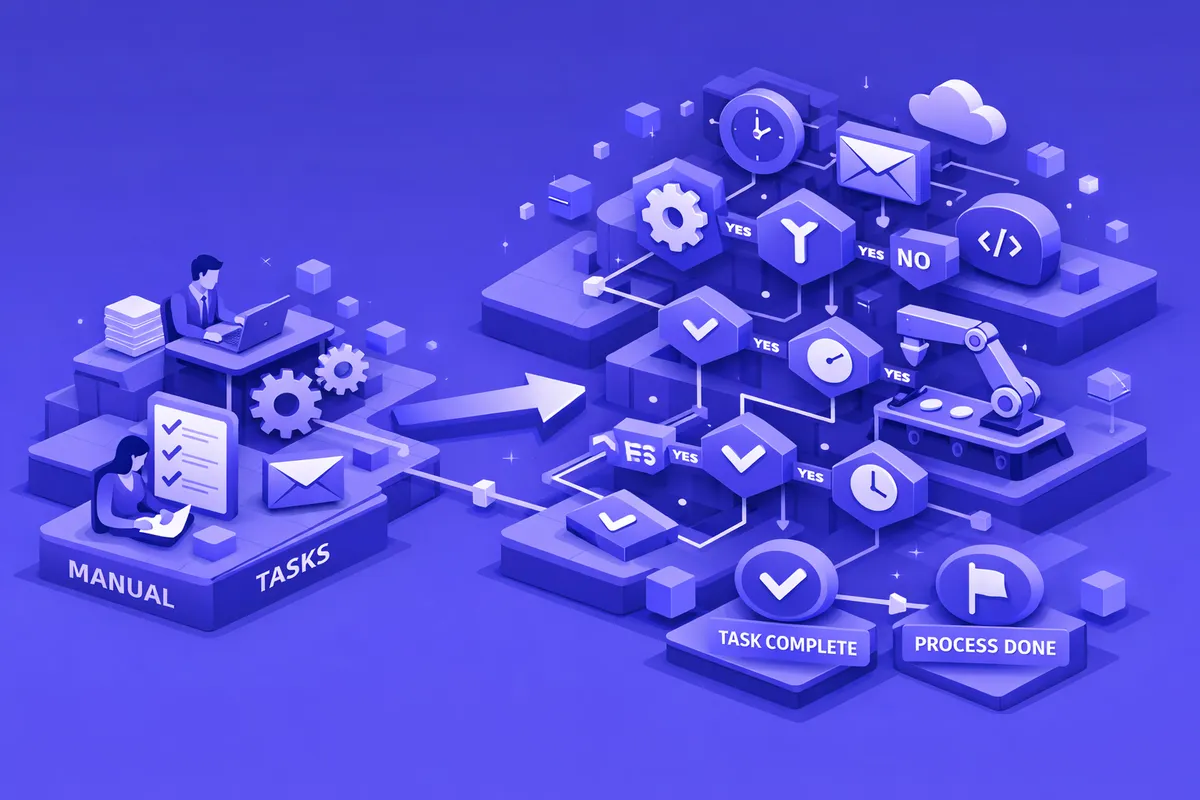
From the observation sessions, we build a process map that shows current state and target state side by side. Every proposed automation is evaluated against three questions: is the process stable enough to automate, does automating it create downstream risks, and is the time savings worth the build cost? Some processes are not ready for automation because they change too frequently. We flag those clearly rather than building systems that will break in six months.
Implementation is phased. High-volume, low-complexity processes go first because they return the most value fastest. Complex processes with exception handling and conditional logic go later, after the simpler automations have proven the infrastructure.
Industries We Serve in East Garfield Park
Community nonprofits and social service agencies along Madison Street use process automation to handle client intake routing, case assignment notifications, attendance logging, and grant report data assembly. Automating these processes frees case managers from administrative tasks and lets them focus on the client relationships their programs were designed to build.
Food businesses scaling beyond the Hatchery Chicago incubator on Lake Street automate purchase order processing, inventory reorder triggers, wholesale invoice generation, and customer follow-up sequences. A food manufacturer shipping to 20 wholesale accounts should not be manually generating invoices for each one. Automation handles that in the background while the founder focuses on production and new account development.
After-school programs and youth development organizations near Garfield Park Fieldhouse automate attendance tracking, parent communication sequences, and program outcome data collection. When a student's attendance drops below threshold, the system automatically triggers a family outreach notification to the assigned coordinator rather than relying on that coordinator to catch it manually during a weekly review.
The churches and faith organizations on Washington Boulevard that run community programming alongside worship services manage volunteer scheduling, event registration, and member communication at a scale that requires process support. Automated volunteer matching, event confirmation emails, and giving acknowledgment letters keep pastoral staff from spending their week on administrative follow-up.
Community health organizations running outreach programs across East Garfield Park automate appointment reminder sequences, follow-up care check-ins, and program eligibility screening workflows. Automated appointment reminders reduce no-show rates by 30 to 40 percent across most health programs, which has a direct impact on program utilization metrics that funders track.
Barbershops and personal care businesses along Central Park Avenue benefit from appointment confirmation automation, review request sequences, and re-engagement campaigns for clients who have not returned in 60 or 90 days. These processes are straightforward to automate with off-the-shelf tools configured to the business's specific cadence and voice.
What to Expect Working With Us
1. Process observation and mapping. We watch your team work before we propose anything. The goal is to find the real manual steps, not the ones that appear on a process diagram. For East Garfield Park organizations that have never mapped their processes before, this phase often surfaces surprising time sinks that are easy to fix.
2. Automation priority ranking and phased plan. We rank every automation candidate by time savings and implementation complexity and present a phased plan that delivers value early. You do not wait six months for the full system to see results. The first phase goes live in weeks and returns measurable time savings before the second phase begins.
3. Build and test with your real data. Every workflow is built and tested using real process scenarios from your organization, not generic test cases. For nonprofit clients, we test against the specific funder reporting formats your grants require. For food businesses, we test against your actual wholesale account list and order patterns.
4. Staff training and transition support. Automation only works if staff trust it. We run training sessions for every role that interacts with an automated process, focusing on how to verify that the automation ran correctly and what to do when something falls outside the automated path. The goal is confident adoption, not passive tolerance.