How We Build Business Intelligence for East Garfield Park
Every engagement in East Garfield Park begins with a question audit. What are the decisions your leadership is making right now that would improve with better data? For a food business at Hatchery Chicago, it might be: which products have positive margin and which are losing money at the production level? For a community health organization near Kedzie Avenue, it might be: which service lines are at capacity and which have room to grow? For a nonprofit managing programs near Garfield Park, it might be: which funders are we utilizing well and which are we under-spending against targets?
From that audit we build a data source inventory. Every system that holds relevant data gets mapped: point-of-sale records, case management software, accounting tools, spreadsheets, grant tracking documents. We assess data quality at each source and build extraction and transformation logic that cleans and connects the data before it reaches the dashboard. For many East Garfield Park organizations, data quality is uneven. Some records are meticulous, others are irregular. Our pipeline design accounts for both rather than requiring a data cleanup project before BI work can begin.
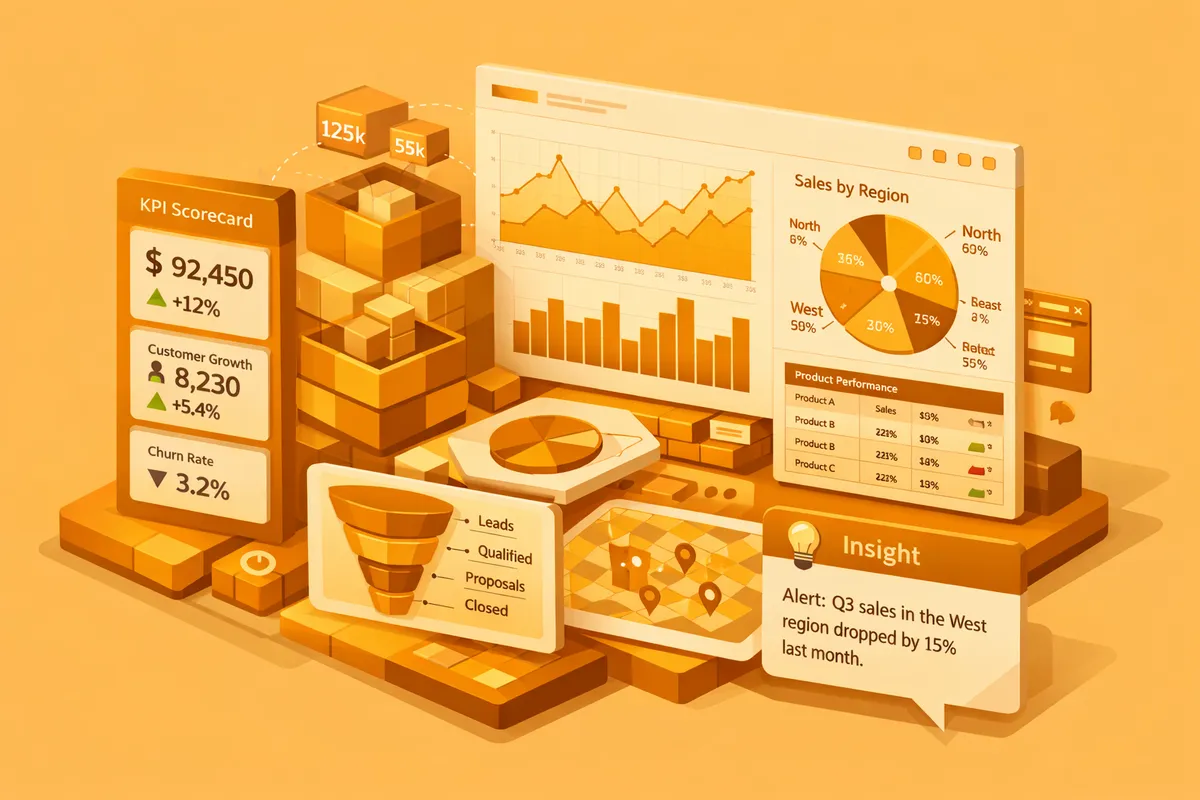
Dashboard design for East Garfield Park organizations centers on decisions, not data. Every metric on a dashboard we build is tied to a question the operator is actually asking. For a food business, that means a daily view of revenue by product, cost ratio by production batch, and wholesale account activity. For a community nonprofit, it means program enrollment and service delivery metrics by week, grant utilization by funding source, and cost per participant by program. The design language is clean and direct: charts that show trends, tables that show current status, and alerts for metrics that have moved outside expected ranges.
Industries We Serve in East Garfield Park
Food businesses and culinary entrepreneurs at Hatchery Chicago use BI to track production costs by batch, revenue by sales channel, wholesale account performance, and margin by product line. East Garfield Park's food incubator produces businesses at every stage from early launch to established wholesale operations. BI dashboards give those businesses the financial visibility that separates sustainable growth from unprofitable volume.
Community health organizations and clinics serving West Side residents along Washington Boulevard and Madison Street use BI to monitor patient census by service type, visit volume trends, billing and collections performance, and staff utilization. For a community health provider where cost control and access expansion are simultaneous goals, real-time operational data changes the quality of every leadership decision.
After-school programs and youth development organizations near Garfield Park Fieldhouse use BI to track student enrollment by program and grade level, attendance trends, program completion rates, and cost per participant. Youth development nonprofits operating near Central Park Avenue often serve multiple funding sources with different reporting requirements. A unified BI view of program data makes multi-funder reporting significantly more efficient.
Community development organizations working the Madison Street corridor use BI to track economic development metrics: small business formation rates, employment counts, real estate activity, and neighborhood investment flows. Organizations coordinating development activity along the Green Line need data that shows impact at both the project level and the neighborhood level to make the case for continued investment.
Churches and faith-based organizations anchored throughout East Garfield Park use BI to track ministry programming participation, facility utilization, congregation giving trends, and community service delivery. For faith institutions that function as neighborhood anchors, data visibility supports both internal resource allocation and external partnership conversations.
Barbershops and personal service businesses along Madison Street and Lake Street use BI to track revenue by service type and staff member, client return frequency, scheduling utilization, and retail product performance. For a neighborhood service business operating on tight margins, knowing which services and which staff are actually profitable changes every hiring and pricing conversation.
What to Expect Working With Us
1. Decision audit with your leadership. We begin by learning the five to eight decisions your leadership makes regularly that would improve with better data. For an East Garfield Park nonprofit, this conversation often surfaces gaps between what the organization knows from relationships and experience and what it can demonstrate from data to funders and partners.
2. Data source inventory and pipeline design. We map every system that holds relevant data and design the extraction and transformation logic that brings it into the analytics layer. We address data quality issues during pipeline design so the dashboards reflect accurate operational reality rather than propagating errors from source systems.
3. Iterative builds with user review at each stage. We build in two-week sprints and review working dashboards with program staff, managers, and executives at each stage. East Garfield Park organizations have deep operational knowledge that shapes what a useful dashboard looks like. That knowledge should inform the build, not get overridden by a designer's assumptions.
4. Training for organizational independence. We train staff to use and extend the dashboards we build. The goal is an East Garfield Park organization that runs on data as a normal part of operations, not one that depends on an outside vendor every time it needs a new report.