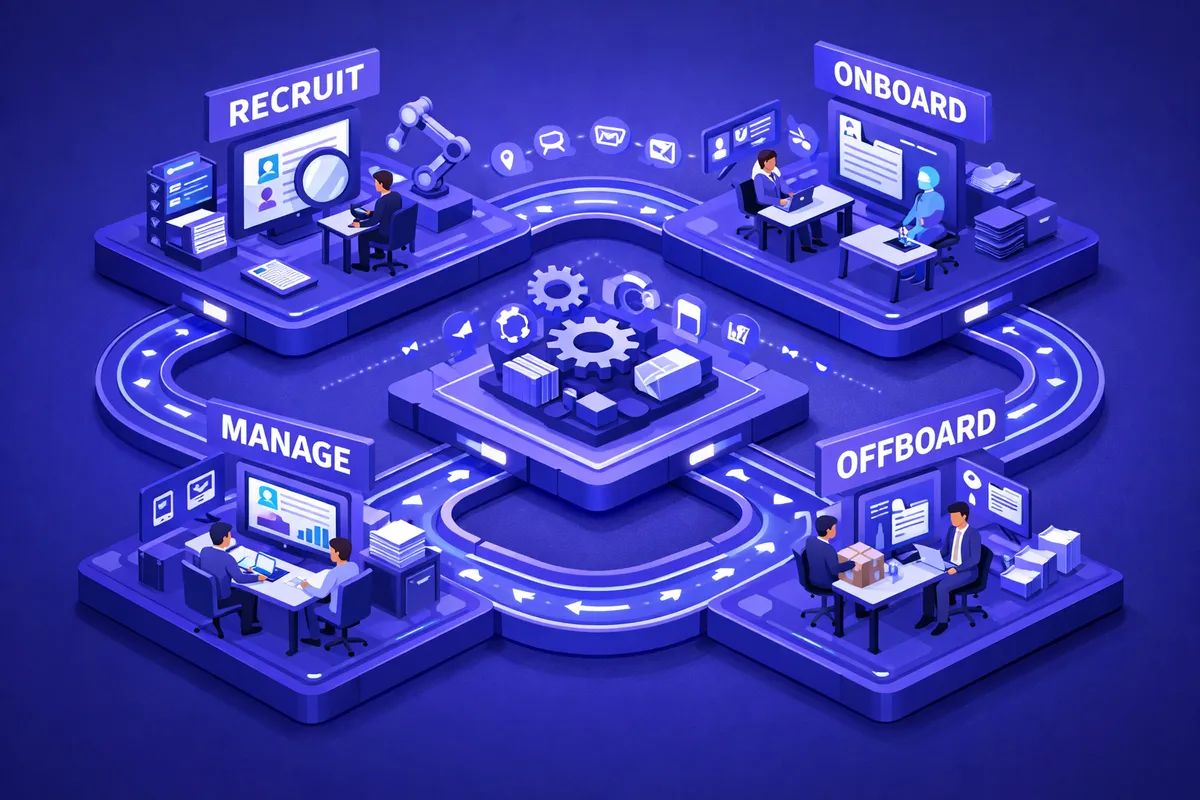
How We Build HR Automation for Douglass Park
We start by sitting with the owner or office manager and mapping what HR actually looks like in their business today. At a community health clinic near Mount Sinai Hospital, that might mean understanding how credentialing works alongside standard onboarding. At a family-run restaurant on Roosevelt Road, it means learning who handles scheduling, how shift swaps get communicated, and what happens when someone calls out. We do not apply a generic system to a business before understanding what that business actually needs.
From that audit, we identify three categories: tasks that should be fully automated, tasks that need a digital tool but still require human sign-off, and tasks that belong to management and should stay there. Not everything benefits from automation. What matters is removing the work that does not require judgment.
We then configure your HR system with your actual job roles, pay rates, document requirements, and scheduling rules. The onboarding workflow gets built around your real hire process, not a template from a software company that has never worked with a Douglass Park bodega or a West Side nonprofit. We train your managers, run a test cohort of new hires through the system, and stay close for the first 30 days to catch gaps.
Most Douglass Park employers we work with are surprised by how much time they recover. The manager at a neighborhood pharmacy on Ogden Avenue who spent four hours every two weeks on scheduling can close that process in under 45 minutes with the right system in place.
Industries We Serve in Douglass Park
Community health clinics and medical practices near Mount Sinai Hospital operate under credential-heavy hiring requirements that make manual onboarding especially costly. Automating license verification, document collection, and compliance tracking means a new medical assistant is fully documented before their first patient interaction, without the clinic manager spending a week chasing forms.
Family-run restaurants and food businesses on Roosevelt Road deal with high turnover and irregular scheduling that creates constant administrative friction. Automated shift management, digital availability collection, and mobile onboarding cut the time between hiring and first shift. Workers get clarity on their schedule before day one, which reduces no-shows.
Churches and nonprofits anchored along Sacramento Boulevard and throughout the neighborhood often hire seasonal or grant-funded staff and need clean documentation for audits and funders. HR automation creates a paper trail that satisfies grant compliance requirements without burdening small staff teams who are running programs, not managing HR software.
Auto shops and service businesses on 19th Street hire mechanics, detailers, and service advisors on an as-needed basis. Automated onboarding handles the W-4s, direct deposit setups, and handbook acknowledgments so a new hire can start the same week they are offered the job, without paperwork delaying their first paycheck.
Neighborhood pharmacies and retail operations on Ogden Avenue balance licensed staff with hourly front-end workers and need scheduling systems that account for both. Automation handles the complexity of mixed staffing models: different accrual rules, different compliance requirements, different communication preferences, all managed in one system.
Local bodegas and corner stores scattered through the neighborhood near California Avenue often have two to five employees and owners who wear every hat. For these businesses, even lightweight HR automation pays dividends: a digital scheduling tool that texts employees their shifts, an onboarding checklist that triggers automatically when a hire is confirmed, and a document storage system that keeps employee files out of a drawer.
What to Expect Working With Us
1. Operations audit and process map. We spend time with whoever actually does HR in your business today: an owner, an office manager, a shift supervisor. We document every touchpoint from job posting through first-day paperwork, and identify where time is lost and where compliance risk lives. For a Douglass Park employer, this often surfaces a few critical gaps that are straightforward to close.
2. System configuration around your real workflow. We configure your HR platform using the actual job titles, pay structures, and document requirements from your business. If you hire through community referrals and do not post on job boards, your onboarding workflow should reflect that. We build for how you actually operate, not how a software template assumes you operate.
3. Manager training and first-cohort support. We train anyone who will touch the system and run your next real hire through it alongside your team. If something does not work the way it should for a Douglass Park business context, whether that is bilingual document support or specific scheduling configurations for shift workers, we adjust before you are on your own.
4. Quarterly compliance check-ins. Illinois labor law changes. Federal I-9 requirements update. We review your HR automation setup every quarter and make sure your workflows are still current. Community employers in Douglass Park have enough to manage without tracking regulatory updates themselves.