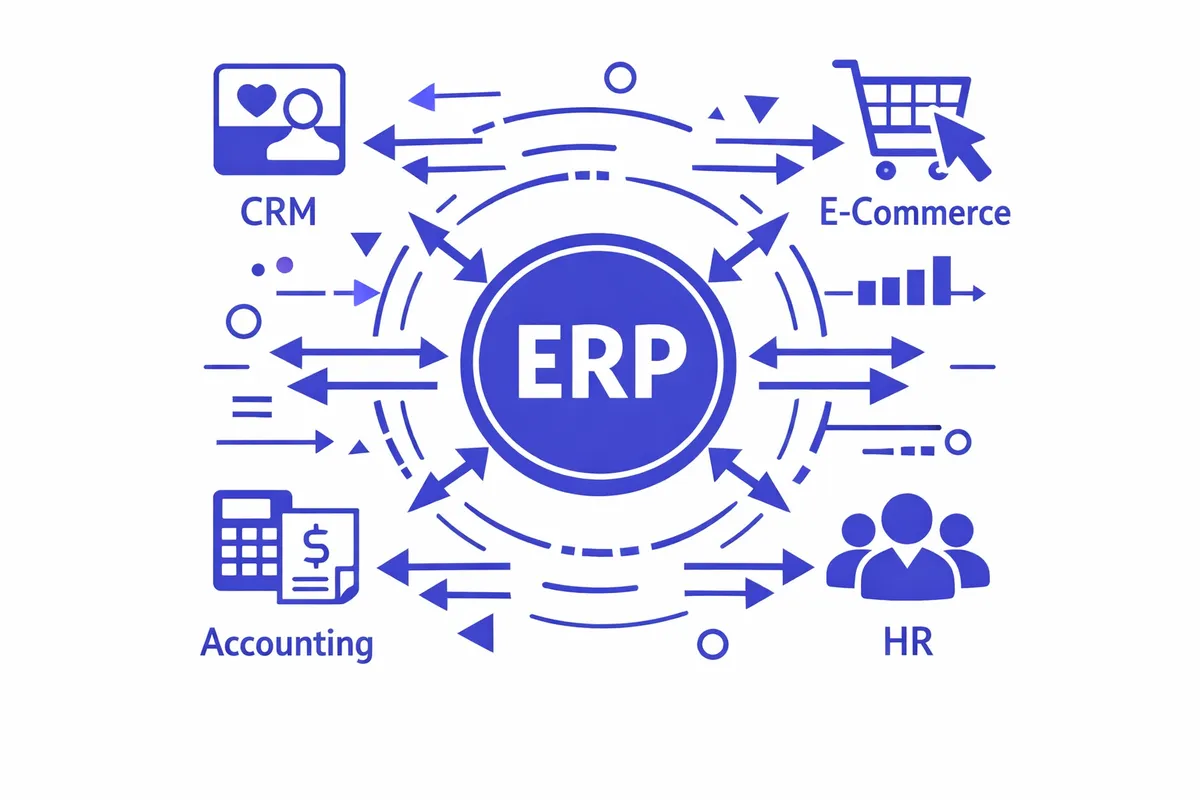
How We Build ERP Integration for Douglass Park
The integration question is always: what decisions are you making slowly or badly because your systems do not share data? For a clinic administrator on Roosevelt Road, the answer might be: I cannot tell you how much of our grant funding is committed versus available without running three separate reports and reconciling them by hand. For a retail business owner on Ogden Avenue, it might be: I cannot see my real-time margin on any product because my POS and my accounting system do not sync.
We map the data flows that matter, assess the systems involved, and design the integration architecture. For some Douglass Park organizations, the right answer is adding API connections between existing systems. For others, one of the existing systems needs to be replaced with something better suited to their current scale, and the integration project is also a migration project. We tell you which situation you are in before we start, not after.
For nonprofit organizations with grant tracking requirements, integration typically means connecting program management software to accounting software so grant expenditure tracking is automatic rather than manual. For healthcare organizations near Mount Sinai Hospital, it means connecting EHR systems to billing platforms and, where applicable, to population health reporting tools. For retail businesses on Sacramento Boulevard, it usually means connecting POS to inventory management and accounting in a single data flow that eliminates the manual reconciliation step entirely.
Implementation follows a staged approach. We start with the most expensive data gap, build the integration that closes it, validate the data quality in the new flow, and then move to the next priority. Trying to integrate everything at once is how ERP projects fail.
Industries We Serve in Douglass Park
Community health clinics and FQHCs near Mount Sinai Hospital operate under complex billing requirements across Medicaid, Medicare, private insurance, and sliding-scale fee structures. ERP integration for these organizations typically means connecting the EHR to the billing platform to the accounting system, so revenue cycle data flows without manual extraction, and grant-funded service delivery is reported accurately without separate data entry.
Social services nonprofits on California Avenue and Sacramento Boulevard manage cases, clients, funders, and program finances simultaneously. Integration work here often means connecting case management software to financial reporting tools and grant compliance platforms, so a program director can see program expenditures against budget at any moment without calling the finance team.
Auto supply retailers and repair shops on Ogden Avenue benefit significantly from connecting POS data to inventory management and accounting. A parts retailer who knows what sold today, what is in stock, and what margin each category generated, all from a single reporting view updated in real time, makes better purchasing decisions than one who reconciles those three systems at month end.
Neighborhood pharmacies on Roosevelt Road and Sacramento Boulevard run complex operations at the intersection of clinical services, retail sales, and third-party billing. Integration between pharmacy management software, retail POS, and billing platforms eliminates the double-entry that creates reconciliation errors and compliance risk.
Faith-based community development organizations that manage properties, programs, and capital projects alongside their core mission need financial systems that can track restricted and unrestricted funds, program expenses, and capital expenditures in a unified view. Integration between their fund accounting system and their program management tools gives leadership the financial picture they need for board reporting and funder accountability.
Multi-location retail businesses that have expanded from a single Douglass Park location to two or three sites need inventory, POS, and accounting systems that share data across locations. Without integration, a business owner on Roosevelt Road cannot see real-time inventory across all locations without calling each site, which creates both operational inefficiency and customer service failures when a product shows as available online but is actually out of stock.
What to Expect Working With Us
1. Systems audit and integration design. We inventory every operational system your organization uses, map the data flows between them, and identify the gaps that create the most operational or financial pain. The output is an integration architecture document that specifies exactly which systems connect, what data flows in which direction, how often, and what the error handling looks like when a sync fails.
2. Build and validation. We build the integration layer, which might be custom API connections, middleware like Zapier or Make for simpler integrations, or a purpose-built ETL process for complex data transformations. Every integration includes a data quality validation step that flags anomalies before they propagate into downstream systems. For Douglass Park healthcare and nonprofit organizations, data integrity is a compliance requirement, not just a quality preference.
3. Parallel running and cutover. For critical system integrations, we run the new automated data flow alongside the manual process for two to four weeks before turning off the manual process. This catches edge cases and builds staff confidence before the organization is fully dependent on the integrated system. Healthcare and financial integrations always use this approach.
4. Documentation, training, and support. We document every integration point, the expected data flow, the validation logic, and the error handling procedures. Staff who manage these systems receive training specific to their role in the integrated workflow. We provide a support period after go-live for troubleshooting and adjustment, and we build a monitoring dashboard that shows integration health at a glance so problems are caught quickly rather than discovered at month-end reconciliation.