How We Build Autonomous Workflow Agents for Douglass Park
We start with a workflow audit across your organization. We interview staff who do administrative work and ask them to describe a typical day, focusing on tasks they repeat frequently and tasks that feel mechanical. We review common processes: how does a patient intake form move through the clinic from arrival to billing, how does a client application move through a nonprofit from submission to case assignment, how does an invoice move from vendor arrival to payment approval. We map each process step by step and identify which steps require human judgment and which are mechanical data handling.
From the audit, we rank workflows by time spent, frequency, and error rate. High-volume, high-error-rate workflows are the best candidates for agent automation because the agent both saves time and reduces the cost of errors. A data entry workflow that takes ten hours per week and produces five errors per hundred forms is a clear priority. A complex decision workflow that takes two hours per week and requires nuanced judgment is not.
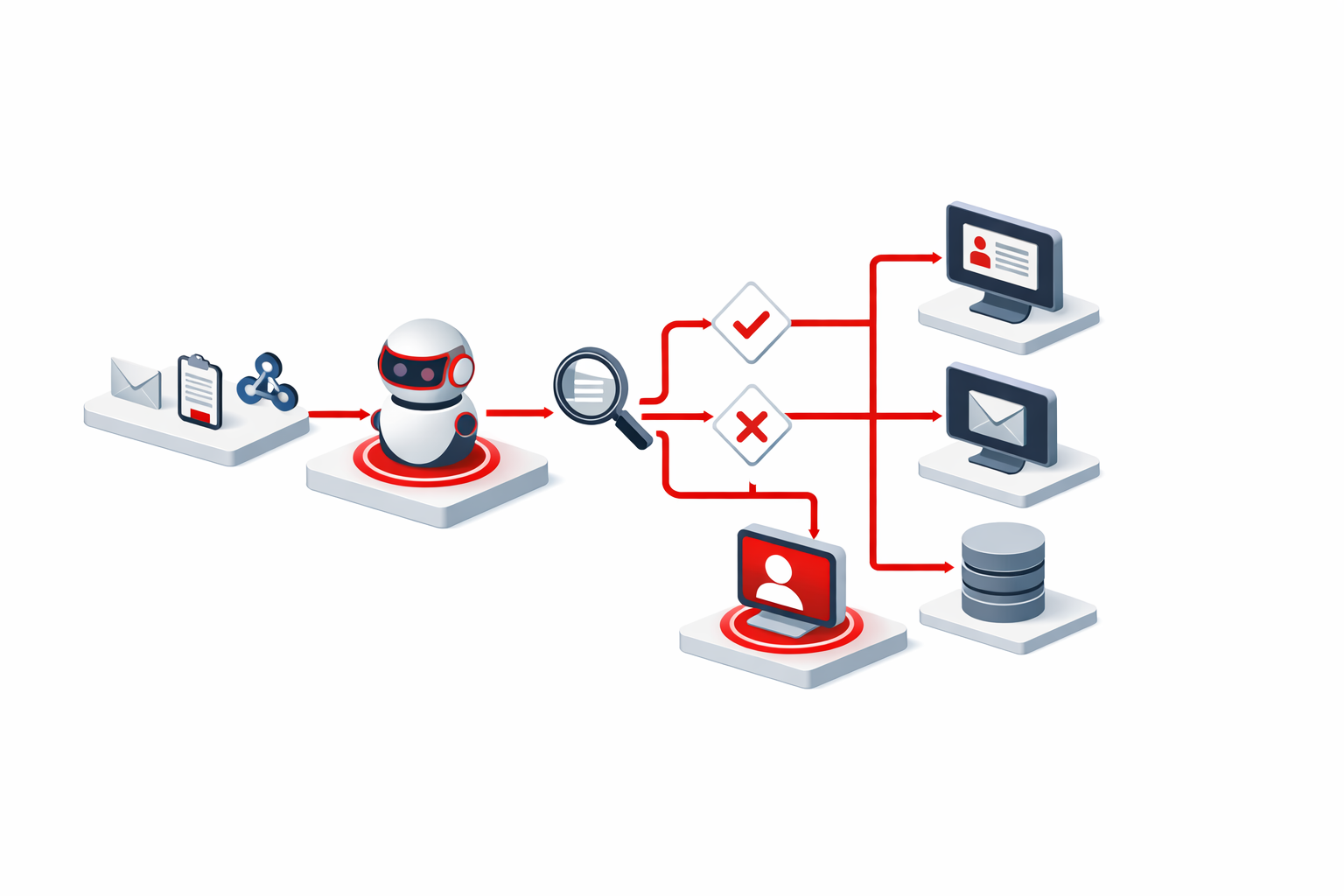
For each prioritized workflow, we design an agent that handles the mechanical steps automatically and escalates non-routine cases to a human for decision. The agent is trained on your specific data and processes: your form layouts, your system field names, your routing rules, your approval thresholds. Nothing is generic. The agent knows that patient intake forms arriving by email go to the patient records system while patient intake forms arriving by fax go to a scanning queue. The agent knows that invoices under $500 from approved vendors route to payment directly while invoices over $500 require manager approval.
We test each agent with historical data from your actual operations before going live. We measure accuracy, identify exception patterns, and refine until the agent performs reliably. After go-live, we monitor performance continuously and provide monthly reports showing volume processed, error rates, and exception patterns that might indicate a need for agent refinement.
Industries We Serve in Douglass Park
Community health clinics and medical practices along Roosevelt Road and California Avenue deploy autonomous agents for patient intake processing, insurance verification, appointment reminder sending, post-visit follow-up, billing queue management, and funder report generation. Clinical staff reclaim hours per day from administrative tasks. Patient-facing work gets more time. Billing cycles accelerate because documentation processing no longer waits in a manual queue.
Nonprofits and social service agencies throughout Douglass Park deploy agents for grant report compilation, client intake routing, case documentation organization, volunteer hour tracking, donor acknowledgment processing, and funder data submission. Development staff and case managers spend their time on relationships and judgment calls rather than data compilation.
Family-run restaurants and businesses on Ogden Avenue and Roosevelt Road deploy agents for invoice processing, inventory reconciliation, vendor communication triage, reservation confirmation, and weekly financial summary generation. Business owners reclaim evening and weekend hours previously spent on bookkeeping and administrative catch-up.
Neighborhood pharmacies and health-adjacent businesses on California Avenue and Sacramento Boulevard deploy agents for prescription refill request processing, insurance billing submission, inventory reorder triggering, and patient communication workflows. Pharmacists spend their time on clinical consultations rather than administrative queues.
Community development and housing organizations near 19th Street and Douglass Park deploy agents for loan application intake, applicant document collection, eligibility screening automation, status update communications, and reporting to government funders. Staff capacity for relationship work and complex underwriting decisions expands.
After-school programs and youth organizations near North Lawndale College Prep and throughout Douglass Park deploy agents for student enrollment processing, attendance tracking and parent notification, program completion documentation, and grant outcome reporting. Program coordinators spend their time with students rather than managing enrollment spreadsheets.
What to Expect Working With Us
1. Workflow audit and prioritization. We document your current administrative workflows, interview the staff who perform them, and identify the highest-value automation opportunities. We deliver a prioritized list of agent candidates with estimated time savings and implementation complexity for each.
2. Agent design and specification. For each prioritized workflow, we design the agent: what it handles automatically, what it escalates, how it interfaces with your existing systems, and how you will monitor its performance. We review the design with your team before building.
3. Development, testing, and refinement. We build each agent and test it against historical workflow data from your organization. We refine until accuracy meets the standard required for the specific workflow. High-stakes workflows require higher accuracy standards than lower-stakes ones.
4. Deployment, training, and monitoring. We deploy agents to live operations and train your staff on how to monitor them, review exception queues, and provide feedback that helps us refine performance over time. Monthly reports show volume processed, accuracy rates, and exception patterns.