How We Build Field Service Management for Chinatown
The discovery phase for a field service management implementation focuses on your current dispatch workflow: how jobs come in, how they get assigned, how technicians receive their schedule, how job completion is documented, and how billing follows. For Chinatown service businesses, we also map the bilingual communication points: which customers communicate in Chinese, which communications currently require the dispatcher to manually translate or make a separate call.
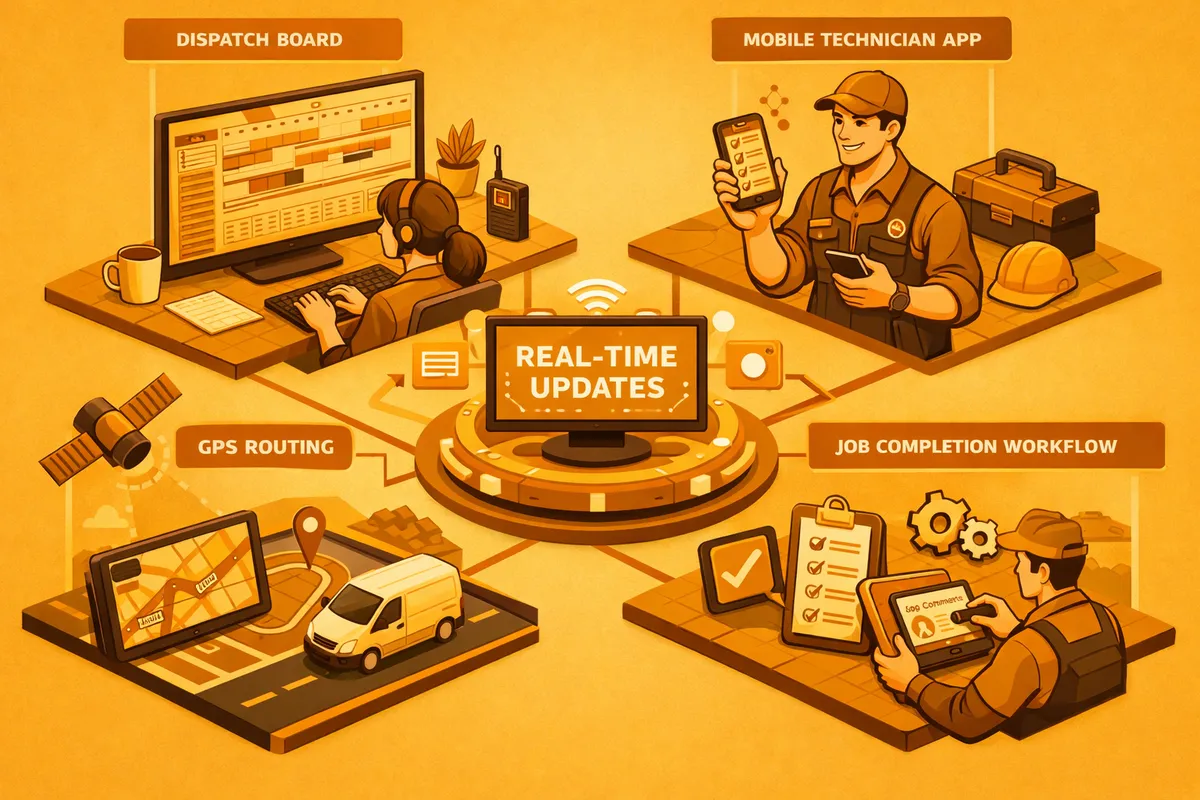
The system architecture connects job intake, scheduling, dispatch, mobile technician tools, and billing into a single flow. A new job request arrives through any channel: phone, website form, or customer portal. The system assigns it to a technician based on skill match, geographic proximity, and schedule availability. The technician receives the job details on a mobile app with navigation built in. When the job is complete, they close it out on the app and the billing trigger fires automatically. The customer receives a completion summary and an invoice in their preferred language.
For Chinatown businesses that handle equipment service or repair, we integrate parts inventory tracking into the field service flow. A technician who identifies the need for a replacement part can check availability and reserve it from the field rather than calling the office. Inventory is decremented when the part is used. Reorder triggers fire when stock hits the threshold.
Industries We Serve in Chinatown
Restaurant equipment repair and maintenance services working the Wentworth Avenue and 22nd Place commercial corridor handle emergency calls that cannot wait for a scheduler to process them manually. Field service management enables on-call technicians to receive and accept emergency dispatch directly to their mobile device, navigate to the job with full customer history visible, and close the job with parts used and time logged before they pull away from the curb. Invoice generation follows within minutes.
Commercial cleaning and janitorial services serving the Chinatown business district and extending into nearby Bridgeport use field service management to route crews efficiently across multiple daily stops, track job completion at each location, and communicate schedule changes to clients without dispatcher phone chains. Recurring service schedules are managed automatically with exceptions and add-ons handled through the same system.
Herbal product delivery services and distributors based near Chinatown Square schedule delivery routes that often need to be adjusted based on traffic, customer availability, and order volume changes. Field service management with real-time route adjustment capability handles those changes without requiring the driver to call the office. Delivery confirmations and customer signatures are captured on the mobile app and attached to the order record automatically.
Appliance and kitchen equipment sales businesses with installation and service components manage post-sale field work through a field service system that connects the sale record to the installation job, the installation job to the warranty record, and the warranty record to future service calls. A customer on Princeton Avenue who purchased a commercial refrigerator can have their full service history accessible to any technician dispatched on any future call.
Pest control and commercial maintenance contractors serving Chinatown's restaurant-heavy corridor manage regulatory compliance alongside the service workflow. Field service management for this context tracks service frequency, records treatment details required by health code documentation, and produces the compliance reports that restaurant operators need for their health inspections.
HVAC and plumbing contractors responding to calls from Chinatown's mix of older commercial buildings and newer Chinatown Square construction manage field service with different technical profiles at each location. The system maintains building-specific equipment histories, surfaces them to the dispatched technician before arrival, and records every service action in a location history that informs future maintenance scheduling.
What to Expect Working With Us
1. Dispatch workflow audit and system design. We document your current job intake, assignment, dispatch, and billing workflows in detail before specifying anything. For Chinatown service businesses, this audit captures the bilingual communication points and the seasonal volume patterns driven by Lunar New Year and the Chinatown Summer Fair. The system design accounts for those peaks explicitly rather than designing for average volume and hoping it holds.
2. Bilingual configuration and customer communication templates. We configure the customer-facing communication layer in both English and Chinese. Appointment confirmations, technician arrival notifications, job completion summaries, and invoices are templated in both languages and triggered based on customer preference. Technician-facing mobile interfaces can also be configured in Chinese for field workers who prefer that interface language.
3. Mobile app deployment and technician training. Field service management is only as good as technician adoption. We deploy the mobile app, run training for your field team in the language each technician works in, and configure the app with the specific job types, parts codes, and service categories your business uses. The training is practical: technicians work through real job scenarios on the app before they go live with customer work.
4. Integration to billing and reporting. Job completion triggers billing without an intermediate manual step. We connect the field service system to your accounting or invoicing platform so the financial side reflects field activity within minutes of job close. Reporting shows technician utilization, job completion rates, average response time, and customer satisfaction metrics across whatever period you want to examine.