How We Build Accounting Automation for Chinatown
The discovery phase starts with your actual transaction patterns. For a restaurant on Wentworth Avenue, that means pulling three to six months of bank statements, POS export data, vendor invoices, and payroll records to map exactly which reconciliation steps happen manually, how often they error, and where the staff time concentration sits. For accountants near Chinatown Square who manage client portfolios, we map the client intake and monthly close workflows to find where the same manual steps repeat across every client file.
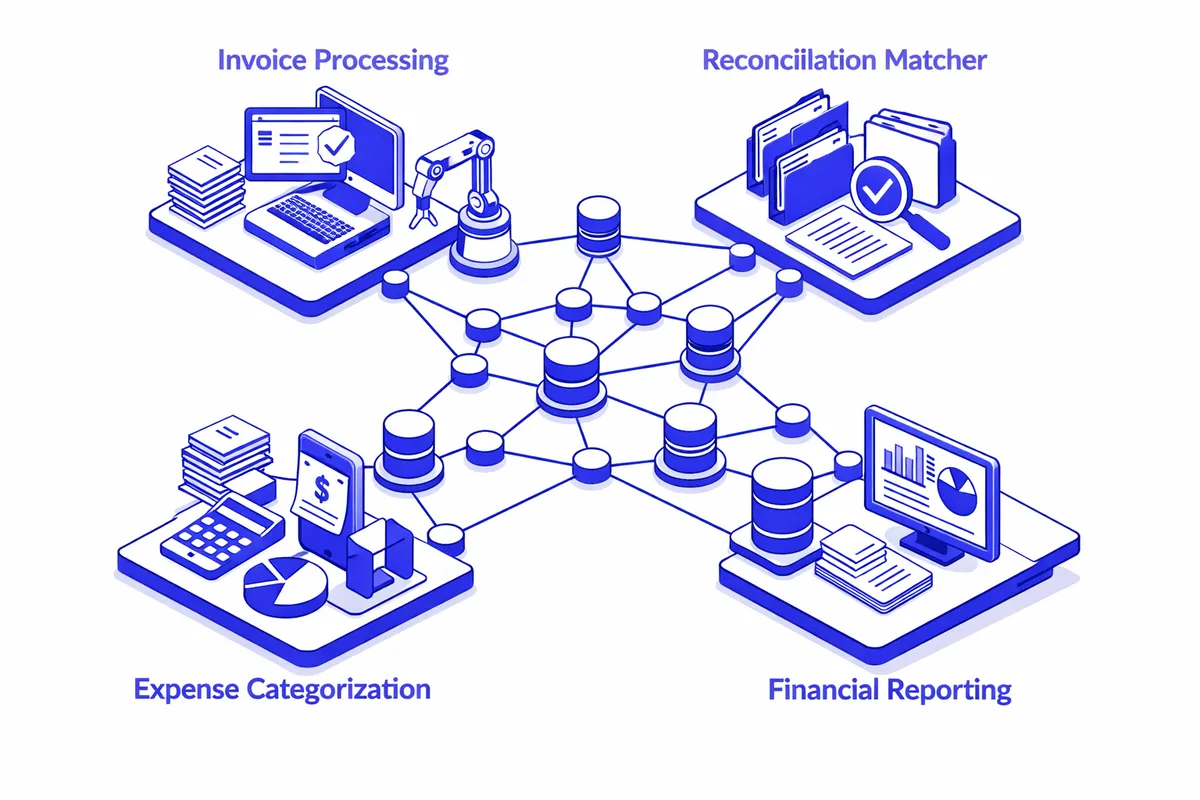
From that map, we build the automation layer. Most Chinatown businesses are running some combination of QuickBooks, bank portals, POS exports, and manual spreadsheets. We integrate those sources into a single reconciliation flow rather than replacing tools you already know. Bank feeds connect automatically. Vendor invoices are parsed, matched against purchase orders, and queued for approval without manual entry. Payroll exports reconcile to the general ledger without human intervention. The work that required three hours after close now happens overnight.
For businesses with Chinese-language documentation, including supplier invoices and contracts from mainland or Taiwanese vendors, we build OCR and parsing workflows that handle Chinese characters accurately. The output feeds into your standard accounting system in whatever currency and format the downstream reporting requires. The configuration is specific to your supplier list, not a generic import template that requires manual cleanup after every run.
Industries We Serve in Chinatown
Chinese restaurants and banquet halls on Wentworth Avenue run high-transaction operations where daily reconciliation between POS systems, cash drawers, and supplier invoices is a constant labor burden. We automate the nightly close, the weekly vendor payment queue, and the monthly reporting cycle so kitchen staff is not also doing bookkeeping at midnight after service ends.
Herbal medicine shops and acupuncture clinics near Chinatown Square often manage a hybrid of retail inventory and service billing, with insurance reimbursements adding a third tracking stream. Automated accounts receivable reconciliation matches insurance payments to patient accounts, flags outstanding balances, and generates aging reports without manual cross-referencing against separate billing and practice management systems.
Import and export businesses along Archer Avenue deal with invoices in multiple currencies from suppliers across Asia, customs fees, freight charges, and domestic distribution billing. We build multi-currency reconciliation workflows that normalize exchange rates, categorize landed costs, and produce the landed-cost-per-unit reporting that these businesses need for margin analysis without requiring a dedicated accounting team to assemble it.
Bakeries and specialty food retailers on Cermak Road balance retail sales, wholesale accounts, and custom order billing. Automated invoicing for wholesale customers, payment tracking against custom order deposits, and inventory cost reconciliation replace the mix of spreadsheets and paper records that most bakeries in this corridor are still maintaining manually.
Accountants serving immigrant businesses near the Pui Tak Center manage client portfolios where the volume of routine monthly tasks is the primary constraint on how many clients they can serve. We automate document collection, bank feed imports, and standard reconciliation steps across all client accounts so the accountant's time concentrates on the work that actually requires their expertise: tax planning, entity structuring, and client advisory.
Chinese American civic organizations and cultural institutions near the Chinese American Museum of Chicago manage grant accounting, donation tracking, and program expense reconciliation that require audit-ready documentation. Automated allocation of expenses to program codes, grant drawdown tracking, and donor acknowledgment letter generation reduce administrative overhead and keep compliance documentation current throughout the fiscal year.
What to Expect Working With Us
1. Transaction and workflow mapping. We spend time with whoever currently handles your books, whether that is a family member, a part-time bookkeeper, or an outside accountant. We document every manual step from bank statement to financial report, identify the error-prone transitions, and quantify how many staff-hours per week the manual process currently consumes. For Chinatown businesses with bilingual documentation, we catalog the specific document types that require manual translation or reformatting before they can be entered.
2. Integration architecture and configuration. We connect your existing accounting software, banking platforms, POS or point-of-sale systems, and vendor portals into a unified data pipeline. Nothing gets replaced without a clear reason. The goal is that your existing tools start talking to each other rather than requiring a human to move data between them. Vendor invoice parsing, payroll integration, and bank reconciliation are configured to your specific chart of accounts and reporting requirements.
3. Seasonal calibration. Chinatown's business calendar has defined peaks. We configure your automation to handle Lunar New Year volume and the Chinatown Summer Fair surge without manual intervention or exceptions. This means pre-testing the reconciliation pipeline at higher transaction volumes before those weeks arrive, not discovering the bottlenecks during your busiest month.
4. Handoff and ongoing support. When the system goes live, we train whoever will monitor it and give you clear escalation paths for the exceptions the automation cannot resolve. Most businesses find the exception rate drops below 5% of transactions within the first month as the system learns your specific patterns. We check in at 30 and 90 days to tune the configuration and address anything that emerged in live operation.