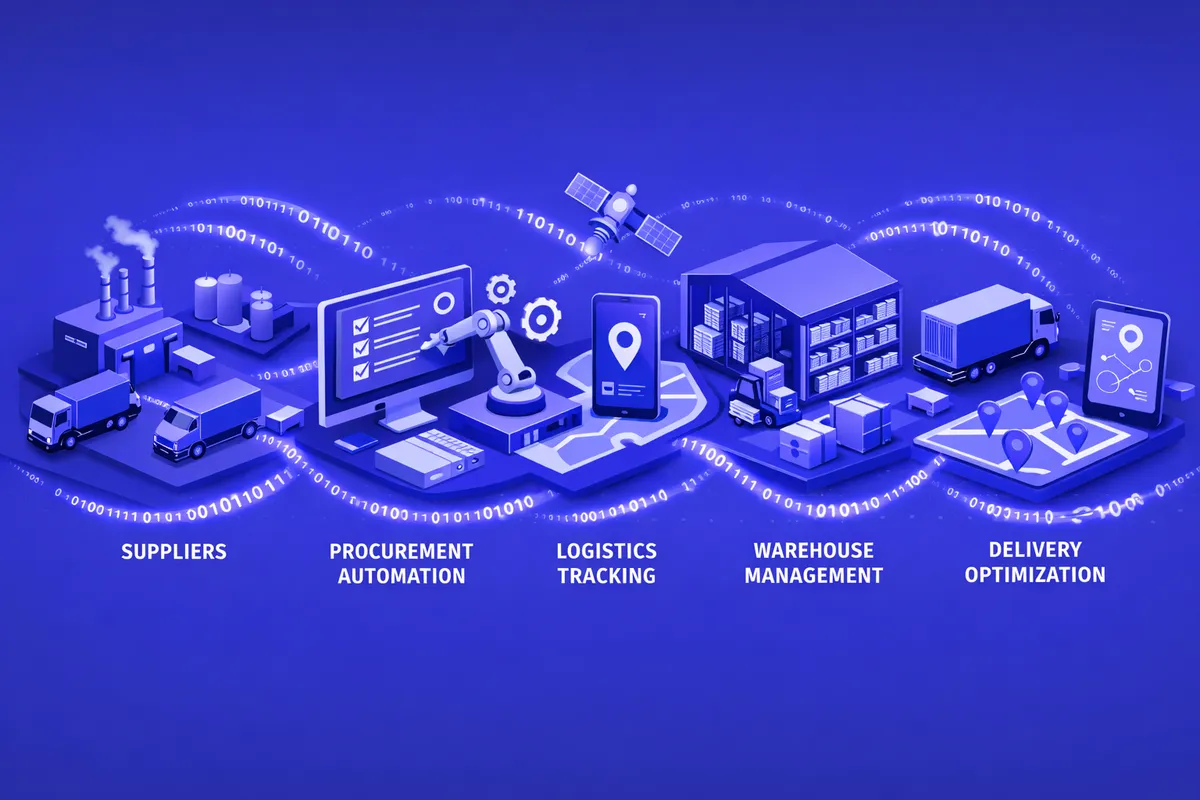
How We Build Supply Chain Automation for Bucktown
The process starts with an operational audit that maps every manual touchpoint in your current supply chain workflow. For a Bucktown retailer, that typically means tracing the path from initial vendor selection through purchase order creation, shipment tracking, receiving, inventory update, and reorder trigger. For a manufacturer in the Elston corridor, it means mapping raw material ordering against production schedules, tracking WIP through the production floor, and connecting finished goods inventory to customer order fulfillment. Every point where someone is entering data by hand, sending an email to check a status, or making a reorder decision from memory is a candidate for automation.
Procurement workflow automation. We build automated systems that generate purchase orders when inventory hits defined reorder points, route POs through approval workflows appropriate to your operation, send orders to suppliers via EDI, email, or supplier portal, and track acknowledgment and ship confirmation without manual follow-up.
Supplier communication. Rather than managing supplier relationships through scattered email threads, we centralize supplier communication through automated systems that handle order confirmations, advance ship notices, delivery ETAs, and exception alerts when something is delayed or incorrect.
Inventory intelligence. For Bucktown retailers managing seasonal merchandise, we build demand forecasting that accounts for the North Avenue foot traffic patterns, the 606 season, and the neighborhood's shopping cycles. For manufacturers, we connect material consumption to production schedules so reorder triggers reflect actual demand rather than arbitrary par levels.
Systems integration. Most Bucktown businesses are already using some combination of QuickBooks, Shopify, a POS system, or an ERP. We integrate the automation layer with your existing tools so the supply chain data flows into the systems your team already uses rather than creating a parallel reporting environment nobody checks.
Industries We Serve in Bucktown
Boutique apparel and retail on the Damen corridor and surrounding streets manages seasonal inventory from domestic and international vendors. Automation handles reorder triggers, tracks inbound shipments, and keeps inventory synchronized across physical and online channels.
Light manufacturers and fabricators along Elston and Clybourn coordinate inbound raw materials, production scheduling, and finished goods fulfillment through systems built for the scale and complexity of a North Side shop floor operation.
Design studios and creative agencies near Holstein Park source materials, equipment, and specialty supplies for client projects. We build procurement workflows that eliminate the manual tracking that consumes project management time.
Coffee and specialty food businesses with multiple suppliers and perishable inventory, from roasters near the Milwaukee corridor to specialty retailers throughout the neighborhood, use automation to manage freshness, track lot information, and trigger restocks before shelves run dry.
Wholesale and distribution operations working out of Bucktown's industrial corridor use inventory automation to synchronize stock across multiple clients, streamline receiving, and generate the fulfillment documentation that customer relationships require.
E-commerce fulfillment businesses using Bucktown warehouses for Chicago-area distribution benefit from carrier integration, order routing automation, and inventory sync that keeps digital storefronts accurate in real time.
What to Expect Working With Us
1. Process mapping and opportunity assessment. We spend the first week documenting your current supply chain workflows in detail. This is not a generic checklist. It is a specific map of your operation that identifies where manual work is creating delay, error, and cost. You receive a prioritized automation roadmap with rough ROI estimates for each opportunity so you can sequence investment rationally.
2. System design and integration architecture. We design the automation workflows and define how they connect to your existing tools. Before any implementation begins, you see exactly what will be built, what systems it will touch, and what the data flows will look like. No surprises mid-build.
3. Phased implementation. We build the highest-impact automations first. For most Bucktown businesses, that means procurement automation and inventory replenishment triggers before anything else. You see measurable operational improvement within the first 60 days, not at the end of a six-month project.
4. Monitoring, reporting, and expansion. After launch, we monitor performance against baseline metrics established in the assessment phase. Procurement cycle time, reorder accuracy, carrying cost, and fulfillment error rate all get tracked. Monthly reporting shows what is improving, what needs refinement, and where to extend automation next.