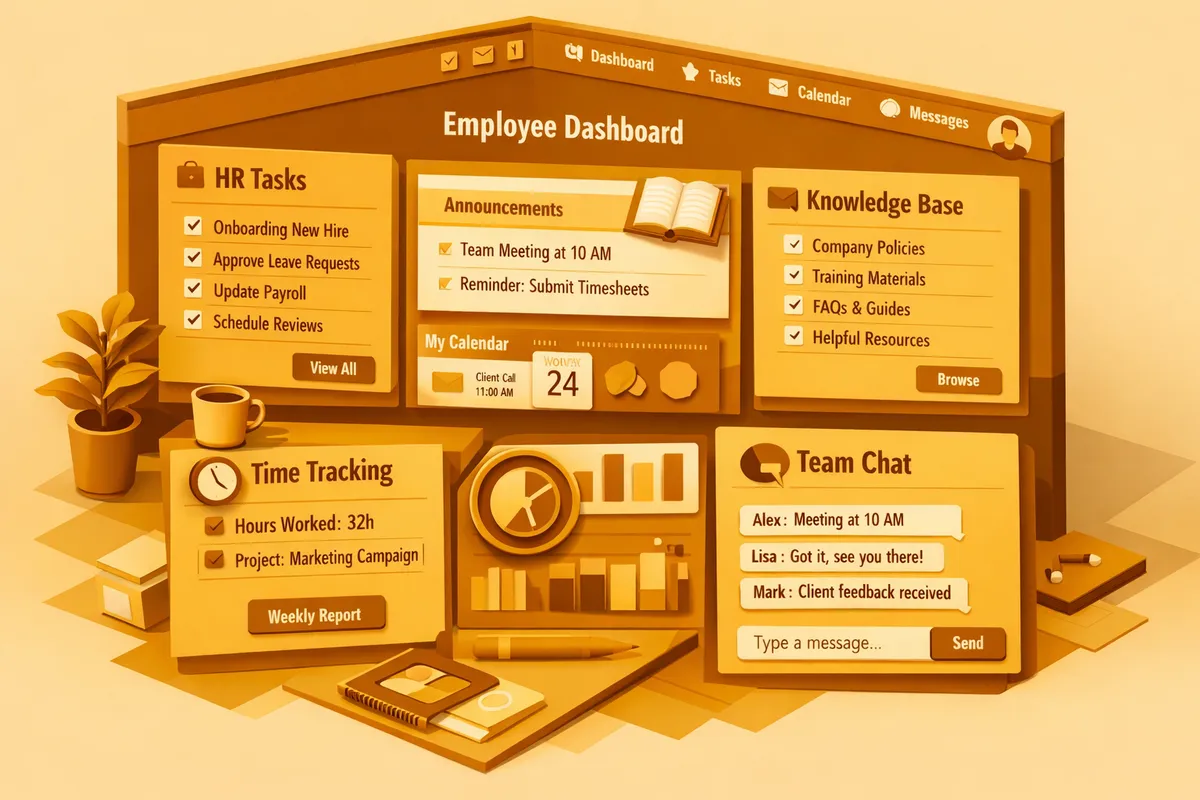
How We Build Employee Portals for Bucktown
We start by auditing your current workforce management touchpoints: how schedules are communicated, how time-off is requested, where onboarding documents live, how training is delivered, and how HR communications reach staff. For a boutique on Damen Avenue, this often reveals that three or four separate communication channels, text, email, a paper schedule, and a shared Google Drive folder, are all doing work that a single portal could consolidate.
The portal design follows your org structure. A yoga studio's portal looks different from a design firm's because the daily workflows are different. Studio instructors need schedule visibility, class assignment details, and certification document storage. Design team members need project briefs, brand asset access, time-tracking integrations, and internal messaging. We build for the actual roles your team fills, not a generic corporate structure.
Access controls are built by role from day one. A part-time retail associate at a Western Avenue boutique sees their schedule, their pay stubs, and their onboarding documents. The store manager sees all of that plus the full team schedule, HR documents, and administrative configurations. We do not build portals where everyone has access to everything; the role structure is fundamental to how the portal works. After the audit and design phase, builds typically run four to six weeks for small business deployments, with staged rollout so your current team adopts features one at a time rather than all at once.
Industries We Serve in Bucktown
Boutique retail stores and clothing shops along Damen Avenue manage shift scheduling, seasonal staff onboarding, and policy distribution through portals built around the rhythms of independent retail. Staff can view their schedules two weeks out, swap shifts with manager approval, and access the employee handbook without asking someone to resend it. Seasonal hires complete paperwork digitally before their first day on the floor.
Yoga studios and fitness facilities near Armitage Avenue coordinate instructors who often teach at multiple studios and manage their own scheduling constraints. A staff portal gives instructors visibility into their class schedule, substitute request workflows, certification expiration reminders, and payroll history. The portal reduces the scheduling coordination overhead that falls on studio directors who are already managing customer relationships and programming.
Independent restaurants and coffee shops near Holstein Park deal with front-of-house and back-of-house teams that have very different information needs. Front-of-house staff need shift schedules, tip reporting tools, and reservation briefings. Kitchen staff need prep checklists, supplier contact information, and health and safety documentation. A properly structured portal serves both without creating confusion by surfacing only what each role needs.
Design firms and creative studios in Bucktown's converted loft spaces use staff portals for project assignment visibility, time-tracking integration, asset library access, and internal knowledge bases. A designer who needs to find the brand guidelines file for a client they worked on six months ago should not have to search three Slack channels and a shared drive. The portal creates a structured, searchable home for the information the team uses regularly.
Real estate offices on Western Avenue manage agents who operate semi-independently: their own client lists, their own showing schedules, their own commission tracking. An employee portal gives each agent visibility into their pipeline metrics, access to shared listing templates and marketing materials, and a place to submit expense reports and compliance documentation without chasing the office manager by email.
Property management and residential real estate services throughout the Bucktown corridor coordinate maintenance staff, leasing agents, and office personnel who need different levels of access to property records, maintenance request queues, and tenant communication logs. The portal routes maintenance assignments to the right staff member, tracks completion status, and archives the record without requiring manual coordination through phone calls.
What to Expect Working With Us
1. Workforce audit and role mapping. We document every communication touchpoint in your current team management process, map it to a portal function, and identify the roles that need different access levels. For a Bucktown boutique, this typically takes one focused session and produces a clear spec before any design work begins.
2. Portal build with role-based access. We build the portal around your org structure from day one, with each role seeing exactly what they need. We connect to your existing scheduling, payroll, or HR tools where APIs exist so the portal surfaces data your team already generates rather than requiring parallel data entry.
3. Team rollout and adoption support. A portal only works if your team uses it. We prepare the rollout communication, run a brief walkthrough session for staff, and monitor adoption in the first two weeks to identify anyone who needs extra support. For seasonal staff at a Damen Avenue boutique, we also prepare a quick-start onboarding flow so new hires are productive in the portal from day one.
4. Iteration based on how your team actually works. After sixty days of operation, we review usage data, collect staff feedback, and prioritize the next round of improvements. Often the first iteration reveals features people want that were not obvious upfront, and practical additions that come from the team using the portal in real conditions are usually more valuable than features designed in the abstract.