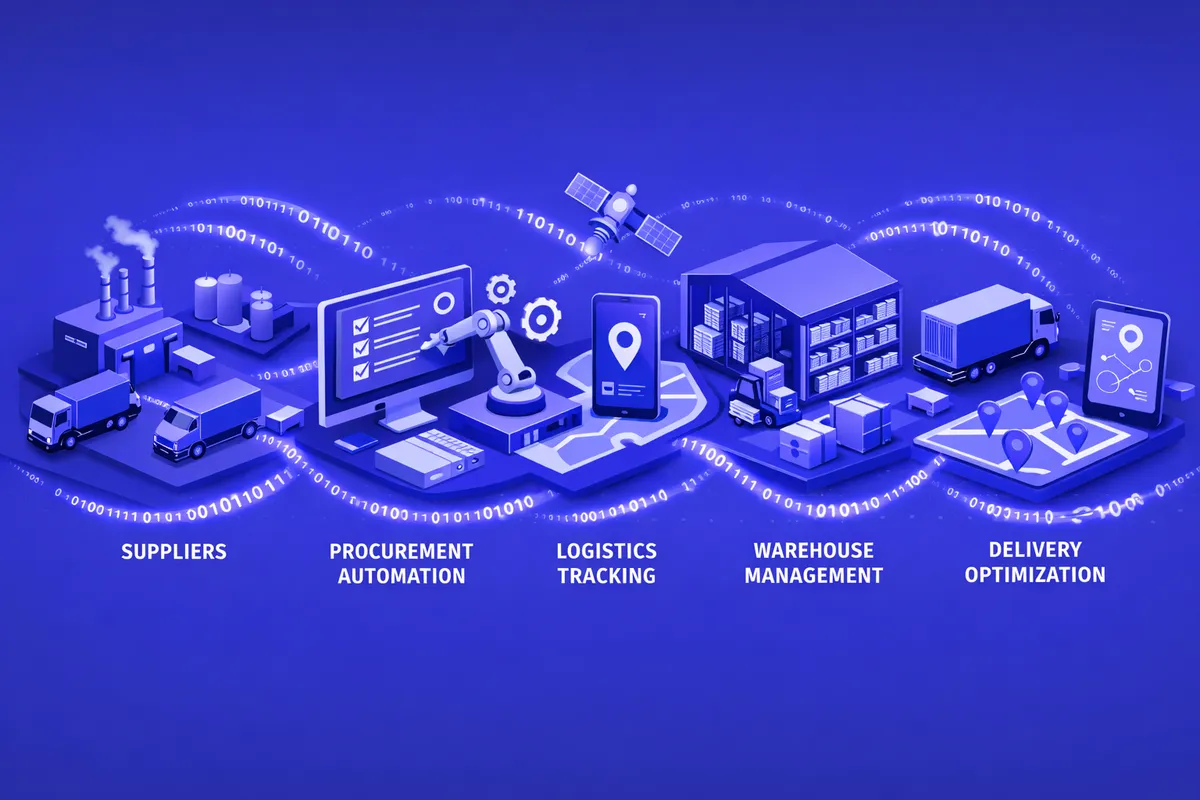
How We Build Supply Chain Automation for Bronzeville
We begin with a vendor inventory. Every vendor relationship in a Bronzeville business gets documented: contract terms, order frequency, lead times, historical delivery performance, and the current manual process for ordering, receiving, and reconciling. For a restaurant on Cottage Grove Avenue, that inventory might cover twenty-five active vendor relationships. For a cultural nonprofit near the Chicago Bee Building, it might cover a mix of recurring service vendors and event-by-event contractors.
From the vendor inventory, we map the procurement workflows. Most Bronzeville businesses have informal procurement processes built around individual judgment and relationships. Those processes work when volume is low and the same person handles every order. They break when volume increases, when staff changes, or when the business is pursuing growth that requires procurement to run without constant owner involvement.
The automation layer formalizes procurement so it runs consistently. Purchase order generation triggers from inventory levels or usage schedules rather than from someone remembering to place an order. Invoice reconciliation happens against documented contract terms rather than memory. Vendor performance is tracked automatically so the data is available when it matters.
We prioritize automations by dollar volume and operational impact. High-dollar vendor contracts, like event production services for Bronzeville nonprofits or subcontractor agreements for consulting firms on Indiana Avenue, get the most sophisticated treatment: automated performance tracking, renewal management, and structured approval routing. High-frequency, lower-dollar procurement, like daily food and beverage purchasing for a King Drive restaurant, gets automated par-level monitoring and purchase order generation based on inventory counts rather than manual daily decisions.
Integration with accounting systems is standard. Purchase orders generate expected expense records automatically. Received goods update inventory. Vendor invoices match against purchase orders and receiving records before routing for payment approval. Accounts payable reviews exceptions rather than every invoice.
Industries We Serve in Bronzeville
Black-owned restaurants and hospitality operations along King Drive and 35th Street manage procurement across food and beverage, cleaning supplies, small wares, and maintenance services. Automated par-level monitoring tied to reservation volume and historical usage patterns means purchase orders go to vendors at the right time without a manager running a manual count every morning. Full-service restaurants supporting Bronzeville community events benefit from procurement automation that accounts for event-driven volume spikes without requiring manual intervention for each event cycle.
Cultural nonprofits and event organizations near the Victory Monument and the DuSable Black History Museum manage vendor relationships for programming calendars where every event has different requirements. A film screening needs a different vendor mix than a community dinner, which needs a different vendor mix than a panel discussion. Automated vendor request workflows generate RFPs, track bids, route for approval, and issue purchase orders for each event type, replacing the email coordination that currently requires staff time for each booking.
Financial services and consulting firms on Indiana Avenue manage subcontractor agreements, software licensing, office supplies, and professional services procurement. Contract lifecycle automation tracks renewal dates, surfaces performance history before negotiations, and routes approval for new vendor agreements without requiring a principal to track contract calendars manually. For firms billing subcontractor costs to clients, automated procurement also creates the documentation needed for accurate client invoicing.
Small publishers and media companies with Bronzeville presence manage printing vendors, distribution partners, and creative services contractors. Automated procurement tracks print run schedules, manages vendor performance against quality and timeline specifications, and surfaces the data needed to negotiate competitive rates when contracts come up for renewal.
Barbershops, salons, and beauty services businesses along Cottage Grove Avenue manage supply procurement from a mix of national distributors and local specialty vendors. Automated reorder management based on actual usage rates prevents both stockout situations on high-demand products and over-purchasing on slow movers, directly improving cash flow for businesses where product inventory is a meaningful working capital component.
Community health and social services organizations in Bronzeville manage procurement for office supplies, program materials, janitorial services, and facility maintenance. Automated procurement workflows with approval routing by dollar threshold and program budget replace ad hoc purchasing processes, providing the documentation that funders and auditors require without adding administrative burden to program staff.
What to Expect Working With Us
1. Vendor and process inventory. The first two weeks are documentation. We catalog every vendor relationship and trace every procurement workflow from order initiation through invoice payment. For most Bronzeville businesses, this surfaces vendor relationships and informal processes that have never been fully documented, and produces a baseline against which post-automation performance can be measured.
2. Automation architecture matched to your operations. We design the automation layer against your actual procurement workflows and vendor relationships, not a generic procurement template. For a Bronzeville restaurant, the architecture differs from a consulting firm on Indiana Avenue. The integration points, the approval routing, the performance metrics, and the vendor communication layer are all designed around how your specific business operates.
3. Phased build starting with highest-impact workflows. We build and deploy automations in order of business impact. For hospitality businesses, that typically means food and beverage purchasing first. For nonprofits, it typically means event vendor management. For consulting firms, it typically means subcontractor agreement tracking and renewal management. Each phase delivers measurable time savings before the next phase begins.
4. Vendor onboarding and performance monitoring. The most valuable supply chain automation includes vendor-facing components: purchase order transmission, delivery acknowledgment, invoice submission, and performance tracking. We manage communication with your vendors about the new process and provide the monitoring dashboard that makes vendor performance visible to the people who negotiate and renew those relationships.