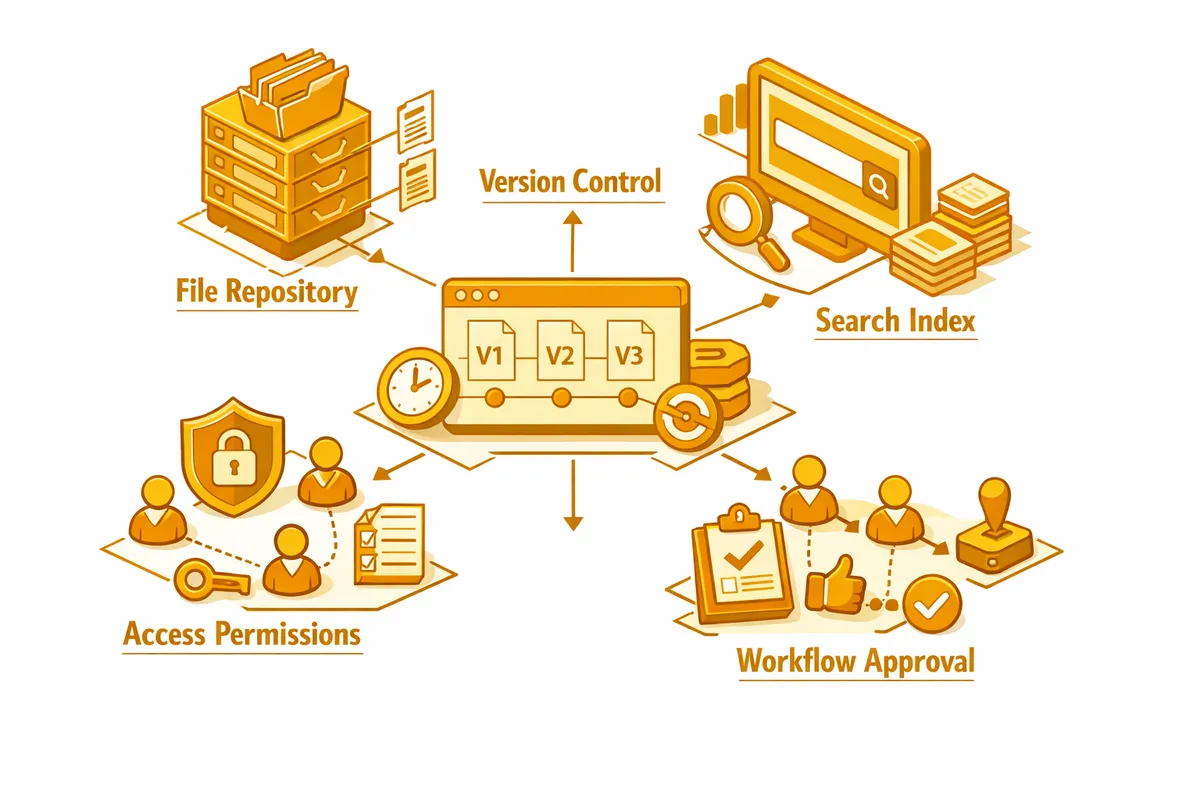
How We Build Document Management for Bronzeville
The design process starts with a document inventory. We work with your team to identify every document type your organization creates and receives, map how each is currently stored, and identify where the friction points are. For a financial advisory on 35th Street, that might surface six different places where client documents are stored across three tools, with no consistent naming convention and no version control. For a nonprofit, it might reveal that grant documentation lives in individual staff members' drives rather than a shared organizational repository.
From the inventory we design a file taxonomy: the folder structure, naming conventions, and metadata standards that will apply to every document type. We do not impose a generic structure. We design one that reflects how your organization actually works and how people naturally search for information. The taxonomy is the most important part of the system because a poorly designed structure will be abandoned for informal workarounds within months.
Implementation uses your existing platform where possible: Microsoft SharePoint, Google Workspace, Box, or Dropbox can all serve as the underlying storage infrastructure if properly configured. Where those tools have limitations, we supplement with purpose-built document management software. We configure the permissions architecture so sensitive documents are accessible only to authorized personnel, implement version control so previous drafts are never lost but the current version is always clear, and set up search indexing so any document in the system can be found by keyword, date, author, or metadata tag.
Automated document routing is often the highest-value addition: new client contracts route to the right folder automatically based on client name, project documents archive on engagement close, and grant documentation moves through review stages with version tracking. These workflows eliminate the manual filing that most organizations do inconsistently.
Industries We Serve in Bronzeville
Consulting firms on King Drive generate contracts, deliverables, and correspondence across dozens of active engagements simultaneously. A document management system organized by client and engagement type ensures that the right materials are accessible during every client interaction, that deliverable versions are controlled so clients always receive the current version, and that closed engagements archive cleanly for reference and compliance purposes.
The financial advisory and tax practices along 35th Street operate in a regulatory environment where document retention, access control, and audit trails are not optional. Client tax returns, account statements, signed disclosures, and correspondence must be retained for specific periods, stored securely, and accessible for regulatory review. A document management system built to these requirements protects the firm and satisfies its compliance obligations.
Cultural nonprofits near the DuSable Black History Museum manage grant documentation across multiple funders with different requirements for record retention and reporting. A system that organizes grant files by funder and award year, tracks document completeness against submission requirements, and archives finalized reports ensures that every funder's documentation requirements are met and that historical grant records are available for reference in future applications.
Small publishers on Indiana Avenue manage submission files, contracts, manuscript drafts, editorial correspondence, and production files for multiple titles simultaneously. Version control is particularly critical in publishing: the difference between an accepted manuscript and a revised final draft needs to be explicit and irreversible. Document management systems designed for editorial workflows enforce that discipline automatically.
Barbershops and personal care businesses on Cottage Grove Avenue that have grown to multiple chairs or locations need employee documentation, licensing records, client consent forms, and purchase records organized in a way that supports both daily operations and compliance with state licensing requirements.
Community development organizations near the Victory Monument maintain case files for community members receiving services, legal documentation, program records, and institutional history that spans decades. Document management for these organizations requires both rigorous access controls to protect client privacy and robust search capability so case workers can find relevant precedent and documentation quickly during service delivery.
What to Expect Working With Us
1. Document inventory and pain point mapping. We conduct a thorough inventory of every document type your organization handles, map current storage locations, and identify the specific situations where poor document management has cost time, created risk, or affected quality. This session shapes the entire design of the system.
2. Taxonomy design and approval. We draft a folder structure, naming convention, and metadata framework specific to your organization's needs and present it for your team's review and approval before implementation. Changes at this stage are far less costly than changes after a full deployment.
3. Platform configuration and automation setup. We configure your chosen document platform with the approved taxonomy, implement permissions and access controls, set up version control, and build automated routing workflows for the highest-volume document types. We migrate existing documents from your current storage locations and apply the new taxonomy during migration.
4. Training and adoption reinforcement. Document management systems fail when people revert to storing files where it is easiest rather than where it is correct. We train every user on the system, document the taxonomy in a reference guide your team can consult, and check in at thirty and ninety days to address any adoption gaps before they calcify into habits.