How We Build Business Intelligence for Bronzeville
Building BI for Bronzeville begins with the specific strategic context of each organization. A Bronzeville consulting firm is not the same as a Loop consulting firm: the client mix, the competitive landscape, and the community accountability structures are different. We start every engagement by understanding the owner or executive director's actual decision context before designing anything.
The discovery process involves structured interviews with the people who will use the dashboards: the principal of a consulting firm, the executive director of a cultural nonprofit, the owner of a Black-owned financial services practice. We document the decisions they make quarterly, the data they currently rely on, and the questions they cannot answer with existing information. That gap analysis defines what we build.
For Bronzeville businesses with established accounting systems and CRM tools, data pipeline design connects those systems into a unified analytics layer. For organizations still running operations from spreadsheets and manual reports, we design a lightweight data collection infrastructure before layering dashboards on top. Building dashboards on inconsistent data produces consistently wrong answers, and we address data quality during the design phase rather than after the build.
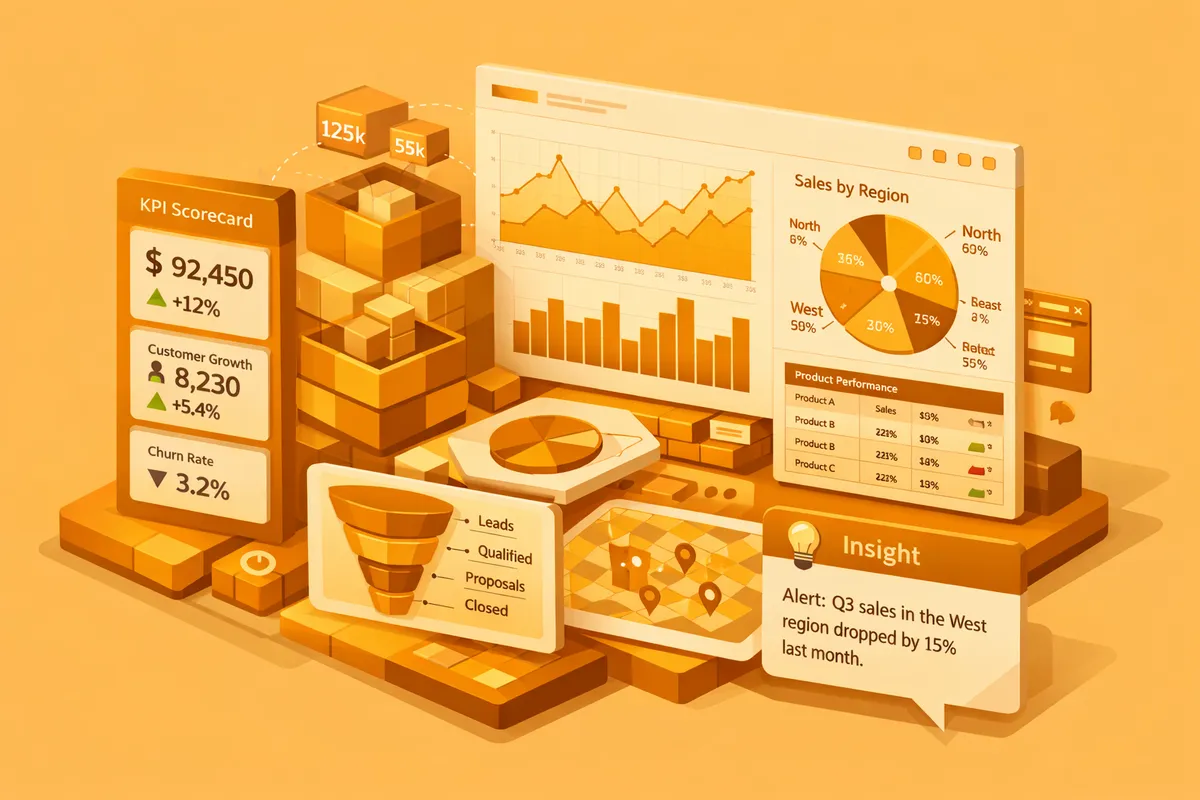
Dashboard design for Bronzeville organizations prioritizes the metrics that drive strategic decisions: revenue mix, client retention, programmatic impact, and cost efficiency. We build for the executive who needs a five-minute morning review of organizational health, not a data analyst who lives in reports. Every element on every dashboard must answer a real question that a real decision-maker in Bronzeville is asking.
Industries We Serve in Bronzeville
Black-owned consulting firms along King Drive and Michigan Avenue use BI to track proposal pipeline by agency and contract type, project margin by engagement, client retention rates, and revenue concentration risk. When a consulting principal can see that two clients account for seventy percent of revenue and the proposal win rate for federal contracts is double the state contract win rate, strategy adjusts with evidence rather than intuition.
Financial services and wealth management practices serving the Bronzeville community build BI around client acquisition costs by referral source, AUM trends by client segment, fee revenue by service type, and retention analysis by client tenure. The Supreme Life Building tradition of Black-owned financial services in Bronzeville is well worth continuing with modern analytical infrastructure.
Cultural nonprofits and arts organizations near the DuSable Black History Museum and the Bronzeville Walk of Fame track grant revenue by funder, programmatic attendance, membership cohort retention, event revenue by format, and donor lifetime value. BI makes annual reports faster to produce and more compelling to funders because the data is organized and consistent rather than assembled manually before each deadline.
Black-owned restaurants and food businesses along 35th Street and Cottage Grove Avenue use BI to analyze revenue by daypart, customer frequency, catering versus dine-in margins, and labor cost ratios. For a restaurant owner building both a dining room and a catering operation, BI shows which channel is growing and which is profitable, supporting investment decisions about staffing and equipment.
Small publishers and media organizations with ties to the Chicago Bee Building's legacy of independent Black media in Bronzeville track circulation or audience metrics, advertising revenue by category, content performance, and subscriber retention. Whether the platform is print, digital, or events, BI consolidates those revenue streams into a single view that supports editorial and business decisions.
Barbershops, salons, and personal care businesses in Bronzeville use BI to track service revenue by category, stylist productivity, appointment retention rates, and retail product performance. For a salon owner managing a team of stylists and a retail operation, BI surfaces which services and which team members drive the most profitable client relationships.
What to Expect Working With Us
1. Strategic discovery with the owner or executive director. We begin with a structured conversation about the decisions that shape your organization's direction: how you price, how you allocate resources, how you evaluate programmatic or operational performance. For Bronzeville organizations, this conversation often surfaces three to five analytical gaps that have real strategic consequences. That gap list becomes the BI roadmap.
2. Data source audit and pipeline design. We map every system that holds relevant data, from accounting software to CRM to grant management platforms, and design the extraction and transformation pipeline. For organizations running on manual processes, we design a lightweight data collection infrastructure first. Data quality is a prerequisite, not an afterthought.
3. Dashboard builds with user review at each milestone. We build in short cycles and present working dashboards to the intended users at each milestone. The test for every dashboard is whether the people who will use it can read it in under five minutes and take action on what they see. If the dashboard requires explanation to interpret, it needs redesign.
4. Training and organizational ownership. We train your team to use the dashboards we build, to add new metrics as the organization evolves, and to interpret the data correctly. The goal is that your Bronzeville organization becomes analytically self-sufficient, capable of answering new questions with the infrastructure we build together, not dependent on external support for every analysis.