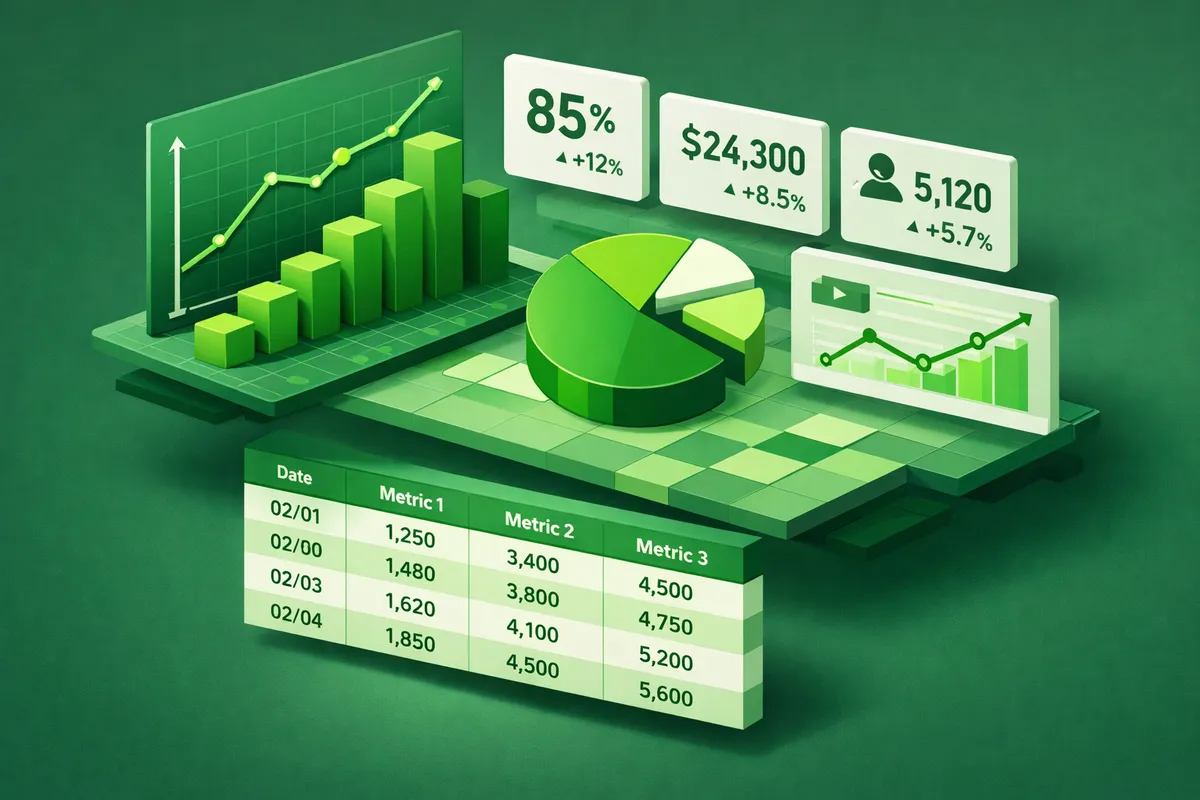
How We Build Analytics and Reporting for Bronzeville
The process begins with an outcomes conversation rather than a tools inventory. We ask what decisions you make each month, what questions your clients or funders regularly ask, and where you currently spend time assembling information you should be able to read from a dashboard. A financial advisory on King Drive might need client portfolio performance, referral source tracking, and revenue by service line. A cultural nonprofit near the DuSable Museum might need program participation metrics, grant expense adherence, and outreach campaign performance. These are different reporting architectures built on the same underlying infrastructure.
We connect your data sources: your CRM, your financial system, your email and social platforms, your program management tools. Every source feeds into a unified reporting layer that updates automatically. No exports. No copy-paste. No waiting until someone has time to run the monthly report. The data is current whenever you open the dashboard.
Dashboard design matters as much as data accuracy. We build views calibrated to each audience: an executive summary for leadership that shows the three numbers that drive every strategic decision, a program detail view for staff running day-to-day operations, and a client-facing report format that presents your performance narrative without exposing internal operational details. Every view generates on schedule or on demand without manual assembly.
We spend time at the end of every engagement walking through how to read the reports, how to identify anomalies, and how to update the system when your data sources change. A nonprofit that adds a new program in year two should not need to hire a consultant to add a new dashboard panel.
We also design for Bronzeville's reporting calendar specifically. The Bud Billiken Parade in August brings a concentrated surge of community activity and donation inquiries for nonprofits along King Drive. Bronzeville Art District events in fall generate a predictable spike in engagement metrics for cultural organizations. Reporting systems built for this neighborhood include those seasonal patterns so you can benchmark August against previous Augusts, not against February. Contextual comparisons produce better decisions than raw numbers without context.
Industries We Serve in Bronzeville
Consulting firms competing for contracts along King Drive's professional corridor use analytics dashboards to track project delivery metrics, client satisfaction scores, and revenue pipeline in real time. When a competing firm walks into a pitch with slides, the consultant who walks in with a live dashboard showing measured outcomes from current clients wins that conversation.
Cultural nonprofits near the DuSable Black History Museum and the Supreme Life Building manage program reporting across multiple funders simultaneously. Automated reporting systems generate funder-specific output from a single data source, reducing the assembly time from weeks to minutes and ensuring that program staff are not pulled from service delivery to compile statistics.
35th Street's concentration of financial services and wealth management practices generates client reporting obligations that are time-consuming to fulfill manually. Automated performance reporting, account summary generation, and portfolio attribution analysis deliver the documentation advisors need to fulfill fiduciary communications requirements without rebuilding reports from scratch each quarter.
Small publishers and independent media companies on Indiana Avenue track a mix of sales, royalties, website traffic, and social audience metrics that do not consolidate naturally across platforms. A unified analytics dashboard surfaces the revenue and engagement trends that inform acquisition decisions, marketing investment, and print-run planning.
Salons and personal care businesses on Cottage Grove Avenue use analytics reporting to track client retention, average ticket size, service mix, and appointment booking patterns. These metrics directly inform staffing decisions and promotional strategy, and they are nearly impossible to extract accurately from a POS system without a dedicated reporting layer.
Civic organizations and community development entities anchored near the Victory Monument work in environments where outcomes measurement is both a funder requirement and a community accountability standard. Analytics systems that track program participation, neighborhood economic indicators, and service delivery metrics give these organizations the evidence base to justify continued investment and advocate for community resources.
What to Expect Working With Us
1. Outcomes mapping session. Before we touch a single tool or data source, we map the decisions you make, the questions you answer, and the reports you currently produce manually. This session produces a reporting architecture blueprint specific to your business and your audiences.
2. Data source connection and validation. We connect every relevant data source, validate that the data flowing in is accurate and complete, and document the logic behind every calculated metric. For Bronzeville nonprofits with complex program data, this step includes working with your program team to define outcome measurements before they are automated.
3. Dashboard build and audience calibration. We build every dashboard view to match its audience: leadership, staff, clients, and funders each see what they need without navigating through irrelevant data. February funder report deadlines, quarterly board meetings, and annual audit cycles all get scheduled reporting automation built in.
4. Handoff and self-service training. We train your team to read the dashboards, interpret anomalies, and request changes as your reporting needs evolve. The system is yours to operate, and we document everything so new staff can come up to speed without external support.