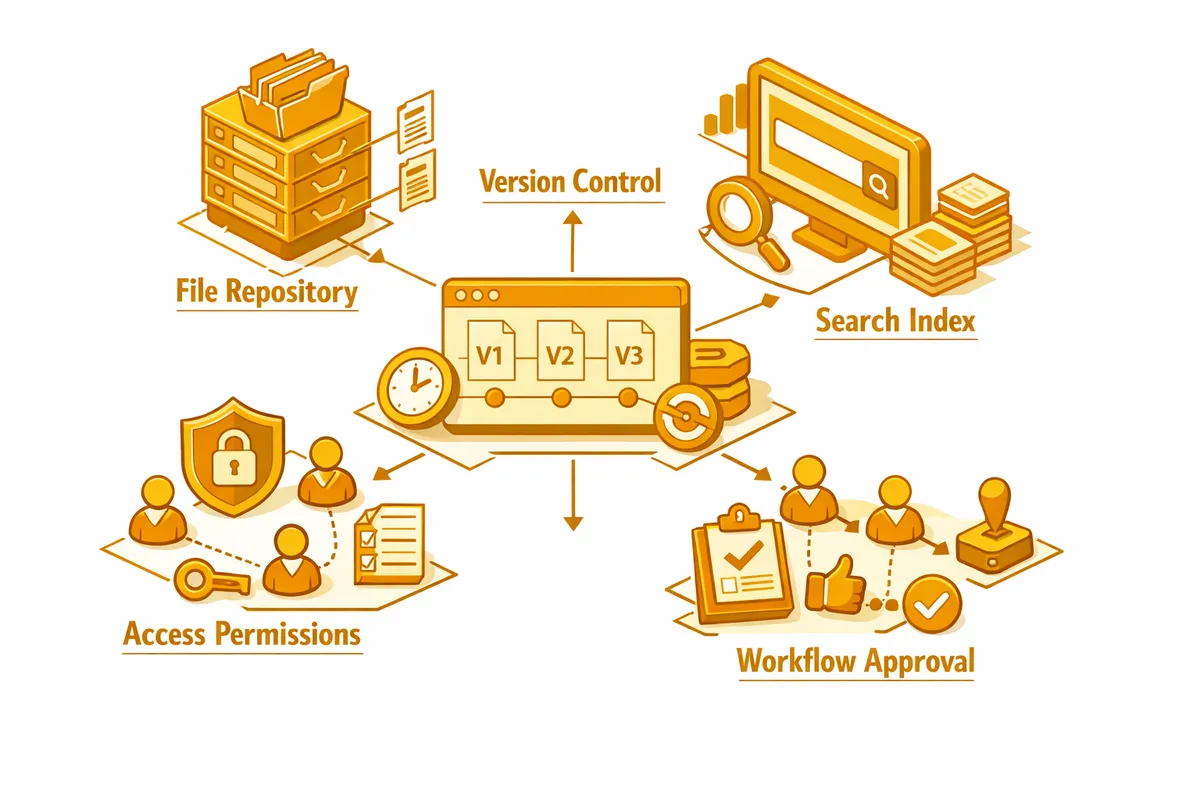
How We Build Document Management for Bridgeport
Document management implementation starts with an inventory of what you actually have. For most Bridgeport businesses, this reveals three categories: documents that are already digital but scattered across email, local drives, and cloud folders with inconsistent naming; documents that are paper and have never been scanned; and documents that exist somewhere but nobody is sure where. Each category needs a different treatment.
For contractors and trades businesses on Morgan Street and across Bridgeport's job sites, we build folder structures and naming conventions around the way jobs actually flow: client, project, phase, document type. Every document goes into a folder path that anyone on the team can reconstruct from memory. We connect the document management system to whatever project management or job cost tool the contractor already uses so documents are accessible from within the existing workflow, not through a separate application.
For trucking and freight companies on Archer Avenue, we set up the regulatory document calendar first. Every license, certification, and permit that requires renewal gets an entry with renewal date and responsible owner. The system sends reminders at thirty, fourteen, and seven days before expiration. No one discovers a lapsed certification because they were too busy running loads to track the calendar.
For family restaurants and bars near Guaranteed Rate Field, the document challenge is not just regulatory compliance. It is also vendor relationship history. A bar that has worked with the same food distributor for fifteen years has purchase agreements, pricing letters, and promotional arrangements spread across years of email. Consolidating that history into a document system organized by vendor means the owner can reference the original pricing agreement without digging through a decade of inbox. That context is valuable during supplier negotiations and even more valuable during disputes.
The Richard J. Daley Library branch on 35th Street sits at the civic center of Bridgeport's daily life. Small businesses that work with city agencies, apply for grants, or manage public contracts benefit from document systems that preserve the full paper trail of those relationships. A contractor bidding on City of Chicago projects needs their insurance certificates, bonding documents, and license records organized and instantly accessible for the application process. Missing one document at submission time means starting over.
Training takes half a day for most Bridgeport businesses. The goal is that every person who needs to file or find a document can do both without asking anyone else. We do the training at your location, working through real documents from your own files.
Industries We Serve in Bridgeport
General contractors and specialty tradespeople filing permits through the City of Chicago build document libraries organized by project and permit type. Every inspection record, every signed change order, and every lien waiver lives in a searchable folder tied to the job. When a dispute arises months after project close, the full documentation trail is available in minutes, not days.
Trucking and logistics companies on the Archer Avenue corridor manage driver qualification files, vehicle maintenance records, carrier agreements, and insurance certificates through a compliance-first document system. Renewal alerts ensure that no driver's CDL medical certificate expires unnoticed and no vehicle registration lapses during a busy freight cycle.
Family-owned restaurants and bars near Guaranteed Rate Field maintain their licensing portfolio, health inspection reports, and vendor agreements in a single system. When the city inspector arrives before a home opener, the operator can produce any requested document immediately from a tablet rather than searching through a drawer behind the bar.
Butcher shops and food processors on Halsted Street manage USDA compliance documentation, temperature logs, supplier certifications, and food safety records that must be production-ready for regulatory review. A document management system built around food safety requirements ensures every audit is a formality rather than a scramble.
Art galleries and event spaces in the Zhou B Art Center community maintain artist contracts, exhibition agreements, insurance certificates, and installation documentation through a system organized by show and artist. When a piece sells, the provenance documentation and consignment agreement are retrievable in seconds for the collector.
Small property management firms holding residential and commercial property across Bridgeport's 31st to 35th Street corridors maintain lease files, maintenance records, inspection reports, and tenant communication archives through a property-organized document system that survives staff turnover because the structure is built into the system, not into a single employee's filing habits.
What to Expect Working With Us
1. Document audit and taxonomy design. Before we set up any software, we catalog your current document types and build the folder structure and naming conventions you will use going forward. A taxonomy that fits your business means you can find any document without searching.
2. Digitization of existing paper records. For Bridgeport businesses with years of paper files, we coordinate a scanning sprint to capture historical documents and enter them into the new system. We prioritize active contracts, permits, and compliance records first, archives second.
3. Integration with tools you already use. The document system connects to your email so attachments are captured automatically. It connects to your project management or accounting software where APIs allow. The goal is that filing a document requires no extra steps beyond the work you were already doing.
4. Compliance calendar setup. Every expiring document, license, permit, and certification gets loaded into the renewal calendar before we close the engagement. The first time a renewal alert fires, you will understand why this was worth doing.
The compliance calendar step is particularly consequential for Bridgeport's trades and logistics businesses, where the regulatory stack is thick and the renewal cycles do not align neatly with the business calendar. A contractor's general liability certificate, their City of Chicago license, their workers' compensation coverage, and their individual trade certifications all expire on different dates. A trucking company's DOT registration, FMCSA authority, IFTA fuel tax license, and individual driver qualifications have renewal timelines that span the calendar year. When those dates are scattered across email, file folders, and memory, something expires. When they are all in one calendar with automated alerts, they do not.