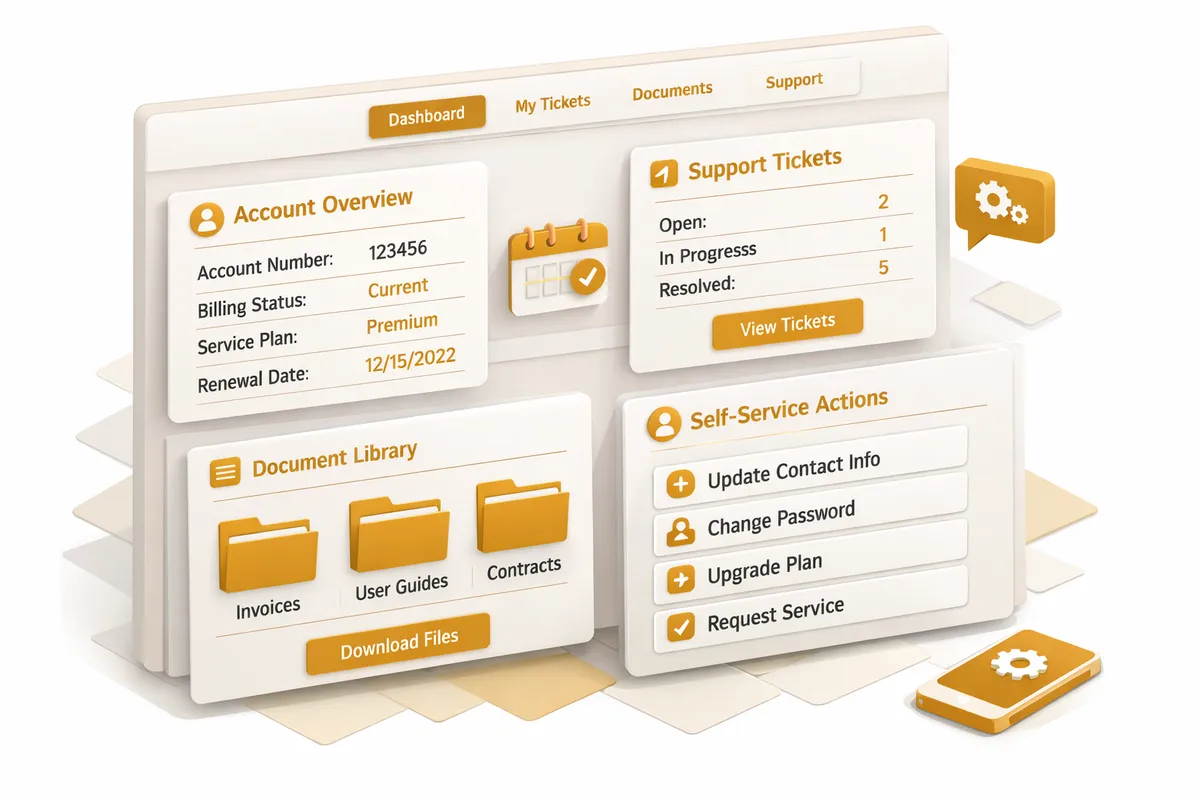
How We Build Customer Portals for Bridgeport
We start with the most common reason your customers contact you. For most Bridgeport contractors, that is a job status check. For most food businesses on Halsted Street, it is order placement and invoice retrieval. For service companies along Archer Avenue, it is appointment scheduling and service history. We design the portal around those high-frequency interactions first. Everything else is secondary.
Authentication matters more than most businesses expect at the start. Your customer portal connects to real operational data. Who sees what, and how securely, shapes the entire architecture. We build customer-level access controls that let each client see only their own projects, orders, and invoices, nothing more. For contractors with multiple job sites for a single client, the portal can group by project or by property with a clean navigation structure the client can use without training.
After launch, we give you analytics on portal usage: how many customers logged in, what they looked at, what they tried to do and could not complete. That data tells us where to invest in the next phase. A portal where sixty percent of visits end on the invoice page without downloading tells us the invoice download flow needs work. A portal where customers repeatedly search for something that is not there tells us what feature to add next.
Industries We Serve in Bridgeport
Contractors and specialty trades working from Morgan Street and across the South Side residential blocks use customer portals to let clients track project progress in real time. Daily photo uploads from the job site, schedule updates, and change order approvals all flow through the portal rather than through phone calls. The client feels informed. The contractor stays on the job.
Wholesale meat and specialty food businesses on Halsted Street serve restaurant clients throughout Chicago. A customer portal lets those restaurant buyers submit standing orders, adjust quantities before a weekly cutoff, track delivery status, and download invoices without calling the office. The portal also reduces order errors because the customer is entering their own order rather than describing it to someone who writes it down.
Trucking and freight companies on the Archer Avenue corridor give their shipper clients a shipment tracking and document retrieval portal. Proof of delivery documents, invoices, and freight bills are available the moment the driver submits the delivery confirmation. The shipper's accounts payable team can process the invoice the same day rather than waiting for paperwork to arrive by mail.
Restaurants and bars near Guaranteed Rate Field that manage regular group and event clients build customer portals for event booking inquiries, deposit tracking, and menu selection. A corporate client who books the private dining room six times a year can log in, view their event history, and submit a new request without calling the manager during service.
Art galleries and creative spaces connected to the Zhou B Art Center neighborhood use portals for collector relationships. Past buyers can log in to view available works, track pieces they have expressed interest in, and receive early access to new show announcements through a private area of the portal before public listings.
Property management companies with residential and commercial holdings across Bridgeport give tenants a portal for rent payment, maintenance request submission, and lease document access. Landlords reduce the number of phone calls they field without reducing service quality. Tenants get responses on requests faster because requests route directly to the right vendor rather than sitting in a manager's inbox.
What to Expect Working With Us
1. Use-case prioritization before design. We interview you and, where possible, a few of your best customers to understand what they actually need from a self-service tool. The portal we build reflects real customer behavior, not our assumptions about it.
2. Design that fits Bridgeport's customer base. Bridgeport customers are practical. They are not looking for a beautiful portal. They are looking for a fast, reliable one. We design for clarity and speed, not aesthetics. The portal looks professional and works on a phone, which is how most customers will access it.
3. Data integration with your existing systems. The portal pulls live data from wherever your information lives: your project management tool, your accounting software, your order management system. We connect those systems so the portal always shows current information without anyone manually updating it.
4. Launch with your ten best customers first. We do a soft launch with a small group of your most engaged clients. Their feedback shapes the final version before full rollout. This also means you have champions who already understand the portal when you ask the rest of your customers to use it.