How We Build Business Intelligence for Bridgeport
Building BI for Bridgeport businesses begins with a direct conversation about how the operator actually makes decisions. A family restaurant owner on Halsted Street is not thinking about data architecture; she is thinking about whether to hire another cook for the weekend rush and whether the new menu item she added last month is pulling its weight. Those are the questions that shape what we build.
We start by documenting the operational decisions each client makes regularly and identifying what information would make each decision better. For a contractor on Archer Avenue, that might mean job cost tracking by trade type and customer category, with a view that shows estimated versus actual margin for every project closed in the past twelve months. For a bar near Guaranteed Rate Field, that might mean daily revenue trending against the White Sox home game schedule, so the owner can staff and stock accurately for each series.
Data source mapping comes next. Bridgeport businesses typically run on point-of-sale systems, basic accounting software, and spreadsheets. We connect those sources into a unified analytics layer and build the transformation logic that turns raw transaction data into useful business metrics. For businesses with simpler systems, we establish consistent data collection habits before building the dashboard layer. A dashboard built on inconsistent or incomplete data misleads rather than informs.
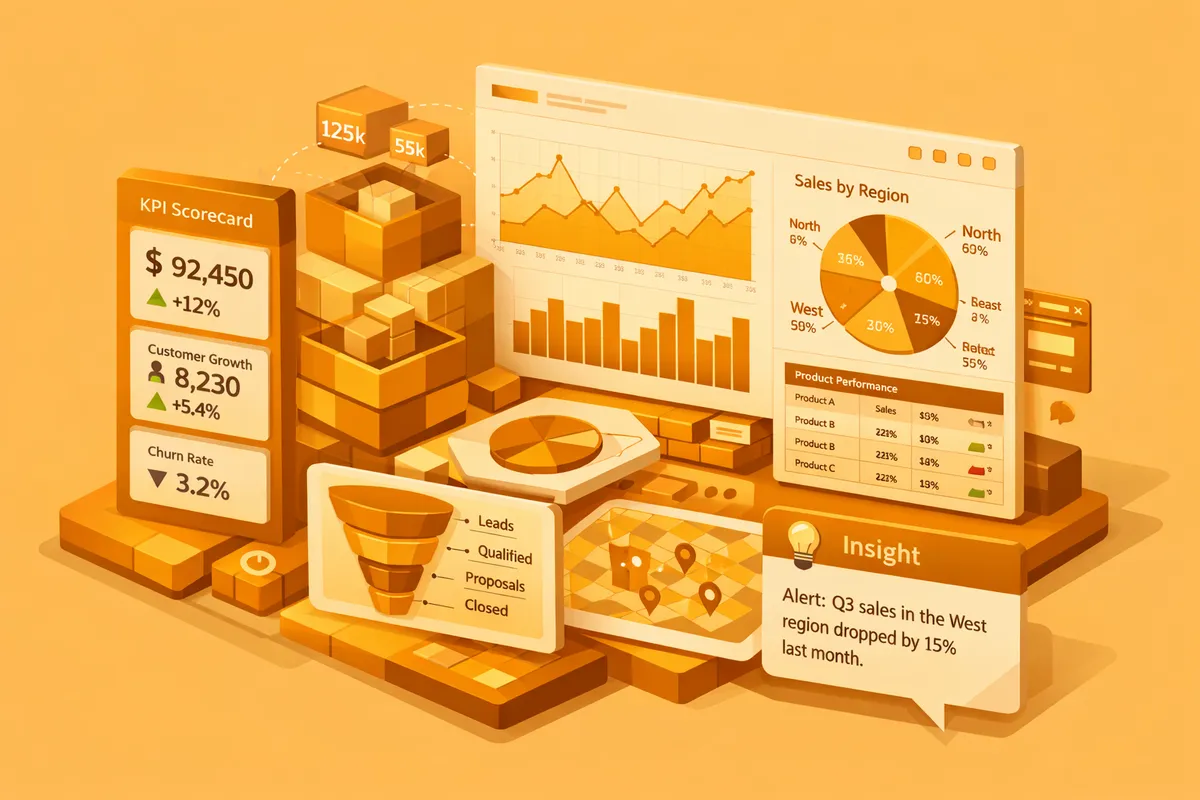
Dashboard design for Bridgeport prioritizes simplicity and daily use. Operators here are not sitting at a desk reviewing analytics; they are on job sites, in kitchens, behind bars. We build mobile-accessible dashboards with the two or three metrics that matter most for each role, surfaced in a way that takes thirty seconds to read and immediately tells the operator what needs attention.
Industries We Serve in Bridgeport
Family restaurants along Halsted Street use BI to track revenue by menu category, shift performance, food cost percentage, and labor efficiency. When a restaurant owner can see that the weekend brunch service has the highest revenue per labor hour of any daypart, and that three menu items account for forty percent of margin but less than twenty percent of orders, she can staff and price accordingly.
Contractors and construction companies operating near Archer Avenue build BI around job cost tracking, labor utilization, and bid-to-win ratio by project type. When a contractor has twelve months of actual job cost data organized by trade and customer category, he can bid the next similar project with precision rather than guesswork, and catch cost overruns in real time rather than at project close.
Trucking and logistics companies near Morgan Street use BI to analyze route profitability, fuel cost per mile by lane, customer revenue concentration, and driver utilization. A fleet operator who can see that two of his eight customers account for sixty percent of revenue and one of his highest-volume lanes is his least profitable after costs can make immediate decisions about pricing and customer mix.
Art galleries and event venues near the Zhou B Art Center on 35th Street track admission revenue, exhibition performance, event attendance, and ancillary revenue by programming type. When a gallery director can see that community events drive membership conversion at three times the rate of ticketed exhibitions, programming decisions shift accordingly.
Bars and neighborhood taverns near Guaranteed Rate Field use BI to analyze revenue by day of week, game-day versus non-game-day patterns, and product category performance. Knowing that certain White Sox series generate significantly higher revenue than others allows bar owners to staff and order inventory with more precision than a gut-feel schedule allows.
Small manufacturers and auto body shops along the Chicago River industrial corridor track job throughput, material cost per job type, and technician productivity. For an auto body shop competing on turnaround time and quality, BI that surfaces cycle time by repair category and technician helps identify where process improvements deliver the most value.
What to Expect Working With Us
1. Discovery conversation with the owner or operator. We begin with a direct conversation about the decisions you make weekly and monthly, the information you rely on now, and the questions you cannot answer with what you have. For most Bridgeport businesses, this takes ninety minutes and produces a clear picture of the two or three BI problems most worth solving first.
2. Data source inventory and connection plan. We identify every system that holds relevant data: POS, accounting software, job management tools, spreadsheets. We assess data quality and consistency, flag gaps, and design the connection and transformation approach. For businesses with simpler systems, we may recommend establishing cleaner data collection habits before building dashboards.
3. Dashboard builds with owner review at each stage. We build in short cycles and review working dashboards with you before adding complexity. The goal is a dashboard that you actually open every morning, not a technically impressive build that sits unused because it does not match how you run the business.
4. Training and ongoing ownership. We train you and any key team members to read and act on the dashboards we build, and to add new metrics as the business changes. The goal is that you own your analytics, not that you depend on us for every question. When your Bridgeport operation evolves, your BI should evolve with it.