How We Build AI Integration Services for Bridgeport
Our process begins with a detailed audit of every system your Bridgeport business currently uses. We map the software tools, identify the manual handoffs where data moves between people instead of between systems, and document where those handoffs create delays, errors, or information loss. For a restaurant on Halsted Street, that audit typically reveals that the POS system, inventory app, and accounting software are three separate islands that communicate only when a staff member manually exports and re-imports data. For a gallery near Morgan Street, the audit reveals that new acquisitions require four separate manual updates across catalog, website, email list, and social scheduler. For a contractor, it reveals that field crews text updates to the office, where someone transcribes them into a job tracking spreadsheet.
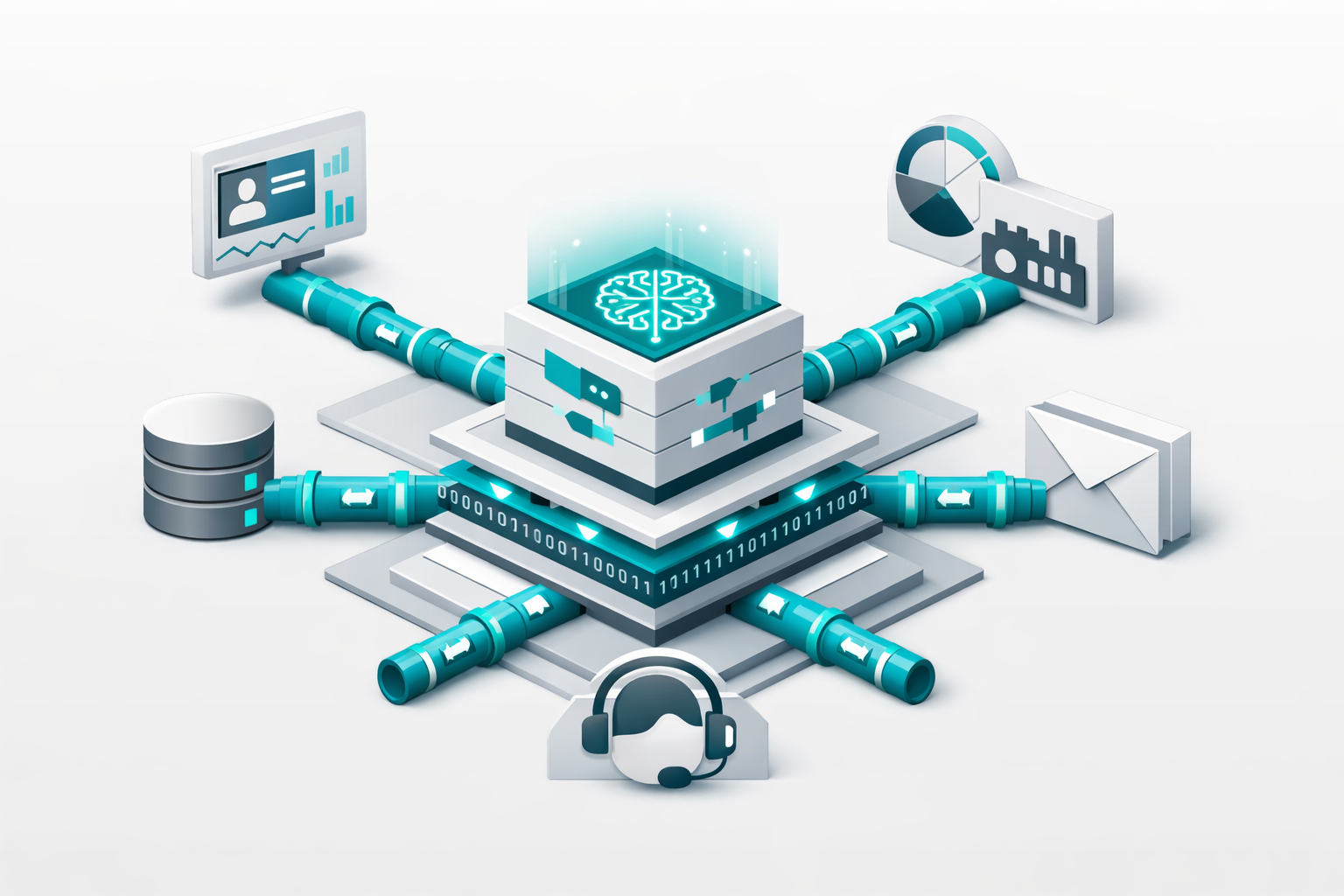
We then design the integration architecture that connects those islands. The integration works as middleware sitting between your existing systems, continuously receiving data from source systems and routing it to the right destinations with intelligent transformation. The goal is to preserve the tools your team already knows while eliminating the manual work of moving data between them.
For a Bridgeport restaurant, this might mean a POS-to-accounting integration that posts every sale automatically with proper category tagging, a POS-to-inventory integration that deducts ingredients from stock with each order, and a customer data integration that feeds purchase history into email marketing segments. For a gallery, it might mean an acquisition workflow that posts new pieces to the website catalog, generates social media content, and segments the collector email list by interest area automatically when a curator enters a new work. For a contractor, it might mean a field note integration that captures crew time entries on mobile devices and posts them directly to job cost tracking and payroll preparation.
Integration design includes business logic, not just data copying. A Bridgeport restaurant's integration might flag when a menu item's food cost exceeds the target margin. A gallery's integration might notify the curator when a collector who previously purchased similar work is visiting the website. A contractor's integration might alert the project manager when actual hours on a job exceed estimated hours by ten percent. The intelligence that turns data flow into business insight is part of what we build.
Industries We Serve in Bridgeport
Restaurants and food service businesses along Halsted Street and 31st Street connect point-of-sale, inventory, supplier ordering, and accounting systems so owners see which menu items drive profit, adjust purchasing automatically when stock runs low, and reconcile daily sales with bookkeeping without manual data entry.
Art galleries and cultural institutions in the Zhou B Art Center and throughout Bridgeport integrate artwork catalogs with email platforms, social media scheduling, and website content management so new acquisitions reach collectors automatically through every channel without duplicated manual effort.
Contractors and construction management firms connect field service apps, crew time tracking, material inventory, and project accounting so project managers see real-time labor and material costs, catch scope creep as it happens, and enter month-end reconciliation already complete rather than starting from scattered records.
Butchers, bakeries, and specialty food retailers serving Bridgeport's multi-ethnic community integrate inventory management with supplier ordering and financial reporting so product categories that sell well automatically trigger reorders, slow movers are flagged for review, and cost of goods is calculated without manual counts.
Trucking and logistics companies operating from Bridgeport's industrial corridor connect dispatch systems, driver mobile apps, customer invoicing, and maintenance tracking so every delivery is billed accurately, maintenance is scheduled before breakdowns occur, and route profitability is visible to management rather than estimated.
Community nonprofits and cultural organizations serving Bridgeport integrate donor databases with email campaigns, event registration platforms, and financial reporting so donor stewardship is automated, event attendance feeds back into contact records, and fundraising outcomes are visible without manual volunteer data entry.
What to Expect Working With Us
1. Technology audit and integration roadmap. We document every system your Bridgeport business uses, map the manual handoffs between them, and present a prioritized roadmap identifying which integrations will have the greatest impact on your operations and in what sequence to build them for maximum momentum.
2. Custom integration layer design. We design middleware architecture connecting your existing systems with minimal disruption to current workflows. The integration is built to be resilient: if one system is temporarily unavailable, data queues and syncs automatically when service resumes. No data is lost and no manual cleanup is required.
3. Development, testing, and parallel operation. We build integration connections, test them with real business data, and run a parallel period where both manual and automated processes operate simultaneously so you can verify the integration is capturing data correctly before cutting over fully.
4. Training and ongoing optimization. We train your team to monitor integration health, recognize when something is not flowing correctly, and adjust integration logic as your business evolves. We provide ongoing support to refine connections when you add new systems or change business processes.