How We Build POS Solutions for Beverly
POS selection for Beverly businesses starts with operational requirements, not brand preference. A neighborhood restaurant near Horse Thief Hollow with table service, a bar component, and a late-night menu has fundamentally different operational requirements than a specialty retailer on Western Avenue with variable inventory and a mix of in-store and online sales. Toast and Revel make sense for restaurant environments. Shopify POS and Lightspeed are better suited to retail. Square works well for service businesses and simpler retail operations. We match the platform to the business, then build the configuration that makes it work for the specific Beverly operation.
Configuration is where most POS implementations go wrong. The default settings on any POS platform are designed for a generic business, not a Beverly neighborhood restaurant with forty-three modifiers in its ordering system or a boutique retailer with multiple pricing tiers, vendor-specific inventory tracking, and custom gift wrapping charges. We configure the system from scratch against the actual menu, inventory, and operational workflows of the Beverly business, then test every function before a single customer touches the terminal.
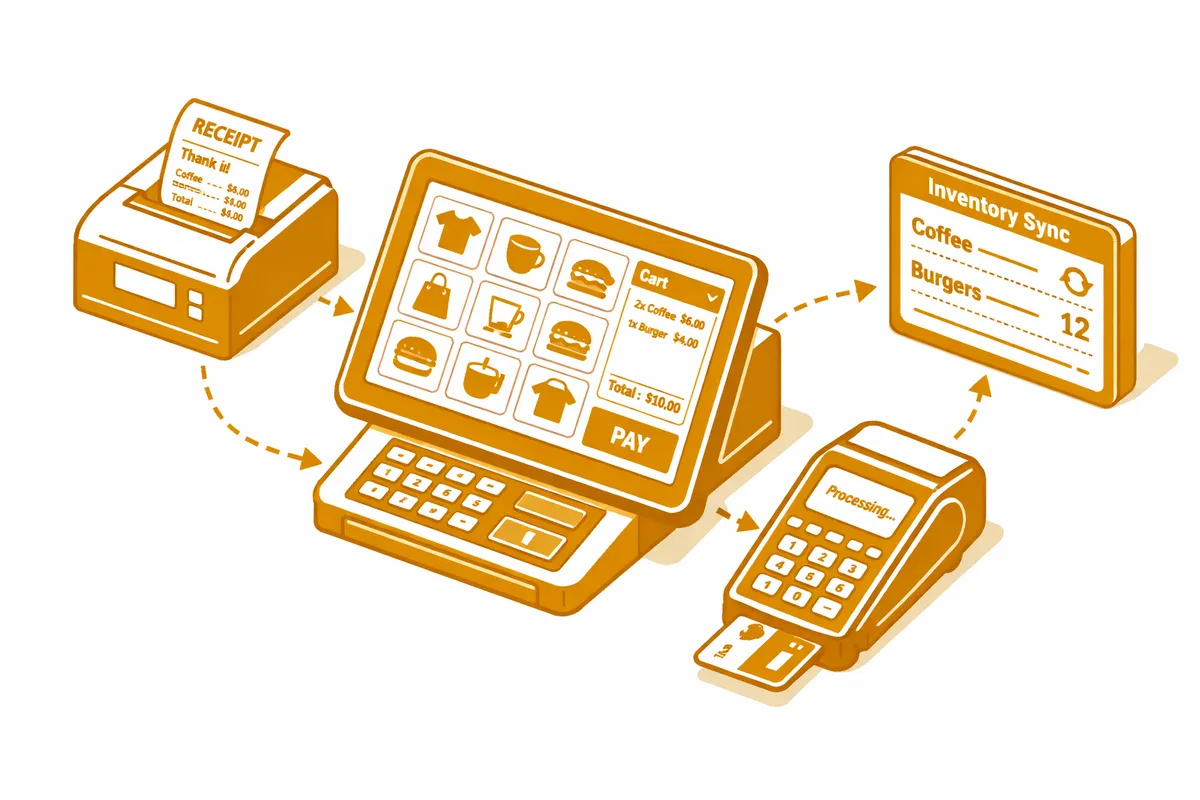
Integration with the tools that surround the POS is the work that most POS vendors underdeliver on. Accounting integration with QuickBooks or similar platforms should be automatic, not a weekly export-and-import exercise. Payroll data export should connect to the scheduling and HR system without manual entry. Online ordering should consolidate into the same reporting view as in-person sales. We manage the integration layer so that the POS operates as the central operational system, not an isolated transaction recorder.
Staff training is built into every engagement. Beverly neighborhood restaurants and retailers have varying levels of staff technology comfort, and a POS system that confuses servers or creates checkout friction for retail staff is worse than the one it replaced, regardless of how good it is on paper. We train with the specific menu, inventory, and workflow of the Beverly business, not with generic demo data.
Industries We Serve in Beverly
Neighborhood restaurants and bars along 103rd Street and near Horse Thief Hollow need POS systems that handle the full service cycle without friction: table management, bar tabs that can merge with a table check at close, modifier-heavy ordering for kitchens with customization-heavy menus, and end-of-night reporting that gives the manager a clear picture of sales, voids, and server performance. The Beverly dining community's preference for genuine neighborhood restaurants over chain alternatives means the operators here have invested in building real operations, and the POS needs to match that investment.
Specialty food retailers and provisioners along Western Avenue balance retail and special order sales with inventory complexity that generic retail POS systems handle poorly. A Beverly specialty food shop that sells both packaged goods and custom-assembled gift items needs a POS that handles both transaction types cleanly, tracks inventory by SKU and by component for assembled items, and integrates with ecommerce so that online and in-store inventory stays synchronized.
Boutique retail and gift shops near the Beverly Arts Center need POS systems with strong inventory management, customer purchase history for loyalty and gift tracking, and the ability to handle product variants (size, color, material) without the register screen becoming a maze. A boutique on Longwood Drive that participates in Beverly Arts Center events and holiday markets also needs mobile POS capability so sales can be processed at an off-site location without a separate system.
Service businesses, including salons, specialty wellness practices, and personal service operators near Wood Street and 95th Street, need POS systems that handle appointment-based payment, service-plus-retail transactions (a haircut plus a product purchase on a single receipt), and staff commission tracking that feeds accurately into payroll. These requirements are distinct from restaurant and retail POS, and choosing the right platform for a service-based Beverly business requires understanding that distinction.
CPA offices and professional services firms along 111th Street and 103rd Street that handle client payment in person benefit from modern POS infrastructure even without a retail component. A professional services POS that handles retainer collection, fee payment, and tax preparation billing via card-present transactions reduces the payment friction that checks and ACH transfers create for clients and eliminates the manual entry into billing software that card-on-file workarounds require.
Neighborhood event venues and community spaces adjacent to the Beverly Arts Center that host ticketed events, classes, and performances need POS systems capable of ticket scanning, merchandise sales, and concession processing in an environment where transaction volume spikes sharply for the duration of an event. Mobile POS configurations that can be deployed at the door, at a merchandise table, and at a concession stand during the Beverly Arts Center's programming schedule give venues the flexibility to staff events efficiently.
What to Expect Working With Us
1. Operations review and platform selection. We review your current POS setup (or lack of one), your transaction volume, your integration requirements, and your operational complexity before recommending a platform. A Beverly restaurant on 103rd Street has different POS needs than a Beverly boutique near the arts center, and we scope the platform to the operation rather than recommending the same solution to every Beverly business.
2. Configuration against your actual menu or inventory. We configure the POS with your real data: the full menu with all modifiers and pricing tiers for a restaurant, the complete inventory catalog with variants and pricing rules for a retailer. We do not hand over a system configured with demo data and a how-to guide. The POS is set up for your business from day one.
3. Integration setup and testing. We connect the POS to your accounting software, payroll system, online ordering platform, and any other tool in your operational stack that needs to exchange data with the register. Every integration is tested with real transaction data before going live. The goal is that the first week of real operation does not surface an integration gap that sends data to the wrong place or fails to send it at all.
4. Staff training and launch support. We train every staff role that will interact with the POS, using your actual menu and workflow. We are available for the first two weeks after launch for questions and quick adjustments. Beverly neighborhood businesses often encounter the first edge case, a menu modification that was not configured, a payment type that was not tested, during their second or third service after launch. We resolve those cases quickly so they do not become habits.