How We Build Legacy System Integration for Beverly
The first phase of every legacy integration engagement is a system inventory. We document every software platform the Beverly business uses, every database it relies on, every manual data transfer process that connects systems that do not talk automatically, and every spreadsheet that functions as an integration layer between two incompatible tools. The inventory reveals the full scope of the fragmentation and prioritizes which connections will produce the most immediate operational relief.
For a medical practice near Ridge Park, that inventory typically reveals three or four critical integration gaps: the scheduling system does not share patient data with the billing platform, the billing platform does not export to the accounting system, and the accounting system requires manual reconciliation with the practice's tax preparation workflow. Each of those gaps is a daily administrative friction point. Integrating them does not require replacing any of the underlying systems.
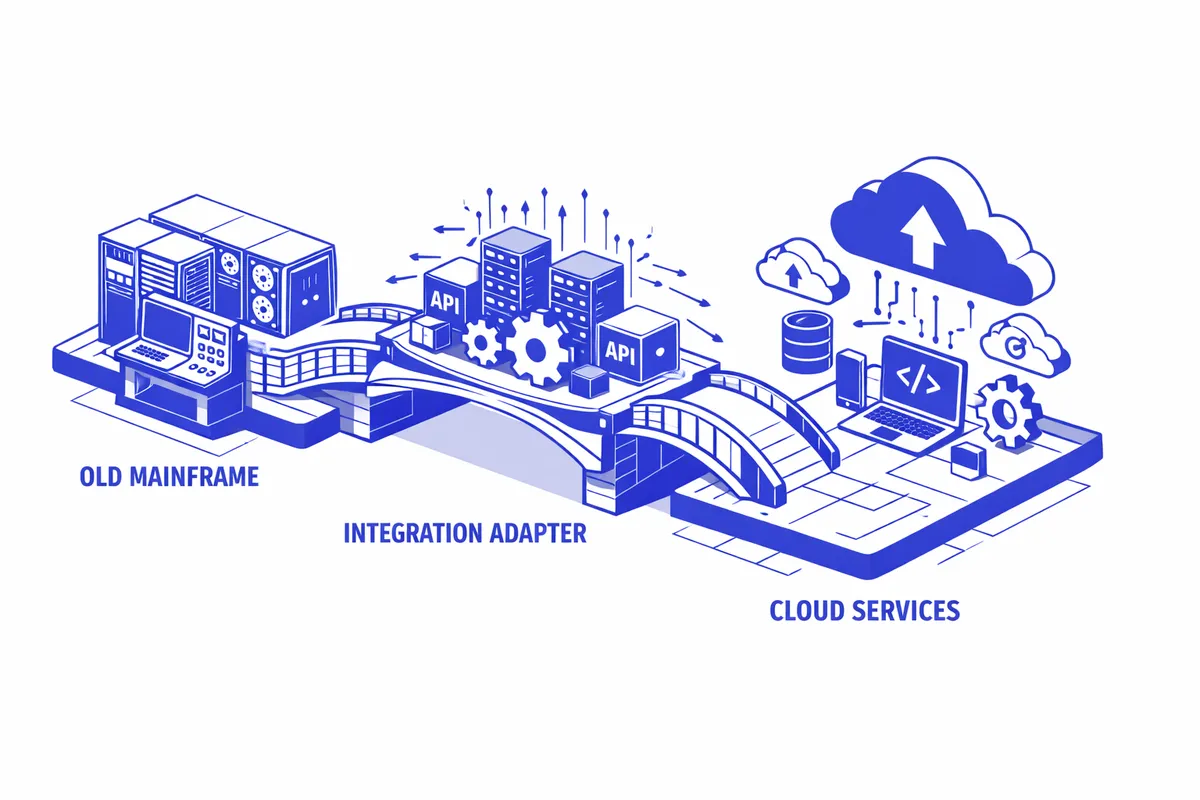
We approach legacy integration with the assumption that the existing systems have earned their place in the operation. A Beverly law firm on 103rd Street that has used the same case management software for fifteen years has fifteen years of case history in that system's database. We do not advise starting over. We build the connectors, data bridges, and middleware that allow modern tools to read from and write to the legacy system, preserving the historical record while extending its useful life and expanding what the firm can do with the data.
Where the legacy system genuinely cannot be extended, we build a migration path that moves data to a modern platform in stages, with the old system remaining readable until the migration is complete and verified.
Industries We Serve in Beverly
Multi-decade law practices along 95th Street carry client files, billing records, and case histories in systems that range from early 2000s case management platforms to literal file rooms that have been partially digitized without a consistent schema. Legacy integration for a Beverly law firm typically means connecting the existing billing system to a modern client portal, building a document management layer that indexes the digitized file archive, and creating API connections to the court filing and calendar systems the firm now uses.
Medical and dental practices near Ridge Park and Walker Branch Library have some of the most complex legacy integration needs in Beverly's professional community. EHR systems from ten to fifteen years ago often run on proprietary databases with no native API capability. We build read-layer integrations that extract patient and clinical data from the legacy EHR and make it available to modern patient communication platforms, billing integrations, and analytics systems without disturbing the clinical workflow that runs on the existing system.
CPA and tax preparation firms on 111th Street face integration challenges that intensify during tax season. Legacy tax software platforms that process client returns are often not designed to connect to document collection tools, client communication platforms, or modern practice management systems. We build the integration layer that connects client-facing intake tools to the legacy tax workflow, eliminating the manual file management and data re-entry that costs staff hours during the firm's busiest period.
Insurance agencies along Western Avenue have built decades of policy and client history inside agency management platforms that were not designed to be extended. Modern quoting tools, client portals, and marketing automation platforms expect to connect via standard APIs that legacy AMS products do not provide natively. We build the middleware that translates between the legacy AMS and modern systems, enabling an agency on Western Avenue to offer digital client experiences without abandoning the platform that holds its full policy history.
Specialty retailers near the Beverly Arts Center that have operated for decades may run their inventory and point-of-sale operations on systems that predate modern cloud architecture. Connecting those systems to ecommerce platforms, digital marketing tools, and modern accounting software requires custom integration work because the legacy POS vendors do not maintain the connections themselves.
Neighborhood restaurants and hospitality businesses near Horse Thief Hollow that have upgraded their front-of-house technology while keeping legacy kitchen management or inventory systems often have a split operational environment where the new and old systems run in parallel with manual reconciliation between them. Integration work that connects the modern and legacy layers eliminates that reconciliation process.
What to Expect Working With Us
1. Legacy system inventory and integration map. We document every system in use, every manual bridge process that connects them, and every data flow that currently requires human intervention. For Beverly professional services firms with long operational histories, this phase consistently surfaces integration gaps that the business has accepted as normal but that represent significant ongoing cost in staff time and error risk.
2. Integration architecture and risk assessment. Before writing any code, we design the integration architecture and produce an explicit risk assessment for each connection. Legacy systems can be fragile, and integration work on an unpatched database requires more care than connecting two modern SaaS platforms. We identify the risk, design around it, and document our approach for review before touching any production system.
3. Phased build with non-disruptive deployment. Legacy integration is deployed in phases, with each phase tested against the production environment before the next begins. A Beverly law firm does not lose access to its case management system while we build the integration. Each new connection is added while the existing system continues to run normally.
4. Documentation and knowledge transfer. Legacy systems often run on institutional knowledge rather than documentation. Part of every Beverly integration engagement is producing written documentation of the integration architecture, the data flows, the maintenance procedures, and the failure modes. When the long-tenured staff member who understands the old system retires, the documentation ensures the firm does not lose the operational knowledge they carried.