How We Build Custom ERP for Beverly
Custom ERP projects start with operational archaeology. We spend the first two weeks documenting every process that currently touches more than one software system, every manual step that bridges a gap between platforms, and every place where information is duplicated across systems because there is no automated connection. For a Beverly law firm, that archaeology typically surfaces four to seven significant friction points: billing reconciliation, matter tracking against time entries, accounts payable for firm expenses, staff scheduling against case load, and document version management. Each friction point becomes a module specification.
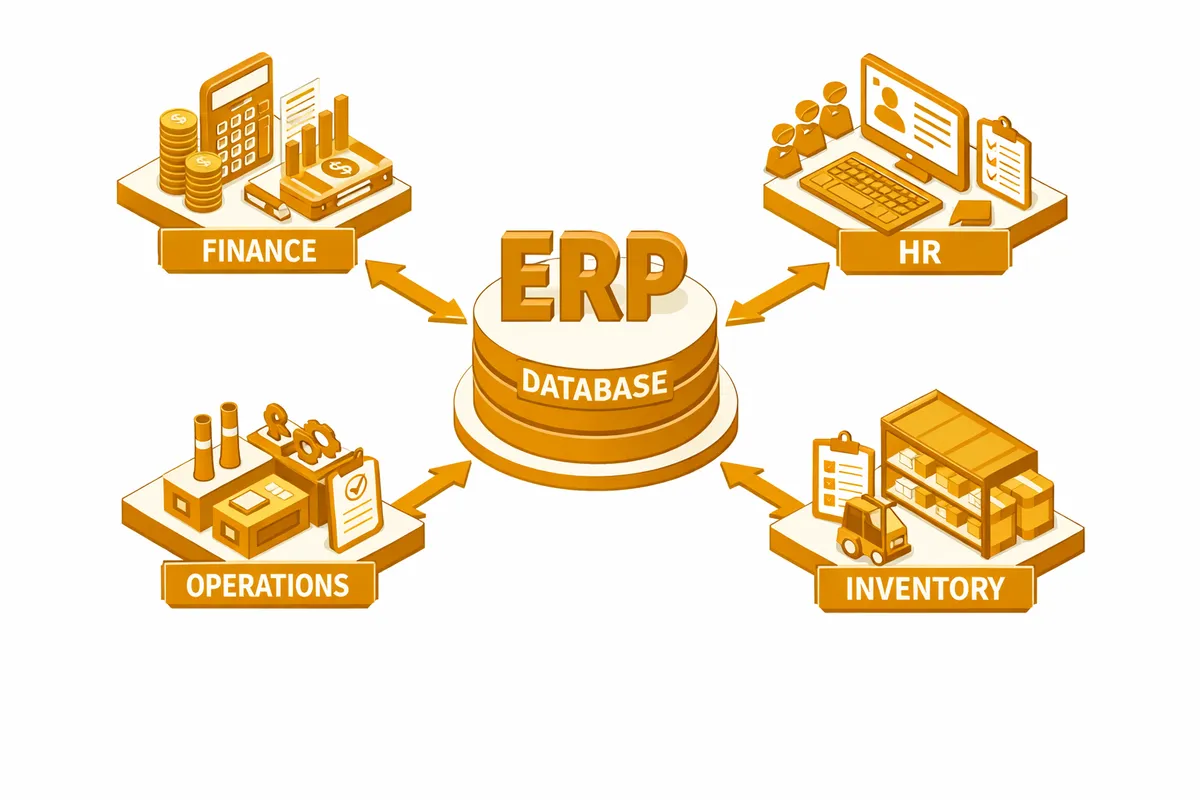
The specification phase produces a functional map of the ERP before any code is written. Beverly business owners review the map, confirm that it accurately represents their operations, and identify priorities. We build to the priority order so the most painful friction is addressed first. This means that even during the build phase, before the full system is complete, the business starts seeing operational improvement.
Integration with existing systems is non-negotiable. A Beverly medical practice near Walker Branch Library will not abandon its scheduling platform mid-build because the ERP we are constructing handles scheduling differently. We build the ERP to coexist with the systems that anchor existing workflows, integrating data flows bidirectionally so that information entered in one system appears where it is needed across all others. The goal is a single operational view, not a rip-and-replace migration that disrupts operations for months.
Industries We Serve in Beverly
Multi-attorney law firms along 95th Street and 103rd Street manage the most operationally complex workflows in Beverly's professional services market: matter lifecycle tracking, time entry and billing, trust account management, document control, court deadline calendaring, and staff allocation across active cases. A custom ERP designed for legal operations gives managing partners visibility into every matter's financial and operational status without needing to pull reports from three separate tools.
Medical and dental groups near Ridge Park operate on operational models that require coordination across clinical scheduling, insurance billing, supply management, and HR. When a practice grows beyond two or three providers, the spreadsheet-and-email coordination layer starts failing. An ERP that connects scheduling to staffing to billing to supply ordering keeps the practice running at full capacity without the weekly manual reconciliation exercise.
Full-service accounting firms on 111th Street face the sharpest operational pressure of any Beverly professional services business during tax season: client portals, document intake, preparer assignment, review workflow, and billing all need to run simultaneously at high volume for eight weeks, then quiet down almost entirely. An ERP with workflow automation calibrated to that cycle prevents bottlenecks during peak and maintains consistent service levels without overstaffing.
Insurance agencies anchored to Western Avenue manage policy portfolios, carrier relationships, commission tracking, renewal cycles, and staff licensing requirements. Agency management systems handle the policy side. A custom ERP layer that integrates with the agency system adds the financial, HR, and reporting functions that agency management platforms do not cover, giving agency principals a complete operational picture.
Boutique commercial operations near the Beverly Arts Center that handle both retail and service revenue streams, such as specialty retailers that also offer custom orders or installation services, need an ERP that manages inventory alongside project management. Off-the-shelf retail systems do not handle project billing. Service platforms do not handle inventory. A custom system handles both natively.
Neighborhood restaurant groups operating multiple locations near Horse Thief Hollow and the 103rd Street corridor need centralized operations for purchasing, scheduling, and financial reporting without losing the autonomy of each location's day-to-day management. A custom ERP designed for multi-location food service in Beverly provides corporate-level visibility with location-level flexibility.
What to Expect Working With Us
1. Operational process documentation. We map every workflow that crosses a software system boundary in your business, interview the staff members who execute those workflows, and quantify the time cost of current manual processes. Beverly professional services firms consistently underestimate this cost until they see it measured; a law firm on 103rd Street that spends 12 staff hours per week on billing reconciliation is paying for half a custom ERP build every month in administrative overhead.
2. Modular specification and prioritization. We translate the process map into a modular ERP specification and work with you to prioritize the modules by impact. High-friction, high-frequency processes go first. The priority order means that real operational improvement begins well before the full system is complete, which matters for businesses that cannot afford a prolonged disruption to their Beverly client base.
3. Phased build with live integration testing. Each module is built, tested against your real operational data, and integrated before the next module begins. We do not present a complete system six months after kickoff and ask you to trust that it works. Every phase is reviewed and signed off with your operational staff before it goes live.
4. Documentation, training, and handoff. Every process in the ERP is documented in plain language. Every staff member who will use the system is trained before their module goes live. The first 90 days after full launch include weekly check-ins to catch any friction in the transition and refine workflows that need adjustment based on real usage. The operational knowledge that currently lives in institutional memory gets encoded into the system so it is no longer at risk when a long-tenured staff member leaves.