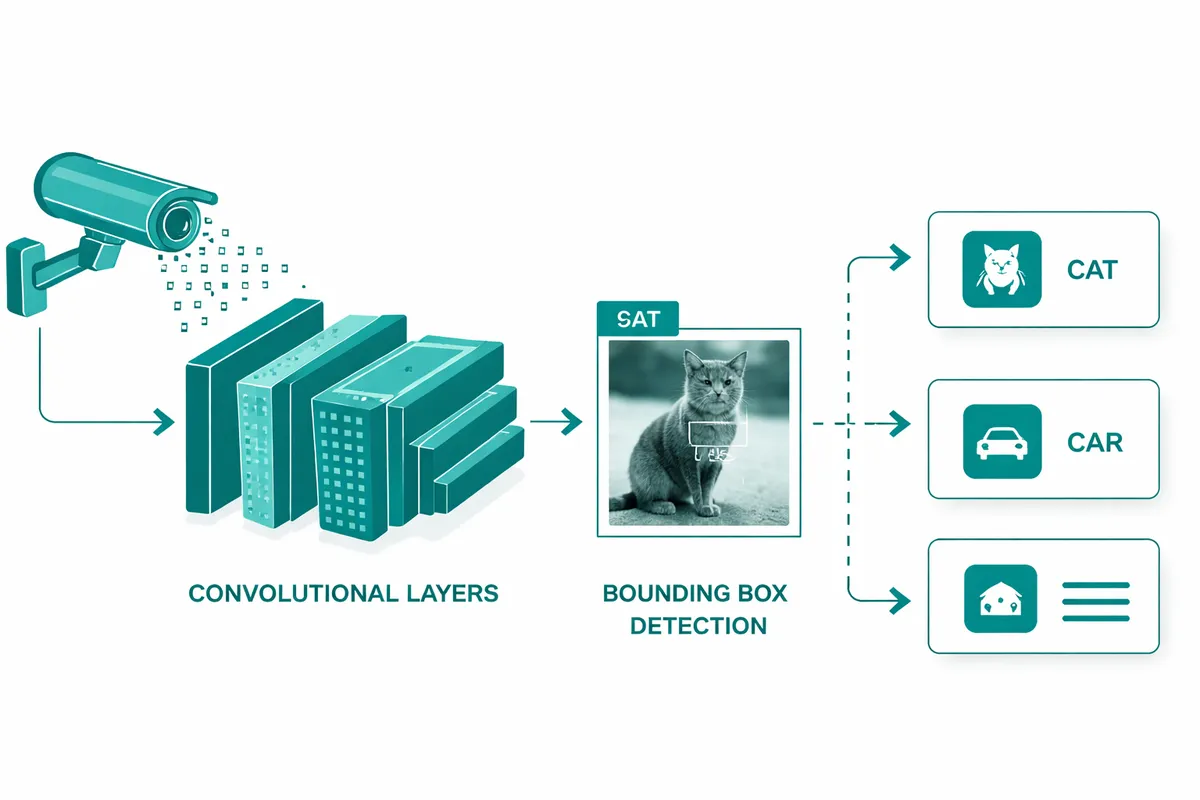
How We Build Computer Vision for Beverly
We begin by auditing the visual data types your practice handles. For a law firm, that inventory includes contract scans, court documents, handwritten notes, photographs, and exhibits. For a medical practice, it includes patient intake forms, prior records, diagnostic images, and insurance documentation. For an insurance agency, it includes property photos, damage documentation, application materials, and claims supporting documents. Each document type has specific visual characteristics that determine the extraction and classification approach.
We build models trained on examples from your actual document inventory. Generic models trained on web data do not perform well on legal exhibits or medical records, which have specific formatting conventions and terminology. Models trained on your documents, with your specific form layouts and document structures, perform significantly better. We collect a training set of representative examples, build the model, and validate accuracy before deployment.
We integrate computer vision outputs with your downstream systems. Extracted data from a new patient intake form routes directly to your EHR. Classified legal documents route to the correct case folder in your document management system. Processed insurance application images route to the application record and trigger the next workflow step. Vision processing is not an isolated capability. It is the front end of an automated workflow.
We monitor accuracy continuously and retrain models as document types evolve. Insurance form redesigns, court filing format changes, and new practice management system templates all affect model performance over time. We handle that maintenance so your team does not need to.
Industries We Serve in Beverly
Law firms and legal practices on Western Avenue and 95th Street use computer vision for court document classification, exhibit indexing, contract clause extraction, handwritten note digitization, and case file organization from scanned productions that arrive in mixed or unsorted formats.
Medical and dental practices near Ridge Park and 103rd Street use computer vision for patient intake form digitization, prior record extraction and routing, insurance document classification, and diagnostic image pre-processing that prepares visual data for clinical review.
CPA and accounting firms serving Beverly's professional families use computer vision for financial document extraction from scanned statements and receipts, prior return scanning and data population, and document classification that routes client submissions to the correct engagement folder.
Insurance agencies along Longwood Drive and Wood Street use computer vision for property photo analysis and damage assessment documentation, application supporting material classification, claims document processing, and policy document extraction for renewal and comparison workflows.
Real estate and property management firms serving Beverly and neighboring Morgan Park and Evergreen Park use computer vision for property inspection document processing, lease agreement extraction, maintenance request photo classification, and listing photo quality assessment.
Boutique retail businesses near the Beverly Arts Center and Horse Thief Hollow use computer vision for inventory label scanning and stock level assessment, product image quality review for online listings, and receipt and supplier invoice digitization for bookkeeping workflows.
Beverly practices benefit from computer vision in a context where administrative precision matters for professional reputation. A law firm on 95th Street whose case files are impeccably organized demonstrates a level of operational rigor that clients notice and trust. A medical practice near 103rd Street whose patient records are accurately transcribed and properly indexed delivers better care and avoids the billing errors that damage patient relationships. Computer vision is not a back-office efficiency tool in isolation. It is infrastructure that supports the front-office standards that Beverly's professional community expects. The practices near Longwood Drive and Wood Street that invest in accurate, automated document processing are the ones whose staff can focus on client interactions rather than on the clerical burden that undermines service quality when left to manual handling.
What to Expect Working With Us
1. Visual data audit and use case prioritization. We inventory the visual document types your practice handles, estimate current processing volumes, and identify which use cases will produce the most measurable time savings. Audit typically takes one to two weeks.
2. Model training and validation. We collect representative examples of your target document types, train classification and extraction models, and validate accuracy against held-out examples. We do not deploy until accuracy meets the threshold appropriate for your use case. Legal and medical applications require higher thresholds than general business documents.
3. Integration and workflow connection. We connect computer vision outputs to your downstream systems and design the workflow logic that routes extracted data to the correct destination. Integration testing runs for two to three weeks before full deployment.
4. Deployment and ongoing monitoring. Vision systems go live with accuracy monitoring in place. We review performance monthly and retrain models when accuracy degrades due to document format changes or new document types. Your team has a clear escalation path for low-confidence extractions that the system flags for human review.