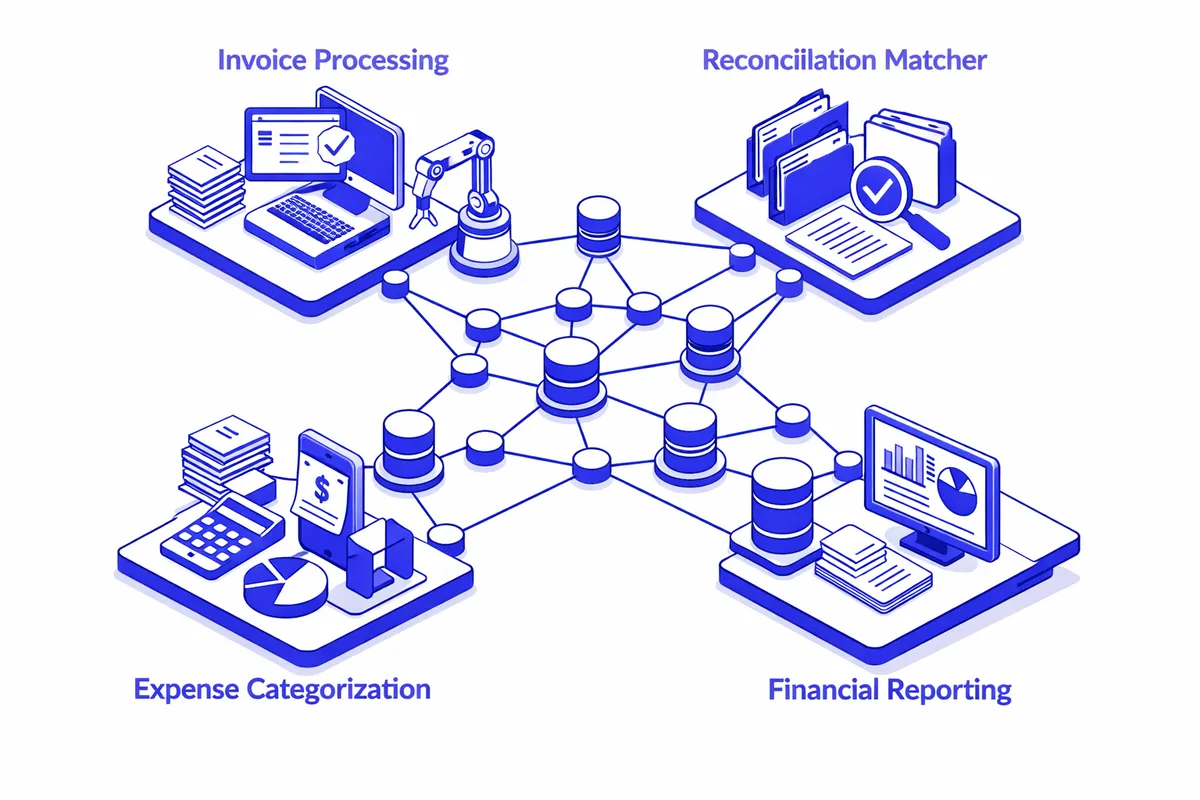
How We Build Accounting Automation for Beverly
Beverly's professional practices have one thing in common: they already know what good process looks like. They just do not always have the tools that make good process efficient. Our approach starts with that existing knowledge rather than trying to teach the team how their own work functions.
We begin with a process audit. For a law firm near Walker Branch Library, that means reviewing the current trust accounting workflow: how entries get made, how reconciliations get run, what triggers a review, and where the manual checkpoints currently live. For a CPA firm on 103rd Street, it means walking through the client billing cycle, the accounts receivable aging process, and the internal expense categorization workflow. For a medical practice near Horner Park, it means tracing an insurance payment from arrival to posting to reconciliation.
From that audit, we identify the highest-leverage automation opportunities. Trust account reconciliation, insurance payment posting, and payroll journal entries are the most common starting points for Beverly professional practices. These are processes that follow deterministic rules but currently require significant manual attention.
We build on top of your existing software. Most Beverly practices use QuickBooks, NetSuite, or a specialty platform like Clio for legal or Kareo for medical. We connect to what you have, layer the automation rules on top, and produce outputs that match the format your CPA or auditor expects at year-end.
Industries We Serve in Beverly
Law firms and legal practices along Western Avenue and 103rd Street use accounting automation to handle trust account reconciliation, client invoice generation, and partner compensation tracking. For firms doing real estate closings along the Western Avenue corridor, the volume of trust account transactions during a busy closing month can overwhelm a manual reconciliation process. Automated three-way reconciliation runs nightly and produces a report that is always current, always audit-ready.
CPA and accounting offices near Ridge Park and Walker Branch Library deploy automation for their internal operations: client billing, staff time tracking to billing codes, and accounts receivable aging. CPA firms that also provide bookkeeping services to clients benefit from automation that standardizes the client deliverable format, so that monthly reporting packages go out on the same template regardless of which staff member assembled them.
Medical and dental practices near St. Xavier University automate insurance payment posting, patient statement generation, and co-pay reconciliation. The volume of small transactions in a busy medical practice makes manual processing both slow and error-prone. Automated payment posting matches the insurance remittance to the claim, applies the contractual adjustment, posts the patient balance, and flags any underpayment against the contracted fee schedule.
Insurance agencies along Western Avenue handle policy premium posting, commission reconciliation, and carrier remittance matching. Insurance accounting involves a flow of money that passes through the agency to and from carriers and clients, with commission calculations tied to each transaction. Automated reconciliation tracks that flow and produces a daily cash position without requiring an office manager to rebuild the calculation from scratch each month.
Boutique retailers and restaurants on 95th Street and the Beverly commercial corridor automate daily sales reconciliation, gift card liability tracking, and vendor invoice processing. For a family-owned restaurant near Horse Thief Hollow, the automation might focus on daily cash drawer reconciliation and payroll posting. For a boutique retailer, it might focus on inventory cost allocation and returns processing.
Event and wedding planners serving Beverly's professional family market automate deposit tracking, vendor payment scheduling, and project-based profit and loss reporting. Event businesses carry complex liability in the form of client deposits held against future services. Automated deposit tracking reconciles outstanding deposits against booked events and flags any aging deposits that have passed the service date without resolution.
What to Expect Working With Us
1. Professional-practice-specific process review. We begin by reviewing your current compliance obligations alongside your accounting workflow. For law firms, that means understanding ARDC requirements. For medical practices, it means understanding your payer mix and ERA processing. The automation we build is designed around your compliance environment, not despite it.
2. Software-first approach. We inventory your existing platforms before recommending anything new. Beverly's professional practices typically have established software investments that a new tool would need to justify displacing. We exhaust the automation potential of your current stack before suggesting a migration.
3. Parallel-run validation with historical data. Every automation runs against three months of your historical transactions before going live. You compare the automated output against your actual records, confirm the accuracy, and authorize the switch to live processing only after the parallel run passes.
4. Controller-ready documentation. We document every automation workflow at a level of detail that your controller, bookkeeper, or outside CPA can read and maintain without our involvement. The goal is a system that belongs to your practice, not one that requires ongoing vendor dependency.