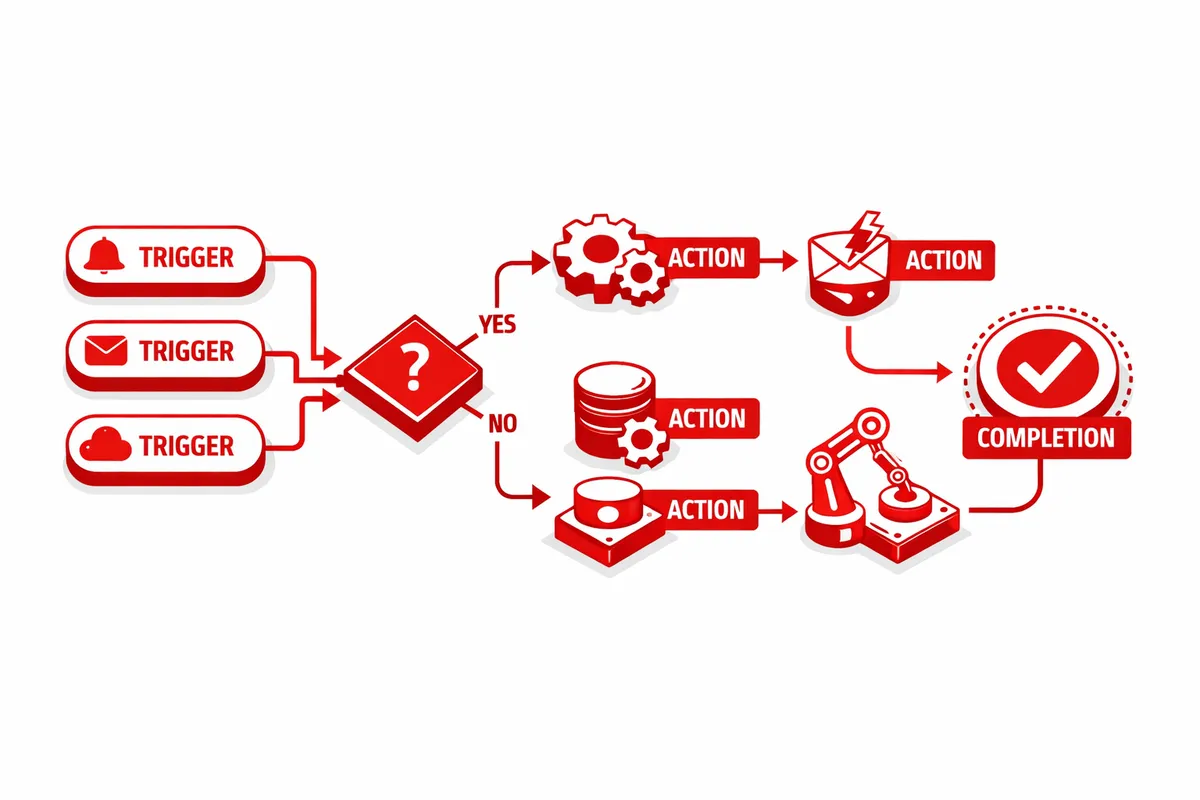
How We Build Workflow Automation for Avondale
We start with a process walk. For a manufacturer on Elston Avenue, that means tracing a job from inquiry to close and documenting every task, hand-off, and decision point along the way. We are looking for the recurring patterns: tasks that happen every time a certain trigger occurs, hand-offs between people or systems that follow predictable rules, notifications that go out on schedule or on status change. Those are the automation candidates.
Automation platform selection follows the process analysis. For Avondale businesses already using cloud-based tools, Make and Zapier cover most automation scenarios without custom development. For businesses with on-premise systems or more complex logic, we may build custom automation using lightweight serverless functions. The platform choice is always the one that produces the most maintainable result for your specific stack, not the one that requires the most technical sophistication.
Build happens in a staging configuration that mimics your live environment. We test every automation against real scenarios, including edge cases, before connecting it to live operations. For a contractor on Belmont Avenue whose billing and CRM are integrated through automation, a misconfigured trigger creating duplicate invoices is a real operational problem. We find and fix those scenarios in staging.
Documentation is a deliverable, not an afterthought. Every automation we build comes with a plain-language description of what it does, what triggers it, and what to do if it breaks. For Avondale businesses that do not have in-house technical staff, knowing how to troubleshoot a failed automation is as important as having it run in the first place.
Industries We Serve in Avondale
Metal fabricators and specialty manufacturers along Elston Avenue use workflow automation to connect job management to procurement, production scheduling, and customer notification. When an order is confirmed, the automation generates the materials list and routes it to the purchasing team, creates the job record in the production schedule, and sends the customer an order confirmation with the expected delivery window, all without a human touching each of those three tasks separately.
Auto body and collision repair operations near Kosciuszko Park automate the repair status communication flow: when a vehicle moves from estimate-approved to parts-ordered to repair-in-progress to quality check to ready-for-pickup, the customer receives an appropriate notification at each stage without a service advisor manually sending each one. The shop floor team updates the job status; the customer communication happens automatically.
Contractors and construction businesses on Belmont Avenue automate bid follow-up sequences, subcontractor notification workflows, and milestone billing triggers. When a project phase is marked complete in the project management tool, the automation creates the billing milestone in QuickBooks, sends the change order summary to the client, and notifies the next subcontractor that their phase is opening. Three tasks that previously required manual action happen automatically.
Polish delis and specialty food retailers on Milwaukee Avenue automate wholesale order processing: a new order from a wholesale account triggers the production request, updates the inventory reservation, generates the delivery schedule entry, and sends the order confirmation to the customer, all from a single order entry action. For businesses with multiple wholesale accounts and daily order volume, that automation recovers several hours of manual administration per day.
Craft breweries and taprooms in Avondale's industrial spaces automate their batch-to-distribution workflow: when a batch passes quality check, the automation updates the inventory record, notifies the distributor of incoming stock, and triggers the tap list update on the website. Events at Avondale Park or the Hairpin Arts Center generate automated social post drafts and email subscriber notifications from a single calendar entry.
Service businesses and tradespeople dispatching from Kedzie Avenue use workflow automation for the administrative layer of their service delivery: new customer intake forms trigger CRM record creation, appointment booking triggers a confirmation text and calendar block, job completion triggers an invoice draft and a review request SMS, and recurring maintenance reminders go out 30 days before the next scheduled service date, all automatically.
What to Expect Working With Us
1. Process documentation and automation identification. We map the workflows in your business that are best suited to automation and document them in enough detail to build from. For Avondale manufacturers and contractors with complex operations, this phase often surfaces automation opportunities that were not on the original list. Most businesses find the process documentation itself valuable independent of the automation it produces, because seeing your workflows diagrammed explicitly often reveals inefficiencies that were invisible in practice.
2. Automation blueprint and platform selection. Before building, we produce a blueprint for every automation: trigger conditions, action steps, error handling, and expected outputs. You review and approve the blueprint before we build. For businesses on Milwaukee Avenue or Elston Avenue with compliance documentation requirements, the blueprint serves as the specification record for each automated process.
3. Build, test, and staged deployment. Every automation is built and tested against real scenarios in a staging environment. We validate the edge cases, not just the clean path, before connecting to live systems. Staged deployment means the automation runs monitored for the first week before it operates fully unattended.
4. Documentation, training, and ongoing support. You receive plain-language documentation for every automation, including how to handle common failures. We train the staff member who will own the automation on monitoring and basic troubleshooting. Ongoing support covers automation updates when your underlying systems change, which they will, and new automation requests as the business evolves.