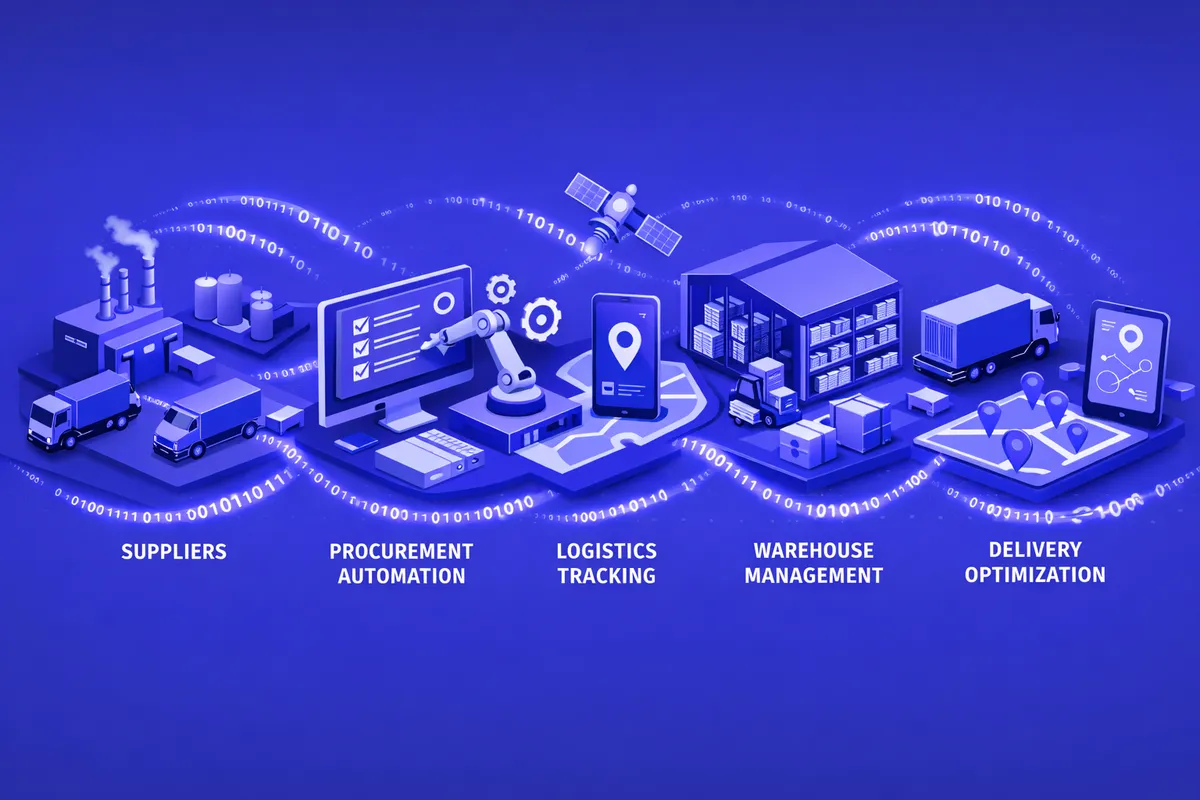
How We Build Supply Chain Automation for Avondale
Avondale supply chain automation starts with a production or operational workflow map, not a vendor list. For a metal fabricator on the Chicago River corridor, procurement is downstream of the job schedule. For a Polish deli on Milwaukee Avenue, it is downstream of the weekly order pattern. For a brewery along Elston Avenue, it is downstream of the brewing and fermentation calendar. We build the automation to match that upstream operational reality.
From the workflow map, we identify the procurement decisions most often made too late: the reorder trigger for a material or ingredient, based on current inventory, upcoming production requirements, and supplier lead time. That is where production delays and stockouts originate. We automate those triggers first.
Vendor communication requires flexibility. Chicago River manufacturers source from suppliers with ordering processes ranging from EDI to fax. Milwaukee Avenue food businesses source from distributors with electronic portals and from specialty importers who take orders by phone. We build procurement workflows that are agnostic to the supplier's channel: the system generates the correctly formatted order and transmits it through the appropriate method.
Integration with QuickBooks, Xero, or your existing accounting platform is standard. Purchase orders generate expected expense records. Received goods confirm those records. Discrepancies flag for review before payment is processed, preventing overpayment on short-shipped orders.
Industries We Serve in Avondale
Metal fabricators and light manufacturers along the Chicago River industrial corridor and Elston Avenue manage raw material procurement tied directly to production job schedules. When a confirmed job triggers an automatic material requisition based on the job specifications, and that requisition flows to a purchase order that is sent to the appropriate supplier based on material type and availability, the fabricator's production team can commit delivery dates with confidence rather than estimating based on informal procurement assumptions.
Polish delis and specialty food retailers on Milwaukee Avenue source from a mix of regional food distributors, specialty Polish and Eastern European importers, and local meat and dairy suppliers. Automated reorder management for the specialty product mix, connected to inventory tracking that reflects actual sales velocity, ensures that the pierogi and kielbasa that define these businesses for their loyal customers are consistently available without requiring the owner to manually track every product's stock level.
Auto body shops and service contractors in Avondale's working-class industrial corridor manage parts procurement from multiple supplier types simultaneously. Automated parts ordering with supplier availability checking, order confirmation tracking, and delivery receipt logging gives the shop manager a view of every open parts order without requiring phone calls to suppliers throughout the day. Jobs move faster when parts status is visible without active follow-up.
Craft breweries and artisan food producers in Avondale's industrial buildings along the riverfront manage ingredient and packaging procurement for products where quality consistency depends on reliable ingredient sourcing. Automated ingredient reorder management tied to the production schedule ensures that a brewery never runs short on a key hop variety in the middle of a production cycle and never over-orders perishable ingredients that cannot be used before they degrade.
Near Kosciuszko Park and along Central Park Avenue, small contractors and construction trade businesses manage material procurement for multiple active job sites simultaneously. Automated job-site material procurement that generates purchase orders from job specifications and tracks delivery to each site reduces the coordination overhead on project managers who currently track material orders through a combination of phone calls, email, and manual project logs.
Avondale Park-area small businesses and neighborhood retailers serving the residential community along Belmont Avenue and Addison Street manage supplier relationships for a product mix that requires regular ordering but not the complexity of industrial procurement. Automated supplier communication and purchase order management for a neighborhood retailer eliminates the manual ordering process without requiring new systems: we build procurement automation around the tools the business already uses for inventory and accounting.
What to Expect Working With Us
1. Operational and procurement workflow mapping. We document your production or operational schedule and map the procurement decisions that feed it. For manufacturing clients along the Chicago River corridor, this mapping surfaces the specific points where procurement delays create production schedule risks. For food businesses on Milwaukee Avenue, it surfaces the product categories where stockouts have the highest customer impact.
2. Vendor network documentation. We document every vendor relationship in a structured format: supplier contact, product categories, lead times, minimum orders, ordering process, and historical performance on accuracy and delivery. For Avondale businesses that source from specialty suppliers with informal ordering processes, this documentation often represents the first time the supplier network has been written down in a form that someone other than the owner can use.
3. Automated workflow build and supplier communication setup. We build the reorder management and purchase order workflows for your priority vendor categories. For suppliers with electronic ordering portals or APIs, we configure direct transmission. For suppliers that require email or phone orders, we build the structured process that standardizes the order and creates documentation regardless of how it is transmitted.
4. Accounting integration and performance dashboard. We connect procurement to accounting and provide a dashboard that shows active purchase orders, expected delivery dates, and vendor performance metrics. Avondale manufacturers and food businesses can see at a glance what is on order, when it is expected, and whether any orders are overdue for confirmation or delivery.