How We Build Document Management Systems for Avondale
The intake process for Avondale businesses begins with understanding what you produce, what you contract for, and what regulatory or compliance requirements govern your industry. A contractor on Belmont Avenue working residential and commercial jobs operates under a specific set of document requirements: client contracts, subcontractor agreements, permits and inspections, material invoices, change orders, and project closeout documentation. A metal fabricator near the Chicago River industrial corridor may operate under ISO certifications, customer-mandated quality plans, and safety compliance requirements. We map your specific document universe before we design anything.
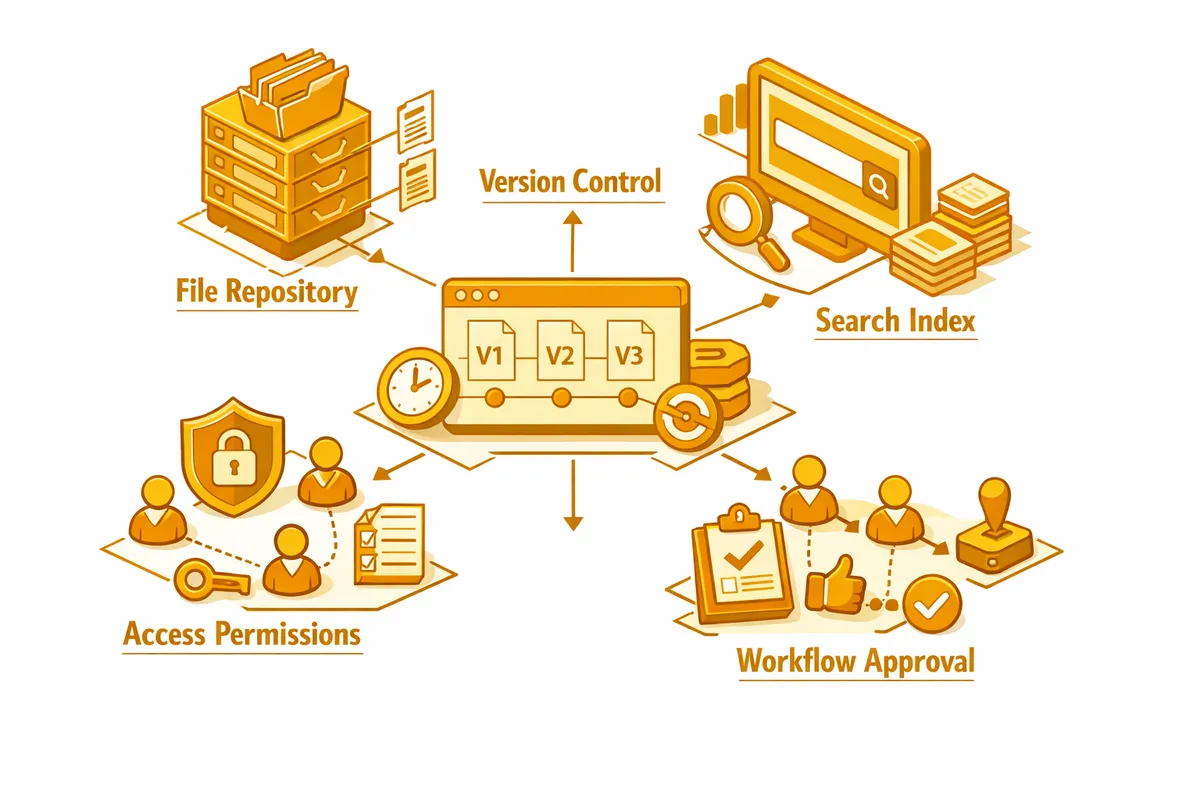
From the intake, we build a taxonomy suited to your operation. For a contractor, that means a project-centric structure where every document belongs to a job, every job is a complete record from bid through closeout, and any document in any job is findable by job number, client name, document type, or date. For a manufacturer, it means a part- or job-order-centric structure with version control for specifications, access controls that ensure the shop floor sees only the current revision, and audit trails that support quality certifications. For a family business, it means a structure organized around the business's natural document categories: vendor agreements, client contracts, employee records, equipment documentation, and regulatory filings, each with retention periods appropriate to its category.
Implementation for Avondale businesses is practical. We migrate your existing documents into the new structure during implementation, applying consistent organization rather than carrying the existing chaos forward. Most businesses see their most critical document categories fully organized within ten to fourteen weeks.
Industries We Serve in Avondale
General contractors and specialty trades businesses along Elston Avenue and Belmont Avenue need project-centric document management with version control for contract drafts, change order tracking, permit and inspection documentation, subcontractor agreement management, and project closeout file assembly. A complete, organized project file is a professional asset in contractor-client relationships and a legal protection when disputes arise.
Metal fabricators and small manufacturers in the Chicago River industrial corridor need job-order-centric document management with version control for engineering specifications and drawings, access controls that ensure production operates from the current revision, quality certification documentation, customer-facing conformance records, and material traceability documentation required for regulated applications.
Auto body shops and auto service businesses on Kedzie Avenue and Milwaukee Avenue need document systems for repair authorizations, insurance claims documentation, parts invoices, equipment maintenance records, employee certifications, and OSHA compliance documentation that currently lives in paper files or scattered digital folders.
Polish delis, bakeries, and family food businesses along Milwaukee Avenue need document management for supplier agreements, food safety certifications, health department records, employee documentation, equipment maintenance logs, and the lease and insurance documentation that governs the physical space. Organized documentation is the infrastructure of a family business that plans to continue.
Craft breweries and small producers in Avondale need document management for licensing and regulatory filings with the Illinois Liquor Control Commission, production records required for TTB compliance, supplier and ingredient documentation, distribution agreements, and equipment maintenance records. The documentation burden of operating a licensed brewery is substantial. A structured system makes it manageable.
Small commercial real estate and property management operations in Avondale need document management for lease agreements, tenant communications, maintenance request records, vendor contracts, building permit history, and insurance documentation organized by property and accessible to property managers without requiring owner involvement in every search.
What to Expect Working With Us
1. Document inventory and compliance mapping. We catalog your document types, storage locations, regulatory requirements, and retention obligations. For Avondale contractors and manufacturers, this includes a review of the document requirements embedded in your client contracts and any applicable industry or regulatory standards.
2. Taxonomy and structure design. We design a classification system, naming convention, metadata schema, and access control model matched to your operation. You review and approve the architecture before we build anything. No implementation begins until you understand and agree with the structure.
3. Implementation and migration. We build the system and migrate your existing documents into the new structure, applying consistent organization and metadata during the migration. Your highest-priority document categories are organized and searchable within ten to fourteen weeks. Migration of lower-priority historical records follows in subsequent phases.
4. Staff training and adoption support. We train your team on the new system and monitor adoption during the post-launch period. Avondale businesses often have mixed comfort with digital tools. We build systems that are straightforward to use and provide training that meets your team where they are.