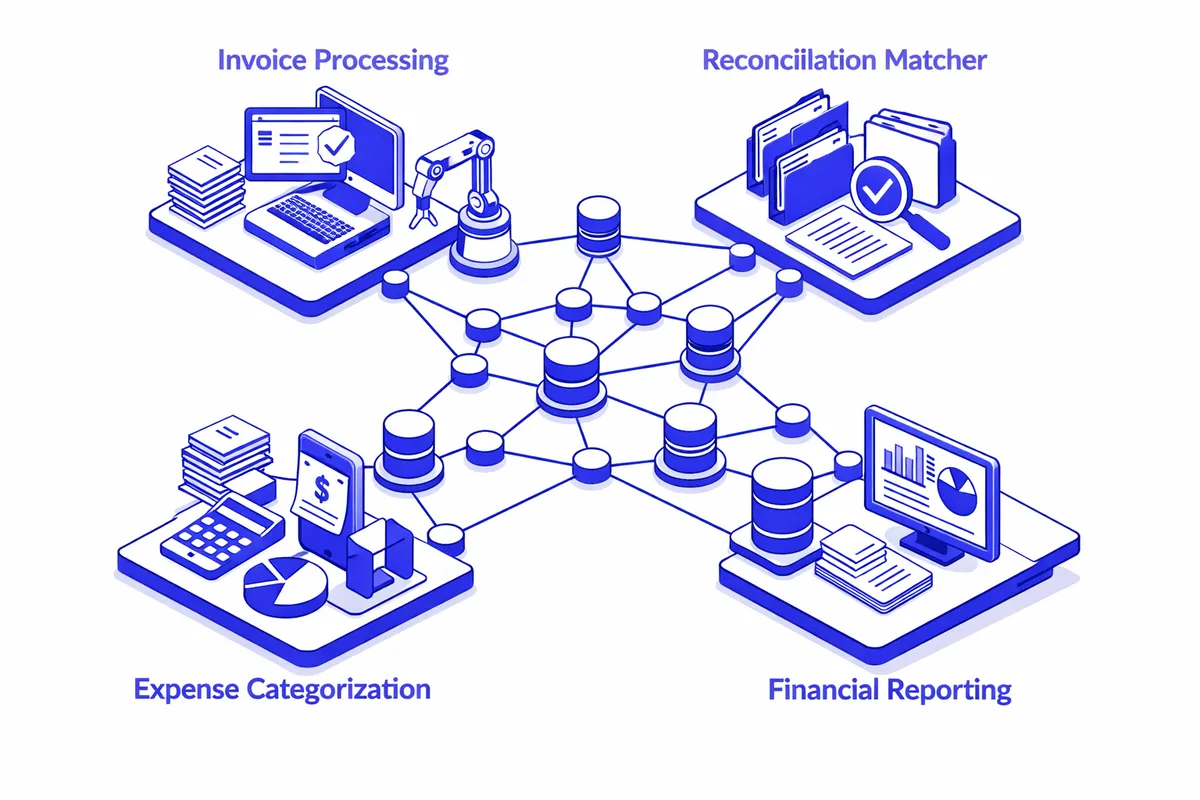
How We Build Accounting Automation for Avondale
For Avondale's manufacturing and trades businesses, the automation process starts with job costing architecture. Before we automate anything, we document how costs are currently tracked at the job level, what data sources exist, and where the current process breaks down. Most small manufacturers on the Chicago River industrial corridor have some combination of a purchase order system, a time-tracking tool, and an accounting platform that do not talk to each other natively. The automation layer bridges those gaps.
For Avondale's food and beverage businesses, the starting point is daily operations: POS data pulling into the accounting platform automatically, cash deposit reconciliation running on a nightly schedule, and vendor invoice posting triggered by receipt of goods rather than whenever someone has time to enter it. The Avondale brewery and restaurant market moves fast enough that a two-day lag in accounting data produces meaningfully worse decisions about purchasing and staffing.
For the established retail and service businesses along Milwaukee Avenue and Belmont Avenue, the engagement often begins with a single high-friction process: usually accounts payable, where vendor invoices are currently entered manually one by one. Automating AP routing and approval through a connected workflow cuts that process from a half-day task to a review of flagged exceptions.
We test every automation against at least three months of Avondale clients' historical data. For a metal fabricator on Elston Avenue testing job cost automation, that means running automated cost allocation against real historical jobs and comparing the outputs to what was actually posted. Discrepancies get investigated before anything touches live books.
Industries We Serve in Avondale
Metal fabricators and light manufacturers along the Chicago River industrial corridor use accounting automation to handle purchase order matching, materials cost allocation by job, subcontractor invoice routing, and work-in-progress inventory tracking. Manufacturing accounting is among the most complex in the small business market, and it is also the segment where manual errors are most expensive. Automation enforces consistent job cost coding without relying on individual staff memory.
Auto body shops and auto service businesses throughout Avondale automate parts ordering cost capture, labor billing reconciliation, and insurance receivables tracking. Insurance-involved auto repair generates a high volume of payments with complex timing and partial payment scenarios that are easy to mishandle manually. Automated receivables tracking shows exactly what is outstanding, from whom, and for how long.
Craft breweries and independent restaurants near Hairpin Arts Center and along Milwaukee Avenue use accounting automation to reconcile daily POS deposits, post food and beverage cost from distributor invoices, and generate weekly margin reports by category. The beverage industry's specific cost tracking requirements, calculating pour cost, tracking keg yields, managing distributor credits, are areas where automation enforces accuracy that manual processes rarely achieve.
Polish delis, bakeries, and specialty food retailers in Avondale's heritage commercial corridor automate vendor payment runs, food cost allocation, and daily cash reconciliation. These businesses often have long-standing supplier relationships with established pricing and recurring orders. Automation handles the recurring transaction posting so owners focus on the business relationships, not the data entry.
Contractors and residential renovation businesses serving Avondale's residential bungalow corridor use job costing automation for labor and materials tracking, subcontractor payment scheduling, and progress billing based on project phase completion. The renovation cycle in Avondale's bungalow housing stock keeps a steady volume of small to mid-size projects active simultaneously, each requiring its own financial tracking.
Small manufacturers and custom fabricators on Addison Street and Kedzie Avenue use automation for production cost tracking, raw materials inventory valuation, and finished goods posting. Custom fabrication businesses often produce one-of-a-kind orders that require job-specific cost tracking but share common materials and labor resources. Automation allocates shared resources correctly without requiring manual distribution entries.
What to Expect Working With Us
1. Process mapping starts with your actual workflow. For Avondale manufacturers, that means walking through your current job costing process step by step. For food businesses, it means tracing a week of transactions from POS close to bank deposit to ledger posting. We document what is happening now before we design what should happen automatically.
2. Prioritize the build around your close calendar. Avondale manufacturers with mid-month billing cycles get their billing automation built and tested before the next cycle runs. Food businesses get their daily reconciliation automation first. We sequence the work around the rhythm of your specific operation.
3. Test with real historical data. Every automation runs against three months of your actual historical transactions before it handles live data. For job cost automations, that means matching automated outputs against real job financials from prior periods. You confirm the logic is right before it runs on this month's numbers.
4. Handoff with documentation your team can maintain. We leave every client with workflow documentation at the controller or office manager level. If you hire a new bookkeeper or bring in an outside accountant for tax season, they can understand what the automation is doing without calling us first.