How We Build AI Integration Services for Albany Park
Our process begins by mapping the current business workflows and identifying where AI could add value. Initial consultations happen at the business location: the attorney's office on Kimball Avenue, the restaurant near the Kimball Brown Line terminus, the clinic on Montrose Avenue. An immigration attorney currently: receives case documents, manually reads them, writes case summaries, files documents in the case folder, and updates the case status. We identify that Claude could automatically analyze case documents and generate summaries, but currently that analysis happens outside the case management system. An opportunity exists to integrate Claude directly into the case management workflow.
A restaurant currently: menu items exist in multiple systems (POS system, website, social media, printed menus). When menu items change, the owner must update each system separately. Product descriptions exist only on the website as generic text. An opportunity exists to integrate AI to generate rich product descriptions once and distribute them across all systems.
A medical clinic currently: patient visit notes are written in the patient record system. Those notes are sometimes reviewed by another doctor. Those notes are summarized for the patient's records. An opportunity exists to integrate Gemini to automatically generate summaries and highlight important clinical information.
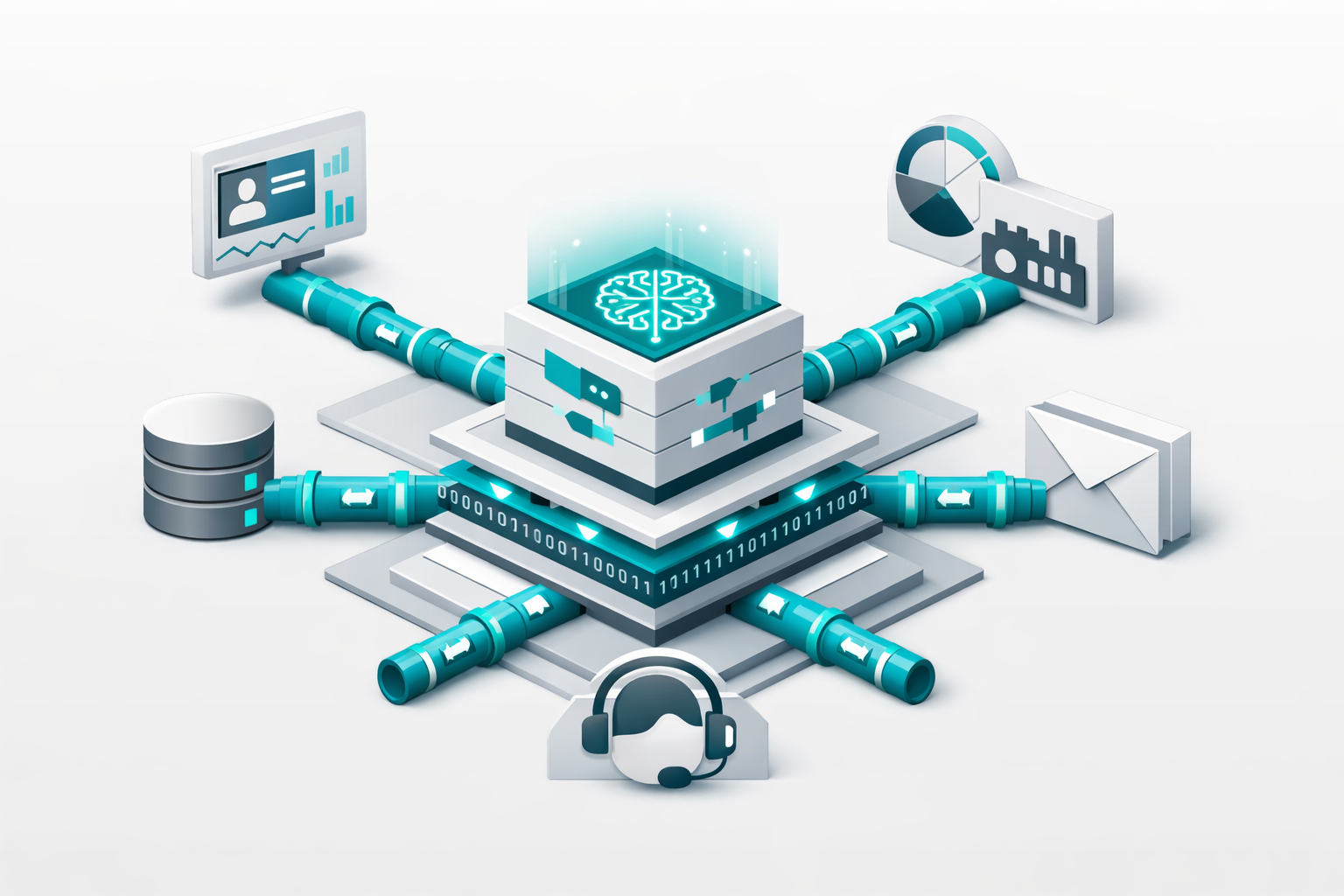
Once we identify integration opportunities, we build custom API connections between the AI tools and the business systems. For the attorney's case management system, we build a connection that allows the attorney to upload a document and trigger Claude analysis automatically. The Claude analysis is formatted, validated, and automatically written to the case summary field in the case management system. The attorney never leaves the case management interface.
For the restaurant, we build connections that allow menu items updated in the POS system to automatically flow to the website, and allow ChatGPT to automatically generate product descriptions for those items. When the restaurant adds a new dish to the POS, the system automatically creates a menu entry on the website and requests an AI-generated product description. The owner approves or edits the description, and it publishes automatically.
For the clinic, we build a connection that allows visit notes written in the patient record system to be automatically analyzed by Gemini. Key clinical information is highlighted. A summary is generated. Flags for follow-up care are identified. All of this happens automatically and updates the patient record without manual intervention.
We also build error handling and quality checks into these integrations. If Claude cannot confidently analyze a document, the system flags it for human review rather than making a potentially wrong automated decision. If ChatGPT generates a product description that does not match the restaurant's brand voice, the system flags it for human approval before publishing. If Gemini identifies a potential clinical concern, the system alerts the physician rather than silently processing it. The AI augments human judgment; it does not replace it.
Industries We Serve in Albany Park
Immigration law offices integrate Claude or similar AI tools into case management systems to automatically analyze legal documents, extract key information, identify required next steps, and flag potential concerns. Case management becomes faster and more accurate.
Medical clinics integrate Gemini or Claude into electronic health record systems to automatically summarize visit notes, identify clinical patterns, flag potential concerns, and generate patient education materials. Clinicians spend less time on documentation and more time with patients.
Restaurants and food service businesses integrate ChatGPT or Claude into POS and website systems to automatically generate menu descriptions, pricing variations, and promotional content. Menu updates happen faster and descriptions are richer and more engaging.
Auto repair shops integrate AI tools into diagnostic and work order systems to automatically generate repair estimates, explain technical issues to customers, and recommend preventive maintenance. Estimates are faster and customers understand their repairs better.
Accounting and bookkeeping services integrate AI tools into accounting software to automatically categorize transactions, flag unusual expenses, generate financial summaries, and answer common business financial questions for clients. Bookkeeping becomes faster and clients get better financial insights.
Property management and rental services integrate AI into tenant communication systems to automatically respond to common maintenance requests, generate lease agreements, and schedule maintenance visits. Tenant communication becomes faster and more responsive.
What to Expect Working With Us
1. Workflow analysis and integration planning. We map your current business processes and identify opportunities where AI integration would save time and improve accuracy. We develop an integration roadmap prioritizing the highest-value opportunities first. We create a detailed integration plan specifying what systems will connect, what data will flow, and what the expected benefit is.
2. Custom API development. We build custom API connections between your business systems and AI tools (Claude, ChatGPT, Gemini, etc.). We develop secure authentication so data flows securely between systems. We build data transformation so information flows in the right format to each system. We build error handling so errors are caught and flagged rather than silently propagating.
3. Workflow automation. We set up automated workflows so information flows from one system to another without manual intervention. When a case document is uploaded, Claude automatically analyzes it. When a menu item is updated, descriptions are automatically generated. When patient notes are recorded, summaries are automatically created. Staff no longer manually transfers information between systems.
4. Testing and validation. We test the integrations with real data from your business. We verify that information flows correctly, that AI tools are being used appropriately, and that results meet your quality standards. We identify cases where human review is needed and set up alerts for those cases.
5. Staff training and deployment. We train your staff on the new integrated workflows. Staff interact with systems the same way they always have, but now AI is working behind the scenes to connect systems and automate data flow. Change is minimal from the staff perspective, but the efficiency gains are substantial.
6. Ongoing monitoring and optimization. We monitor the integrations' performance, tracking data flow accuracy, processing speed, and error rates. We identify opportunities to improve the workflows. We alert you to issues and maintain the integrations as your business evolves.