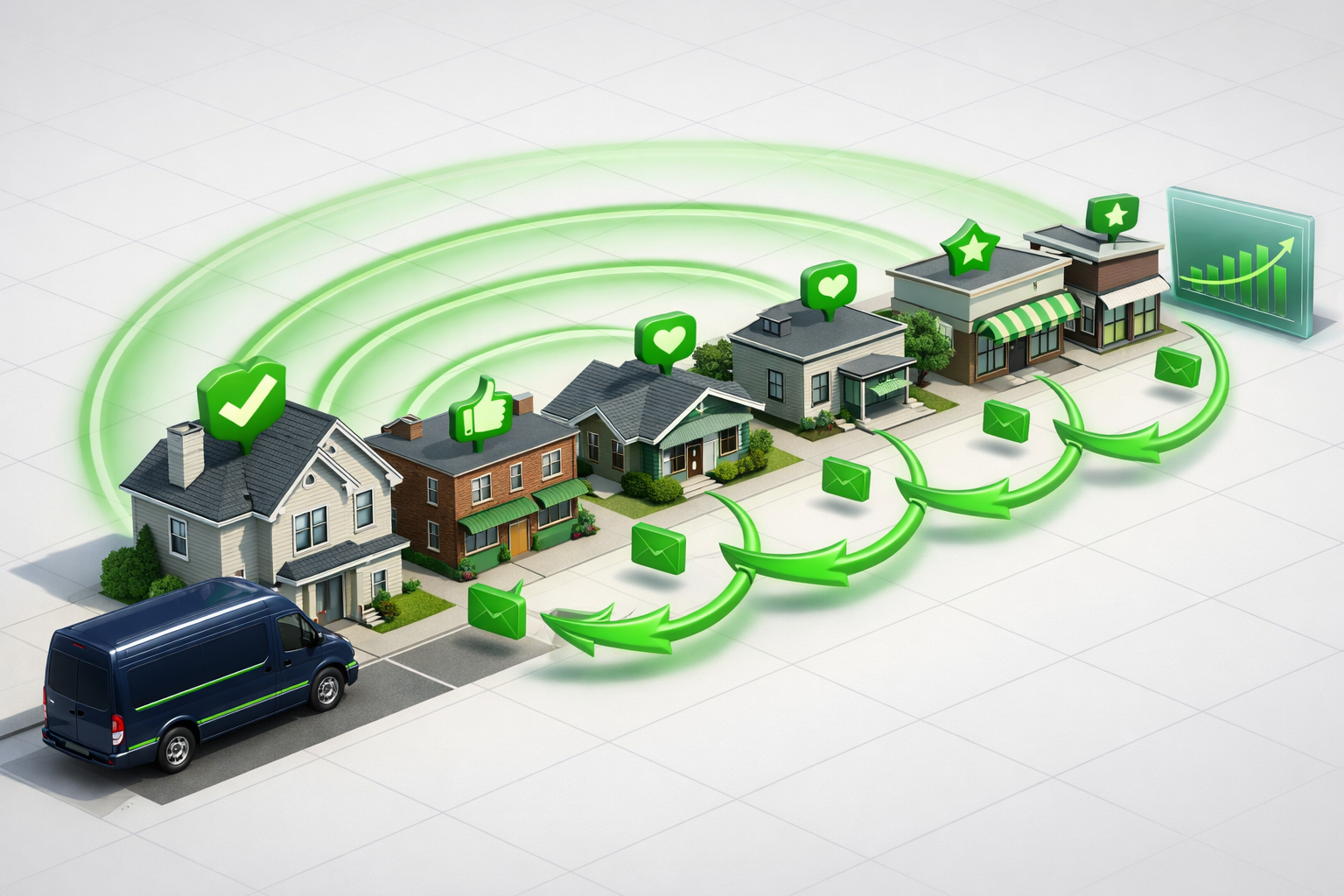
Building a Referral Engine: The Highest-ROI Channel Most Businesses Ignore
Ask ten service business owners where their best customers come from. Nine will say "word of mouth." Ask those same nine owners what they do to generate word of mouth, and you will get shrugs, vague answers about "doing good work," and maybe a story about a customer who surprised them with a referral last quarter.
That is not a strategy. That is luck.
The top performers in every service category, from HVAC to law firms to residential cleaning, generate 30 to 40 percent of their new business from referrals. They do it on purpose. They have systems. They measure results. They ask for referrals the same way they ask for payment: confidently, consistently, and at the right moment.
This is how to build one.
Why referrals beat every other channel
A referred customer closes at 3 to 5 times the rate of a cold lead. They negotiate less. They refer more often themselves. They stay longer. Studies across professional services, home services, and B2B consistently show referred customers have a 25 to 40 percent higher lifetime value than customers acquired through paid ads.
The cost side is just as lopsided. A referred lead costs between $0 and $200 depending on your incentive structure. A paid lead in a competitive local market (roofing, legal, dental) runs $80 to $400. An SEO lead costs less per lead at scale but requires a 6 to 12 month investment before it pays off. Referrals pay on contact.
The reason is structural. A referral arrives with trust pre-loaded. The prospect has already heard a specific, personal endorsement from someone they know. Your sales job is not to build credibility. It is to not break it.
Paid channels do the opposite. They buy you a skeptical stranger's attention and ask you to earn trust from zero. Both work. One works dramatically better.
Why most businesses only get referrals passively
The typical service business "referral program" is a line on the contact page that says "Refer a friend, get $50 off." No one sees it. No one cares. It generates two referrals a year and the owner concludes referrals "do not work for our business."
Three things kill passive referral programs:
A real referral engine solves all three.
The three types of referral programs
Most owners only run one of these (customer referrals) and miss the other two. You want all three running in parallel.
1. Customer referrals
Your existing happy customers refer new customers. This is the foundation. It works in every category.
2. Partner referrals
You build formal relationships with adjacent businesses who serve the same customers but do not compete with you. A residential roofer partners with a gutter company, a solar installer, an insurance adjuster, and a real estate agent. A personal injury attorney partners with chiropractors, auto body shops, and medical clinics. Each partner sends 2 to 10 referrals a month. Five good partners can equal your entire paid ad budget.
3. Influencer and community referrals
A local business owner, neighborhood Facebook group admin, church leader, or trade association president refers you to their audience. This is not Instagram influencer marketing. It is the small-group, high-trust version. One active community referrer can send 20 to 50 leads a year with almost no incentive beyond a genuine relationship.
Getting the incentive right
Incentives are where most programs fail. Owners default to "10% off the next service" and wonder why no one refers.
Some rules:
For customer referrals:- Cash beats credits for one-time services. If your average customer uses you once or twice a year, a $100 Visa gift card outperforms a $150 service credit. Credits only work when you know the customer will buy again soon.
- Give to both sides. The person referring gets something AND the new customer gets something. This makes the referrer feel generous instead of mercenary when they make the recommendation.
- Match the value of the transaction. A $50 referral reward on a $15,000 HVAC install is insulting. Aim for 2 to 5 percent of the average job value. For high-ticket services, $250 to $500 per closed referral is common and fair.
- Pay promptly. Send the reward within 7 days of the new customer's first paid job. Delay kills the loop.
- Formal revenue share (often 10 to 20 percent of first-job value) or flat per-lead payments ($50 to $250 depending on category).
- Document the arrangement in a one-page agreement. Informal "handshake" partner programs collapse the moment someone doubts they are being paid fairly.
- Often recognition and relationship, not cash. A handwritten note, a feature on your website, inclusion in a small annual gift program. Cash can actually insult this group. Read the situation.
Scripts and timing
Timing is 80 percent of the outcome. The script barely matters if the moment is wrong.
Do not ask at the end of the job. The customer is tired, distracted, and has not yet experienced the full value of what you did. Asking here feels transactional and produces weak referrals. Ask 3 to 14 days after completion, after the customer has lived with the result. For a lawn service, ask after the second cut. For a kitchen remodel, ask two weeks after final walkthrough. For a professional service, ask after the first measurable win.A simple post-service ask:
> "Hey [Name], it has been about two weeks since we finished. I wanted to check in and make sure everything is still working great. If you have a minute, we have two quick asks. First, if you have 60 seconds, a Google review helps us a ton. Second, we grow almost entirely through referrals from customers like you. If anyone you know is thinking about [service], sending them our way means a lot. We give you $150 and them $100 off when they book. I'll text you the referral link. No pressure either way. Really appreciate your business."
This script works because it is specific, it is grateful, it gives the customer a clear next action, and it is not pushy. The referral link matters. People will not search your website to refer someone. Give them a URL they can paste into a text message in 3 seconds.
For partners, the ask looks different. It is a relationship-building conversation, not a pitch:
> "I have been sending customers your way for about 3 months now. I want to formalize this so we both benefit. Here is what I am thinking: I pay you $200 for every customer you send who books a job with us. You get a dashboard to track referrals in real time. We can do the same for customers I send you, on whatever terms work on your side. Coffee next week to talk through it?"
The tech stack
You do not need enterprise software. You need a few things that work:
- A CRM that tracks referral source. Every new lead gets a "source" field. "Referred by" is a separate field that links to the referring customer. HubSpot, Pipedrive, Close, and even a well-built Airtable base all work. Without this, you cannot measure or reward.
- A dedicated landing page per referral partner. A URL like
yourcompany.com/partner/smith-insurancetracks attribution automatically. Every partner gets their own page and their own tracking. - A short referral form, not a full contact form. Three fields maximum: referred person's name, phone or email, and who referred them.
- Automated payout. Gift cards from Tremendous, Rybbon, or Giftbit can be triggered by a Zapier or n8n workflow the moment a referred customer's first invoice is paid. No manual tracking spreadsheet. No forgotten payouts.
- A review request system running in parallel. Referrals and reviews reinforce each other. Customers who leave reviews refer at 2x the rate of those who do not.
The mistakes that kill programs
A realistic timeline
Months 1 to 2: You build the infrastructure. CRM fields, landing pages, scripts, tech stack, partner list. Referrals do not increase yet. Expect the same baseline you have always had.
Month 3: First visible uptick. Your post-service ask is now running on every completed job. Partner conversations are producing 1 to 3 referrals per active partner. You close your first wave of systematic referrals.
Month 6: Referrals are 15 to 25 percent of new business. You have 3 to 5 active partners, 50 to 100 past customers who have been asked at least once, and your top 10 customers have referred multiple times.
Month 12: If you keep asking, keep tracking, and keep paying fast, referrals become 30 to 40 percent of new business. Your paid ad spend either drops or gets redirected to retargeting and brand. Your cost per acquisition drops. Your customer lifetime value rises. You stop panicking when a Google algorithm update hits, because half your pipeline is immune to it.
The real takeaway
A referral engine is not a tactic. It is an operating system. It requires the owner to decide that referrals are a channel worth investing in, not a nice surprise that shows up sometimes.
Most of your competitors will never do this. They will keep buying Google Ads at $8 a click, wondering why their margins are shrinking, while the business down the street, quieter and less visible, books 60 percent of next year's revenue from a list of people who were happy last year.
That is the gap. Close it.