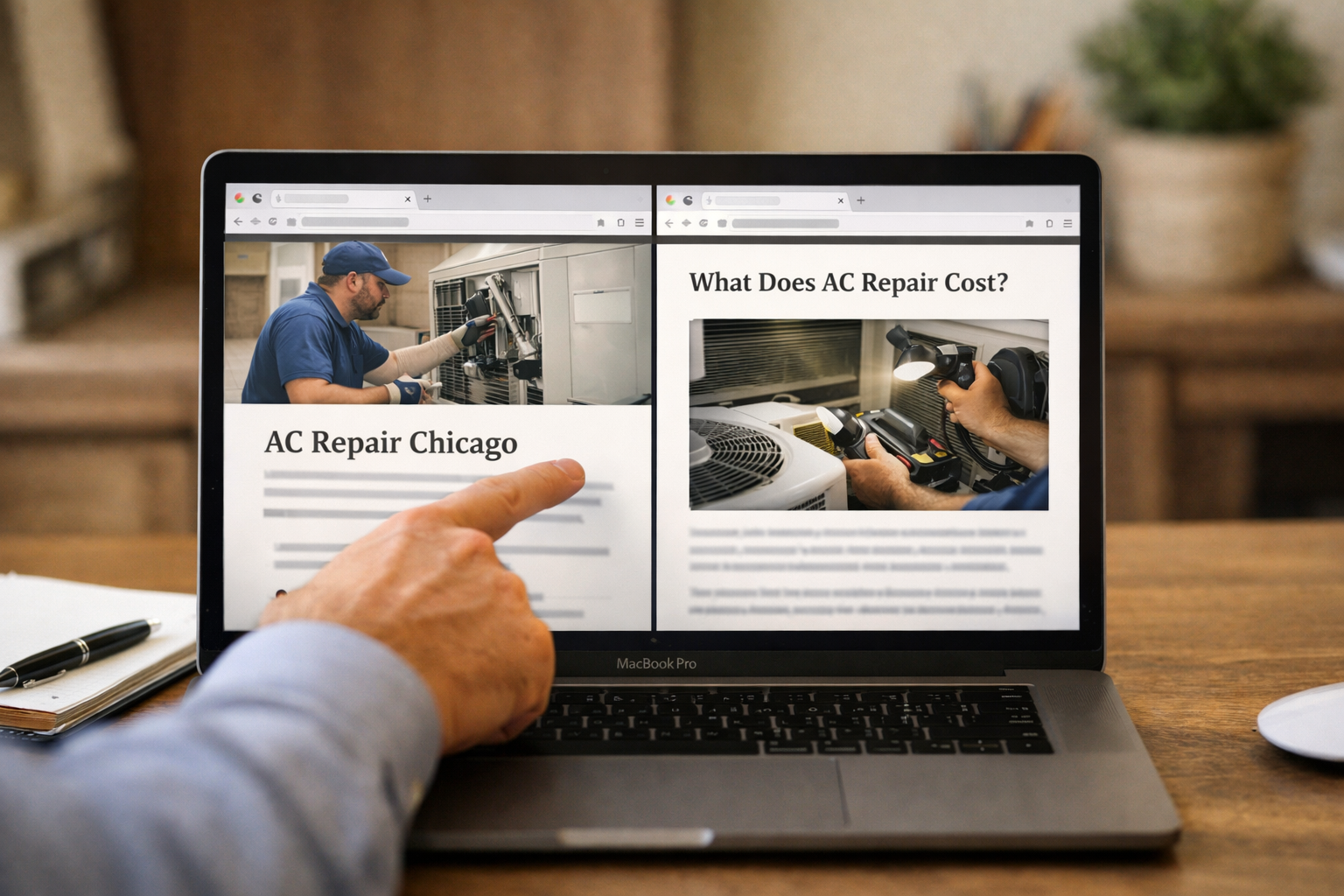
service pages vs blog posts local business
The question comes up every time a small business owner decides to get serious about their website: should I focus on building out my service pages, or should I start a blog?
The answer depends on where you are in your digital presence, but for most local service businesses, the order is clear. Service pages first. Blog posts second. And not even close.
Here is why, and what to do with each.
What Service Pages Do
A service page is a dedicated page on your website for a specific service you offer. Not a list of everything you do on one page. Not a "services" landing page with brief descriptions. A full page for each service.
A good service page does several things:
- Tells Google and AI systems exactly what that service is, who it is for, and where it is available
- Ranks for queries from people who are actively searching for that specific service right now
- Converts visitors who arrive with intent: they are looking for someone who does this thing, in this area, at a reasonable price
What Blog Posts Do
Blog posts serve a different function. They answer informational questions: how does this work, what does it cost, how do I know if I need it, how do I compare my options.
People in the early stages of a decision read blog posts. People ready to hire read service pages.
Blog posts do build AI visibility over time: they establish topical authority, they earn links from other sites, and they get cited in AI answers for informational queries. But a business with no service pages and a great blog is leaving direct purchase traffic on the table.
The Two Types of Search Intent
Understanding search intent is the core of this decision.
Commercial intent: "water heater installation Evanston," "business accountant Chicago freelancer," "roofing contractor Logan Square." These people are looking to hire. They need a service page that meets them with clear information. Informational intent: "how much does a water heater installation cost," "when do I need a business accountant," "how long does a roof last." These people are researching. They need a blog post or FAQ that educates them before they decide.The traffic from commercial intent queries converts to leads. The traffic from informational queries mostly does not, at least not immediately. Both matter for building authority and visibility, but one is a better use of limited time for a small business at the start.
The Right Order for Most Local Businesses
Phase 1: Build Your Service Pages (Month 1 to 2)
Every service you offer should have its own page. If you offer five services, you need five pages. If you operate in multiple neighborhoods or cities, consider separate pages for major service areas.
Each page should include:
This is the content that ranks for commercial queries. It is also the content that AI systems pull from when recommending local service providers.
Phase 2: Write Foundational FAQ and How-To Content (Month 2 to 3)
After your service pages are in place, the next best investment is content that answers the informational questions your customers ask before they book. These are typically the questions that appear in Google's "People also ask" boxes and in AI Overviews.
For a pest control company, that might be:
- "How do I know if I have bed bugs?"
- "What does a termite inspection include?"
- "How long does extermination treatment take?"
Phase 3: Publish Supporting Content Regularly (Ongoing)
Once the foundation is in place, a consistent content publishing cadence starts to compound. Each new piece of relevant, well-written content adds to your topical authority and gives AI systems more material to work with when recommending businesses in your category.
At this stage, the question of service pages versus blog posts is no longer relevant. You have both. The focus shifts to adding depth: more neighborhoods, more service variations, seasonal topics, comparison posts, case studies.
The Common Mistake to Avoid
Many small businesses start a blog before their service pages are complete. Sometimes this is because a blog feels more accessible. Sometimes a marketing vendor recommends it because producing blog content is easier to bill for.
The result is a website with 20 blog posts and a single "Services" page that lists everything in two sentences. That website will not rank for commercial queries and will not appear in AI recommendations for service searches. The blog content may drive some traffic, but it converts poorly because there is nothing solid to convert visitors to.
Fix the service pages first. That is where the money is.
Use the Missed Lead Cost Calculator to see what better commercial visibility would mean for your monthly lead volume. Then review your AI search visibility setup to see where your service pages stand, and check our local SEO services for how we approach this work with clients.
Sound familiar? Book the $500 AI Workflow Audit to map your current lead and admin process and identify the first workflows worth automating.