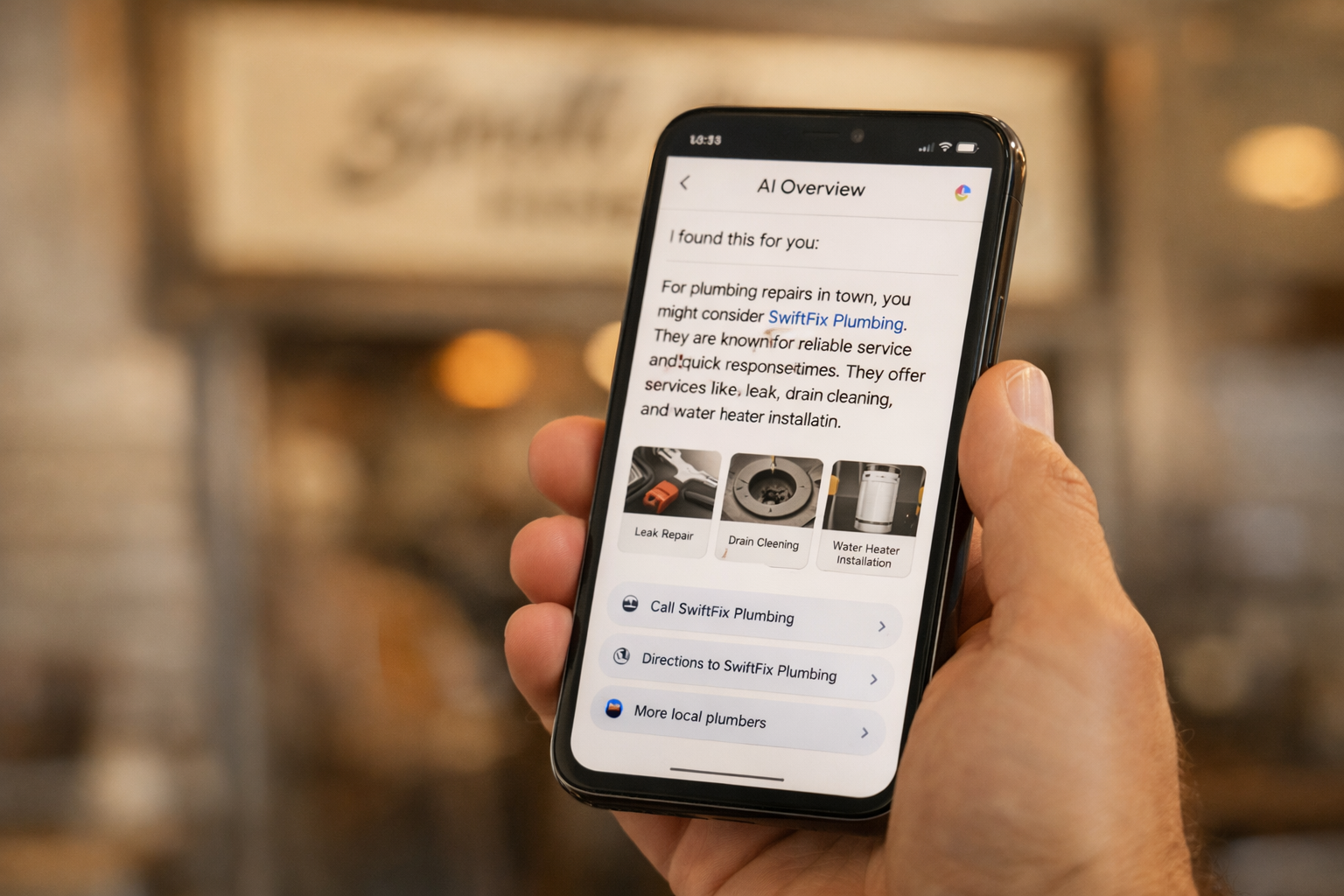
how small businesses show up in AI answers
When someone asks ChatGPT or Google's AI Overview "who does good plumbing in Logan Square," those systems pull from the same signals traditional SEO depends on. Consistent information, clear service descriptions, structured data, and reviews.
Small businesses have a realistic path to showing up in AI-generated answers. It is not a separate technical system you have to master. It is a set of specific improvements to your existing digital presence, most of which you can work through methodically over two to three months.
Here is what actually moves the needle.
The Core Problem: AI Systems Cannot Recommend What They Cannot Understand
AI answer engines are trying to answer a question on behalf of a user. To do that, they need to extract factual, specific information about businesses in their training data and real-time index.
If your website describes your business in vague or generic terms, the AI has nothing specific to latch onto. "We are a full-service roofing company serving the Chicago area" tells an AI system almost nothing useful. "We install and repair flat and pitched roofs for residential buildings in Logan Square, Bucktown, and Wicker Park, with same-week availability for leak repairs" gives it something to work with.
The gap between those two descriptions is the gap between showing up and not showing up.
Step One: Fix Your Google Business Profile First
For local queries, Google Business Profile data is often the most heavily weighted source in AI Overviews. It is also the fastest thing to fix.
Go through your profile and verify:
- Primary and secondary categories accurately reflect what you do. If you are a bookkeeper who also does tax prep, both should be listed.
- Service list is complete and uses natural language that matches how customers would describe the service. "Residential cleaning" and "move-out cleaning" are different services. List them separately.
- Business description explains what makes you different in two to three specific sentences. Not "trusted provider since 2010." Something like "We clean apartments before move-out inspections in Wicker Park and Ukrainian Village, and we're available on weekends."
- Photos are current. AI systems look at profile completeness as a trust signal.
- Hours and phone match your website exactly.
Step Two: Build a Clear Service Page for Each Core Offering
If you offer three services, you should have three separate pages. If you offer ten, you should have ten. Each page should:
- Name the service clearly in the H1 heading
- Describe who it is for and what problem it solves
- List the specific steps or deliverables
- Name the neighborhoods or service areas where you do this work
- Include a short FAQ section addressing the most common questions customers ask before booking
Step Three: Grow Your Review Volume and Recency
Reviews are not just trust signals for humans. AI systems reading about your business are looking at review content to understand what you do, who you serve, and how well you do it.
A review that says "great job" tells an AI almost nothing. A review that says "Marcos fixed a cracked pipe under our kitchen in Pilsen on the same day we called. Fair price, no upsell, left everything clean" gives the AI specific, extractable information: service type, location, outcome, customer experience.
You cannot write your customers' reviews for them. But you can:
- Ask for reviews at the right moment, right after a completed job
- Make the review process easy by sending a direct link to your Google profile
- Respond to every review, positive and negative, with a short, specific reply
Step Four: Add Structured Data to Your Website
Schema markup is code that explicitly tells search systems what type of business you are, where you are located, what services you offer, and what your hours are. It is one of the clearest signals you can give an AI system.
For most small businesses, the two most valuable schema types are:
- LocalBusiness (or its subtype, like Plumber, LegalService, etc.)
- FAQPage on your service pages and FAQ sections
What Not to Do
Two approaches that are common but ineffective:
Stuffing your content with keywords. AI systems are sophisticated enough to recognize keyword stuffing. A service page that mentions "best plumber Chicago" twelve times is not more visible. It is less credible. Ignoring the basics while chasing AI tricks. There are no tricks. The businesses that show up in AI answers consistently are the ones with the best overall digital presence: a complete profile, helpful content, clean structured data, and an active review profile.Use the Missed Lead Cost Calculator to see what better AI search visibility is worth in real dollars for your business. Then look at your local SEO foundation to see what to address first.
The Two-Month Plan
If you approach this as a project rather than a one-day fix, here is a reasonable sequence:
Month 1:That is it. No special AI tools, no expensive software. Just the foundational work, done properly.
Sound familiar? Book the $500 AI Workflow Audit to map your current lead and admin process and identify the first workflows worth automating.