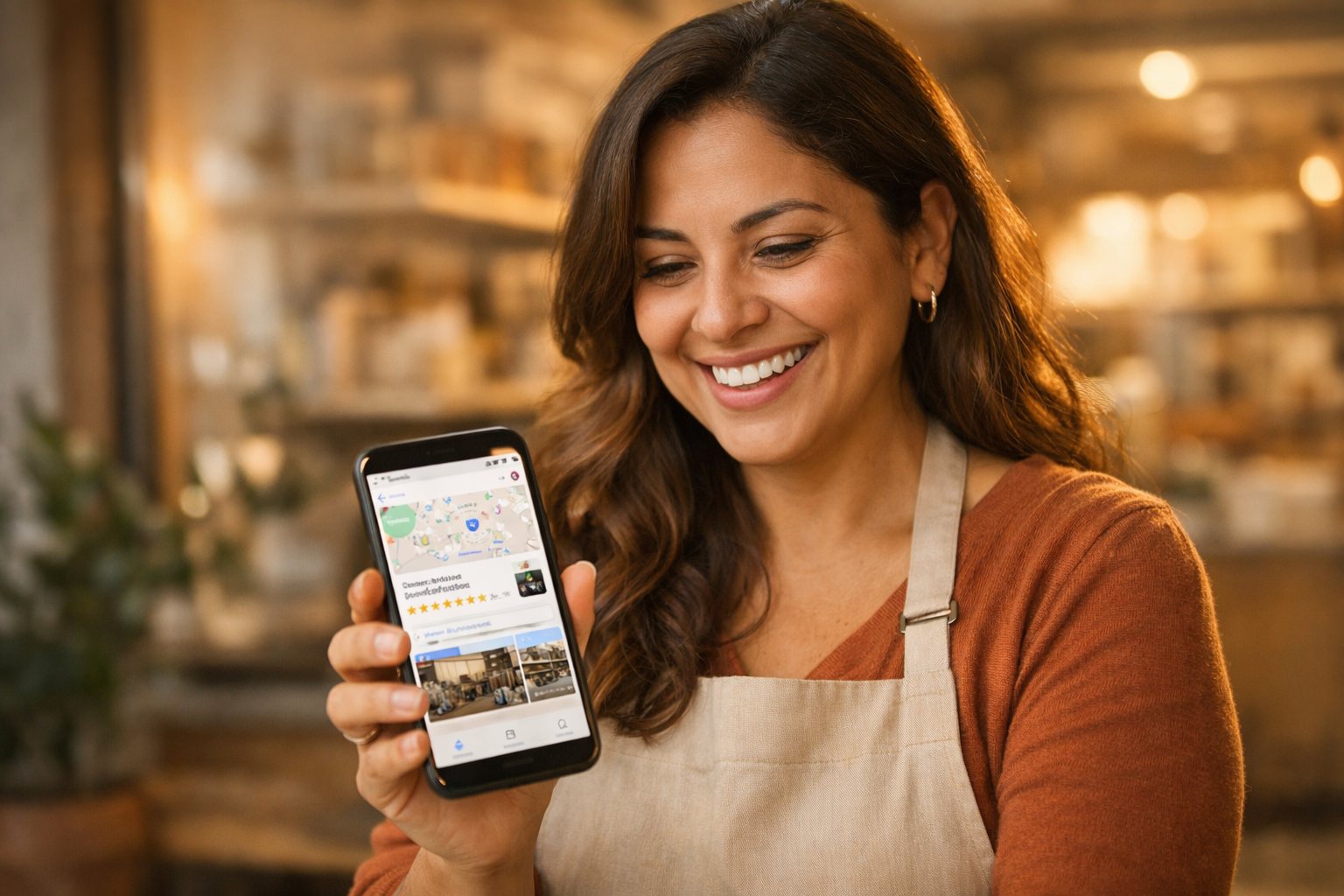
how reviews help local business search visibility
Reviews do three things for a local business: they influence whether potential customers trust you, they signal to Google that you are a real and active business, and they provide the kind of specific, natural-language content that AI systems use to understand what your business actually does.
Most business owners know about the first two. The third one is less understood and increasingly important.
Reviews as Data, Not Just Social Proof
Think about what a strong review actually contains: a service name, a location, a specific outcome, and a personal account of the experience.
"Miguel installed our water heater in Bridgeport last November. He was there within two hours of our call, finished in under three hours, and the price matched the estimate exactly. I've already recommended him to my neighbor."
That review contains: the service (water heater installation), the location (Bridgeport), the timeline (same-day), the outcome (accurate estimate), and a referral signal. An AI system reading about Miguel's business across dozens of reviews like this develops a very specific picture of what he does and where.
Compare that to: "Great work, highly recommend!" That review tells an AI system almost nothing.
You cannot write your customers' reviews. But understanding this dynamic changes how you ask for them, when you ask, and why it matters that people leave detailed ones.
How Reviews Affect Traditional Search Rankings
Google uses review signals to determine local pack placement, the three-business box that appears at the top of local search results. The factors that matter most:
- Volume: More reviews generally help, but only to a point. The difference between 5 and 50 reviews is significant. The difference between 200 and 250 is marginal.
- Recency: A business with 20 reviews in the past six months typically outperforms one with 100 reviews that stopped accumulating two years ago. Google interprets recency as a signal of an active, operational business.
- Rating: A 4.6 with 80 reviews will usually outrank a 4.9 with 12. The rating matters, but volume and recency often outweigh a small rating difference.
- Response rate: Businesses that respond to reviews signal engagement to Google. This is a small but real factor.
How Reviews Affect AI Visibility
AI systems reading about local businesses do not just look at your star rating. They read the actual text.
When someone asks ChatGPT or uses Google's AI Overview to find "who does good roof repair in Pilsen," the systems generating that answer are pulling from several sources: your website, your Google Business Profile, directories like Yelp and Angi, and review content. The businesses that appear in the answer are typically the ones with:
- High review volume relative to competitors
- Recent reviews that signal the business is currently operating
- Review text that mentions the specific service and location being searched
How to Get Better Reviews Without Faking Them
The honest answer: you cannot control what people write. But you can influence the circumstances that lead to detailed reviews.
Ask at the right moment. The best time to ask for a review is right after a job is completed, when the customer is satisfied and the experience is fresh. This is when they have the most specific things to say. Make it easy. Send a text or email with a direct link to your Google review page. Every extra step loses people. A link that opens directly to the review form is the difference between a 15% conversion and a 2% one. Give people something to write about. If you finish a job and remind a customer about what you did, where you did it, and what made the job notable, you are priming them to write a specific review. "We installed the new HVAC unit in your Avondale property today. If you're happy with the work, a Google review mentioning the type of system and your experience would mean a lot to us." That framing produces better reviews. Respond to every review. Responding to reviews, especially negative ones, is visible to both customers and search systems. A professional response to a 2-star review demonstrates that you take feedback seriously. It also gives you an opportunity to provide additional context that other potential customers will read.Yelp, Facebook, and Industry Directories
Google reviews matter most for local search visibility. But AI systems are also reading Yelp, Houzz, Angi, Thumbtack, and industry-specific directories. For certain business types, reviews on those platforms carry significant weight.
A home contractor should prioritize Houzz and Angi alongside Google. A restaurant should have Yelp covered. A health or wellness business should look at Healthgrades or ZocDoc. The point is not to spread yourself thin across every platform. It is to have a solid presence on the two or three platforms most relevant to your industry.
Building a Review System
A review system is not complicated. It is a consistent process that runs after every completed job.
A simple version looks like this:
This can be set up in most CRMs or with a basic automation tool. Once it is running, reviews accumulate without requiring manual effort.
Use the Missed Lead Cost Calculator to see what a stronger review profile is worth in recovered leads. Then review your full AI search visibility setup to see where reviews fit in the broader picture.
Our local SEO services include review strategy and system setup as part of the foundational package.
Sound familiar? Book the $500 AI Workflow Audit to map your current lead and admin process and identify the first workflows worth automating.