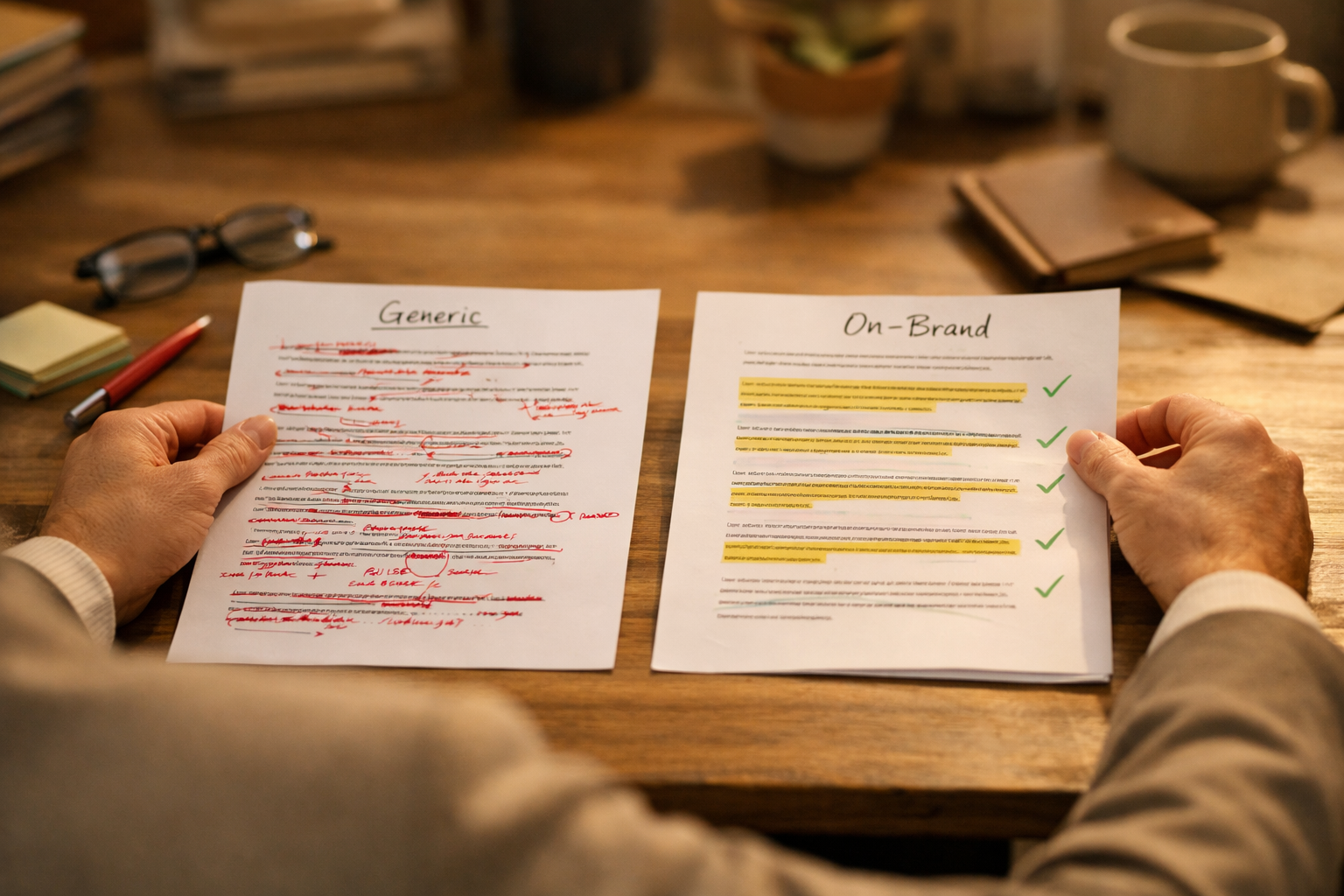
AI content creation without sounding generic
The complaint about AI-generated content is almost always the same: it sounds like it could have been written for any business. Vague claims about "quality service" and "customer satisfaction." Generic advice that applies to every plumber, every accountant, every contractor equally. Nothing specific enough to actually reflect a real business.
That is a real problem. It is also a problem with how people are using AI, not a fundamental limitation of the technology.
The difference between AI content that sounds generic and AI content that sounds like your business comes down to what you put into it.
Generic Output Comes From Generic Input
If you ask an AI to "write a blog post about roof maintenance for homeowners," you will get a blog post about roof maintenance for homeowners. It will cover the points you would expect: inspect for damaged shingles, clean your gutters, check the flashing. It will be accurate. It will be interchangeable with anything written by any roofing company anywhere.
The input was generic. The output matched.
Now change the input: "Write a blog post about flat roof maintenance for commercial property owners in Chicago. Our company has been doing commercial flat roofs for 18 years. The most common mistake we see is owners ignoring ponding water, thinking it will drain on its own. It usually means there is a drainage issue that needs to be addressed before winter. We use a specific drainage audit process we developed after seeing this problem on about a third of the flat roofs we inspect. Write from the perspective of an experienced contractor who has seen this mistake many times."
The output will not be generic. It cannot be, because the input was specific.
What Makes Content Sound Like Your Business
There are a few things that make a piece of content distinctive rather than generic.
Specific observations from your work. What do you notice on job sites that customers do not? What do you see repeatedly that surprises customers when you tell them? A landscaper who notices that most lawn drainage problems originate from grading issues near the foundation has a specific observation. A bookkeeper who notices that most small businesses are misclassifying one specific expense category has a specific observation. These observations come from you. AI can help you write them clearly. Your actual process or method. Not "we do quality work" but "we do a site assessment before quoting, and here is why that matters." Not "we provide excellent customer service" but "we always walk you through the job before leaving to confirm everything you asked for was done." Your actual process differentiates you. It is also what AI needs from you to write content that sounds like your business. Real examples, even anonymized ones. "We had a client last fall who came to us after three other contractors quoted the job without looking at the drainage first. Here is what we found and why the quote would have been wrong." That is a specific example. AI cannot invent it, but you can describe it and AI can help you write it well. Opinions. "Most people think you need to overseed in the spring. We disagree." "There is a common approach to bookkeeping that small businesses use because it is simple, but it causes problems at tax time." Opinions give content a point of view. They make it readable. AI can take your opinion and develop it into a full argument.How to Give AI What It Needs
The goal is not to hand AI a vague prompt and accept whatever comes back. The goal is to give AI your specifics and let it do the writing work.
Here is a practical approach:
The Role of AI in Your Content Process
AI is not replacing your expertise. It is handling the production work: structure, transitions, sentence-level clarity, formatting. You are providing the substance.
Think of it like dictation. A surgeon who dictates clinical notes to a transcription service still provides the medical judgment. The transcription handles the documentation. Similarly, you provide the business insight, the specific examples, the opinions built from experience. The AI Content Engine handles the structure and the writing.
The businesses that produce generic AI content are typically skipping the input stage. They are asking for a blog post the way you would order from a menu. The businesses that produce content that sounds distinctively theirs are treating AI like a writing partner: they bring the specifics, AI brings the craft.
A Few Specific Things That Prevent Generic Content
Some practical guardrails:
- Never accept the first draft without adding one specific detail. One example from a real job. One number that comes from your actual experience. One observation that only someone in your field would have.
- Read it out loud. If it sounds like a website you have never visited, it needs revision.
- Replace every claim with evidence. "We provide fast response times" means nothing. "We call back within two hours and we can usually schedule same-day or next-day for most jobs" means something.
- Cut the adjectives. Most AI-generated fluff lives in the adjectives. Experienced, professional, dedicated, committed. Nouns and verbs carry content. Adjectives pad it.
If AI is producing generic content for your business, the fix is not a different AI tool. The fix is more specific input.
Your business has years of real experience in it. That experience is your competitive advantage online, same as it is in person. Get it into the content.
If you are unsure what that looks like in practice for your specific type of business, the Missed Lead Cost Calculator can also help you see what the current gap between your content and your competitors' is actually costing.
Sound familiar? Book the $500 AI Workflow Audit to map your current lead and admin process and identify the first workflows worth automating.