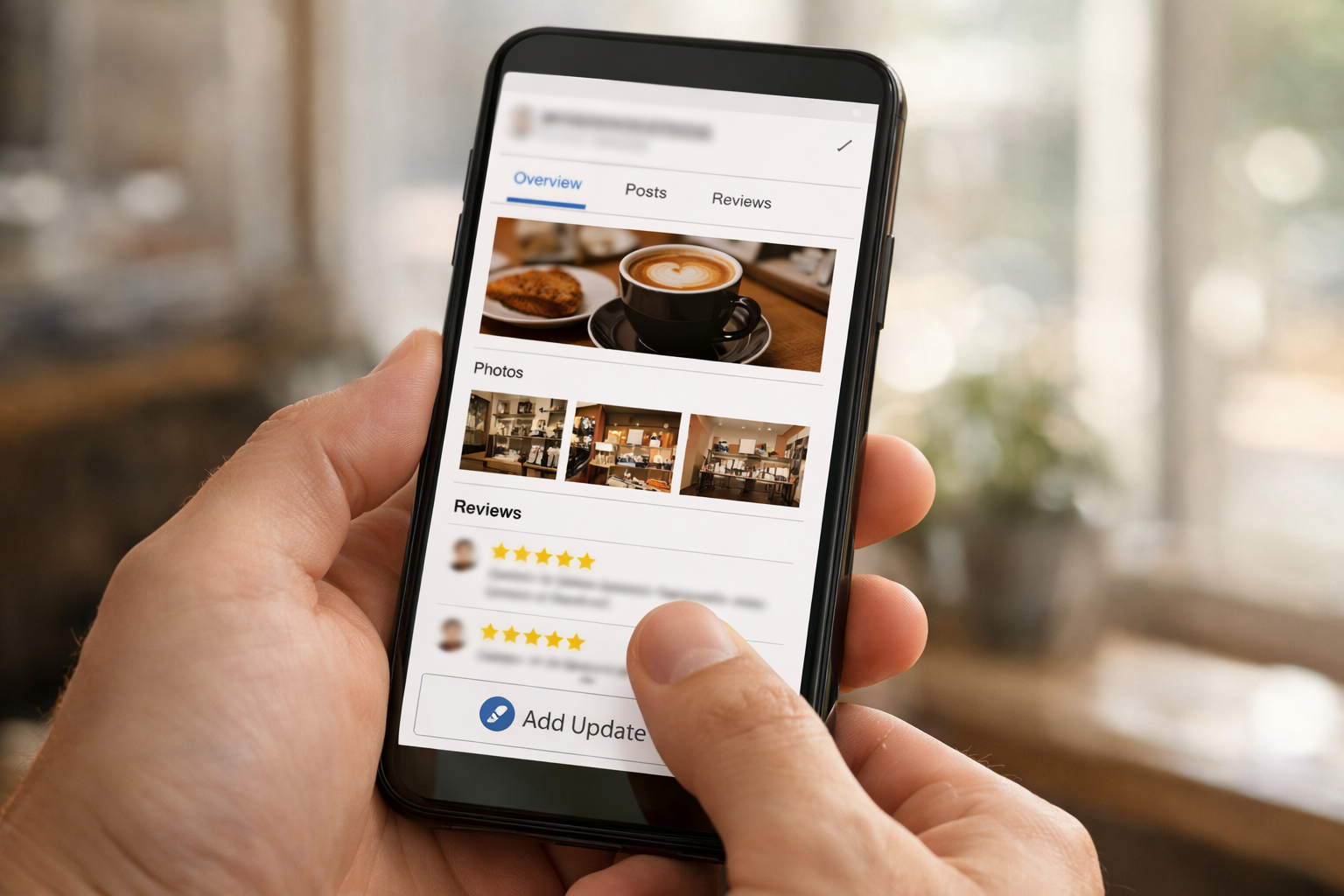
Google Business Profile posting strategy local business
Most local service businesses set up a Google Business Profile once and never touch it again. They fill out the basic fields, add a few photos, and consider it done. That approach leaves a significant amount of local search visibility on the table.
Google uses signals from your GBP activity to determine how relevant and current your business is for local searches. A profile that has been active in the last 30 days consistently outperforms an identical but dormant one. For local service businesses competing for "near me" searches and city-level keywords, that difference in ranking position can mean the difference between being called and being skipped.
Here is how to build a GBP posting strategy that is sustainable for a small business without a dedicated marketing team.
What GBP Posts Actually Do
Before building a strategy, it is worth being clear on what GBP posts accomplish.
They signal activity to Google. Regular posts tell Google that your business is operating, engaged, and relevant. This is a soft but real ranking factor. They give searchers more to engage with. When someone finds your profile in the local pack or in Maps, posts give them additional context about your work, your offers, and your expertise. A potential customer who sees a photo of a completed job similar to what they need is more likely to call. They surface in knowledge panels. For branded searches (people searching your business name directly), GBP posts can appear prominently and reinforce credibility.What GBP posts do not do is override weak fundamentals. If your profile is missing key categories, has few reviews, or has incorrect information, posts alone will not fix that. The posting strategy described here assumes your profile is otherwise in good shape.
The Four Types of Posts That Work for Local Service Businesses
Not all GBP post types perform equally for local services. These four are the most effective.
1. Completed Project Posts
A photo of completed work, a description of what the job involved, and the location. This is the highest-performing post type for contractors, home services, and any business that produces visible results.
The description should include:
- Type of work
- Neighborhood or part of the city
- One specific detail (scope, material, challenge, or interesting element of the job)
- A soft call to action (linking to a booking page or contact form)
2. Seasonal or Timely Service Posts
Service businesses have natural seasons. Use them.
An HVAC company posts about A/C tune-ups in April before the first heat wave. A landscaper posts about spring cleanup services in March. A window company posts about storm prep in September. A plumber posts about frozen pipe prevention in November.
Timely posts match what people are searching for right now. They are also easy to plan ahead: you know your seasons, so you can schedule these in advance.
3. Customer Question and Answer Posts
Take the most common question you get from customers and answer it in 150 to 250 words. Post it to your GBP with a relevant photo.
This type of post performs well because it matches the informational searches people do before they are ready to hire. "How much does it cost to re-roof a house?" "What causes mold in bathrooms?" "Do I need a permit for a deck?" If you answer those questions in your GBP posts, your profile appears for people at an earlier stage of the buying process.
The Google Business Profile Content System is built around this content type specifically: generating regular question-and-answer posts from the topics most relevant to your business.
4. Offer Posts
If you have a current promotion, a seasonal discount, or a free consultation offer, post it. Offer posts display differently in GBP than regular posts and can include a direct booking link.
Offers do not need to be discounts. A free estimate, a free inspection, or a no-obligation consultation is an offer. For service businesses where the barrier is often the unfamiliarity with the process, lowering the first step creates real conversion.
How Often to Post
The honest answer is: consistently is more important than frequently.
Two posts per week is a strong cadence. One per week is adequate. Two per month is the minimum to remain active in Google's eyes.
What kills GBP strategy is the burst-and-stop pattern: ten posts in the first two weeks, then silence for three months. An irregular active profile is better than that, but a consistent one is better still.
A practical schedule for a one-person or two-person service business:
- Two posts per week: one completed project post (from a job photo taken that week), one seasonal or question post
- Every two weeks: review the post drafts in one sitting and schedule the next two weeks at once
Practical Tips for Writing Posts That Get Engagement
A few things that consistently improve GBP post performance:
Start with the result, not the process. "New fence installed in [neighborhood]" is a weaker opening than "A homeowner in [neighborhood] now has a cedar privacy fence that will last 20 years without the rot issues the old one had." The result is what the reader cares about. Use photos from the actual job. Stock photos perform significantly worse than real project photos. Authenticity signals are real on Google, and they matter to the humans reading too. Keep descriptions between 150 and 300 words. Long enough to be substantive, short enough that people read the whole thing. Include a specific location. Not just the city. The neighborhood, the part of town, or even the general type of property (a commercial building in the Loop, a single-family home on the North Side) gives Google and readers geographic context. Always include a call to action. Even a soft one: "We offer free estimates for projects like this" with a link to your booking page. GBP posts without a CTA leave the next step ambiguous.What a Full Month Looks Like
Using the schedule above, here is what a roofing contractor's GBP might publish in April:
- Week 1: Completed shingle replacement in [neighborhood] (project photo)
- Week 1: Why spring is the best time to get a roof inspection (seasonal post)
- Week 2: Completed flat roof repair on a commercial property downtown (project photo)
- Week 2: Common question: how long does a roof replacement take? (Q&A post)
- Week 3: Emergency repair after storm damage in [neighborhood] (project photo)
- Week 3: Current offer: free 15-point inspection for homeowners within 20 miles (offer post)
- Week 4: Before and after from a full tear-off and replacement (project photo)
- Week 4: How to tell if your gutters are causing roof damage (Q&A post)
If you are not seeing calls come in from Google searches, the Missed Lead Cost Calculator can help you estimate what that gap is costing per month. For most service businesses, a consistent GBP posting strategy is one of the highest-return activities they can do.
The AI Content Engine handles the drafting so you do not have to write these from scratch. You provide the job details, and the system produces the post. You review and approve.
Sound familiar? Book the $500 AI Workflow Audit to map your current lead and admin process and identify the first workflows worth automating.