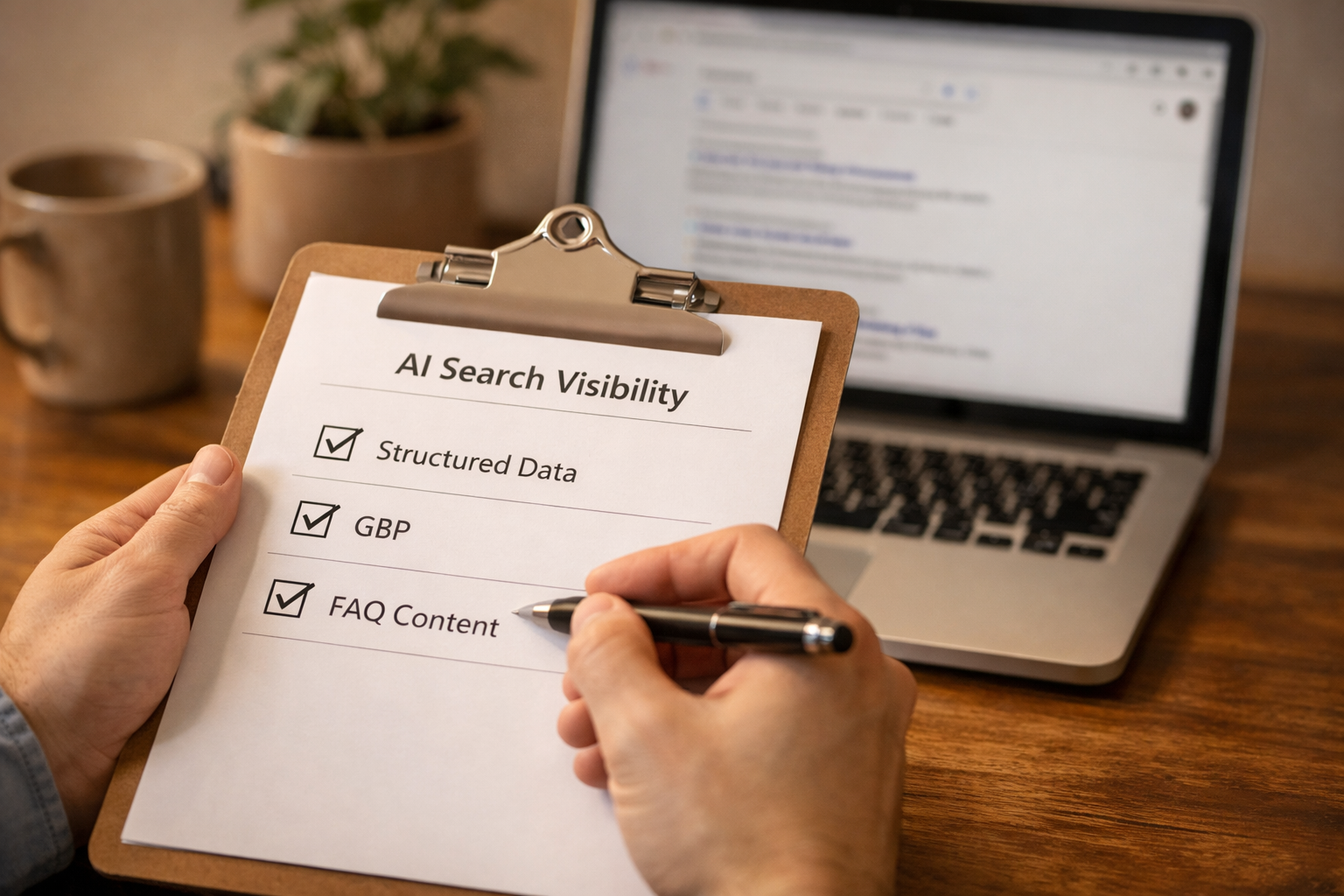
AI search visibility checklist small business
AI search visibility is not a single thing you implement once. It is a collection of specific improvements across your Google Business Profile, website, content, and review profile. Most of the items on this list are fixable without a developer. Some require about an hour of focused work. A few need technical help.
Work through this in order. The items at the top have the most impact on whether your business shows up in AI-generated search answers.
Section 1: Google Business Profile
Your Google Business Profile is the single most important asset for local AI search visibility. AI Overviews and local AI recommendations pull heavily from it.
- [ ] Claim and verify your profile if you have not already. An unclaimed profile is incomplete and uneditable.
- [ ] Set your primary category to the most specific, accurate description of your business type.
- [ ] Add secondary categories for additional services that are genuinely part of what you do.
- [ ] Write a specific business description (750-character limit). Name what you do, where you do it, and one or two things that distinguish you. No generic language.
- [ ] List every service under the Services section. Use natural language. "Move-out cleaning" and "deep cleaning" are different services; list them separately.
- [ ] Set your service area with specific cities or neighborhoods, not a radius.
- [ ] Confirm your hours are current and match your website exactly.
- [ ] Confirm your phone number matches your website exactly.
- [ ] Add photos: exterior, interior or team, and work examples. Aim for at least ten current photos.
- [ ] Post to your profile at least once a month. Google treats posting activity as a freshness signal.
Section 2: Website Structure and Content
Your website is the primary source of detailed information for AI systems. How it is structured determines how much useful content they can extract.
- [ ] Each service has its own page. Not a combined services page, not a dropdown menu. A separate URL per service.
- [ ] Each service page has a descriptive H1 that names the service and location. "Residential Electrical Repairs in Wicker Park" is better than "Our Services."
- [ ] Each service page names your service area specifically. List the neighborhoods or cities, not just the metro area.
- [ ] Each service page has a FAQ section with at least five questions answered specifically. Questions should reflect what customers actually ask before booking.
- [ ] Your homepage states your business type, primary service, and city in the first screen without requiring the visitor to scroll.
- [ ] Your contact page includes full address or service area, phone, email, and hours. These should match your Google Business Profile exactly.
- [ ] Page titles (meta titles) are descriptive, not just your brand name. "Licensed Plumber in Rogers Park | Hernandez Plumbing" is better than "Hernandez Plumbing."
- [ ] URLs are clean and descriptive.
/water-heater-installation-chicagonot/services?id=3.
Section 3: Structured Data (Schema Markup)
Structured data explicitly labels your content for search systems and AI. Without it, search systems guess. With it, they know.
- [ ] LocalBusiness schema is present on your homepage. It should include business name, address, phone, hours, and geographic service area.
- [ ] FAQPage schema is applied to FAQ sections on your service pages. If you are on WordPress, Rank Math or Yoast handle this through the FAQ block.
- [ ] Service schema is applied to individual service pages where possible.
- [ ] Verify your schema is valid using Google's Rich Results Test (search.google.com/test/rich-results). Fix any errors the tool flags.
Section 4: Reviews
Reviews are data, not just social proof. AI systems read review content to understand what your business does and who it serves.
- [ ] You have at least 40 Google reviews. Below this threshold, you are at a disadvantage in most competitive service categories.
- [ ] You received at least two new reviews in the past 30 days. Recency matters as much as volume.
- [ ] You respond to every review, positive and negative, within a few days of it being posted.
- [ ] You have an active review request system in place. This can be as simple as a text message with a direct link sent after each completed job.
- [ ] Your reviews are present on relevant third-party platforms in addition to Google: Yelp, Houzz, Angi, or industry-specific directories depending on your business type.
Section 5: Consistency Across Platforms
AI systems encounter your business across many sources. Conflicting information reduces confidence and lowers the chance you are included in AI recommendations.
- [ ] Your business name is spelled identically on your website, Google Business Profile, Yelp, and all directories.
- [ ] Your address or service area description is consistent across all platforms.
- [ ] Your phone number is identical everywhere it appears online.
- [ ] Your services are described consistently across platforms. If your website says you do "commercial electrical work" but your Google profile does not list it, that is a gap.
- [ ] Check for duplicate Google Business Profiles and request removal of any you find. Duplicate profiles split your review count and confuse search systems.
Section 6: Content Depth and Authority
Beyond the basics, these items build long-term AI visibility by establishing your business as an authoritative source in your category.
- [ ] You have a blog or resources section with at least five posts that answer informational questions relevant to your services.
- [ ] Your content uses specific geographic references: neighborhood names, streets, landmarks, local institutions.
- [ ] At least one authoritative third-party site mentions or links to your business. Local news, industry directories, a local business association, or a professional licensing board listing all count.
- [ ] Your website loads in under three seconds on mobile. Use Google PageSpeed Insights to check.
- [ ] Your site is listed in Google Search Console and has no major crawl errors or indexing issues.
Using This Checklist
Go through each section and mark what is already done, what is missing, and what needs updating. Items in Section 1 and 2 are where most businesses have the biggest gaps. Start there.
If you want a structured audit with prioritized recommendations, the AI search visibility review covers all six sections and identifies the specific items with the highest impact for your category and market.
Use the Missed Lead Cost Calculator to estimate what current visibility gaps cost monthly. Then review our local SEO services to see how we structure the implementation work.
Sound familiar? Book the $500 AI Workflow Audit to map your current lead and admin process and identify the first workflows worth automating.